Police Dispatched but Driver Refused Breath Test
Turns Out Driver Was Unlicensed and Had Criminal Record
Citizen Suffers Three Broken Teeth from Driver's Punch
Drivers stopped a vehicle that was dangerously swerving across lanes. It was clear that the driver was intoxicated. However, the driver instead swung a fist at the drivers who blocked his car and was eventually arrested. Investigation revealed that he was unlicensed and had a prior record of drunk driving.
 Other drivers stopped a vehicle that was dangerously swerving between lanes because it clearly appeared to be driven under the influence. However, the driver of the vehicle, instead of cooperating, swung a fist at the drivers who blocked him and was eventually arrested.
 [Photo by SBS News]
On the 3rd, SBS reported on an incident that occurred on May 21 on a road in Maejun-myeon, Cheongdo-gun. The black box footage reported by SBS showed an SUV performing reckless driving. Sensing the danger of an accident, a vehicle overtook and blocked the SUV. Two citizens blocked the SUV from front and back with their cars, barely stopping it. Upon inspection, it was confirmed that the driver was intoxicated. The 50-year-old drunk driver got out of the car and kicked and punched the citizen who blocked the car in the middle of the road.
When another citizen approached to intervene, the driver struck his face, causing serious injuries including three broken teeth. The assault was because the citizen told him to stop drunk driving. Even after the police arrived, the driver refused to take a breathalyzer test. It was later found that he was not only unlicensed but also had a prior criminal record. A warrant for his arrest was issued, and he was handed over to the prosecution on charges including refusal to take the alcohol test.
Refusal to Take Alcohol Test and the Widmark Formula
According to the Traffic Enforcement Guidelines of the National Police Agency, "For drivers who refuse to comply with alcohol test requests, the disadvantages of refusal must be clearly notified at intervals of 10 minutes, three or more times. If the driver continues to refuse after the police notification (30 minutes after the initial test request), it is recorded as refusal to take the test." In such cases, drivers who refuse the alcohol test can be punished with imprisonment of up to 6 years or a fine of up to 30 million won under current law. According to police statistics, cases of refusal to take alcohol tests reached about 3,900 in 2022, an increase of more than 40% compared to three years ago.
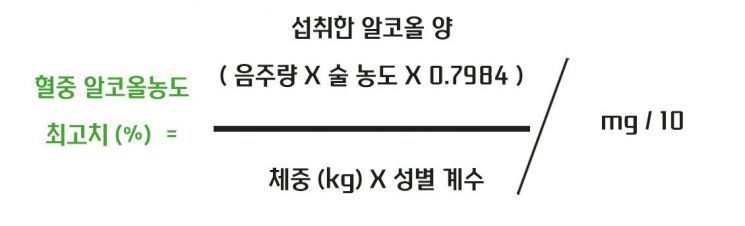 The Widmark formula generally recognized by the court is calculated as Blood Alcohol Concentration = (Amount of alcohol consumed x Alcohol concentration x Alcohol specific gravity: 0.784 x Absorption rate in the body 0.7) ÷ (Body weight x Gender Widmark coefficient x 10).
 [Photo by Asia Economy DB]
Recently, acts such as fleeing after causing accidents by drunk drivers including Kim Ho-jung and even Lee Chang-myung in the past, or obstructing alcohol tests by drinking again after driving, have become openly common. When blood alcohol concentration cannot be properly measured as in previous cases, the Widmark formula is used to estimate blood alcohol concentration to determine guilt or innocence. Created in 1931 by Swedish physiologist Erik M. P. Widmark, this formula is used when a significant amount of time has passed after a drunk driving accident and the alcohol concentration at the time cannot be measured, allowing calculation of the blood alcohol concentration at the time of driving. Various variables such as type and amount of alcohol, drinker’s weight and gender, and elapsed time are used in the formula.
© The Asia Business Daily(www.asiae.co.kr). All rights reserved.


















