New Express Bus Route Established in New Town, Introduction of Metropolitan DRT
Suburban Line Service Resumed, BRT Established
Wonjung Station Transfer Center to Open This December
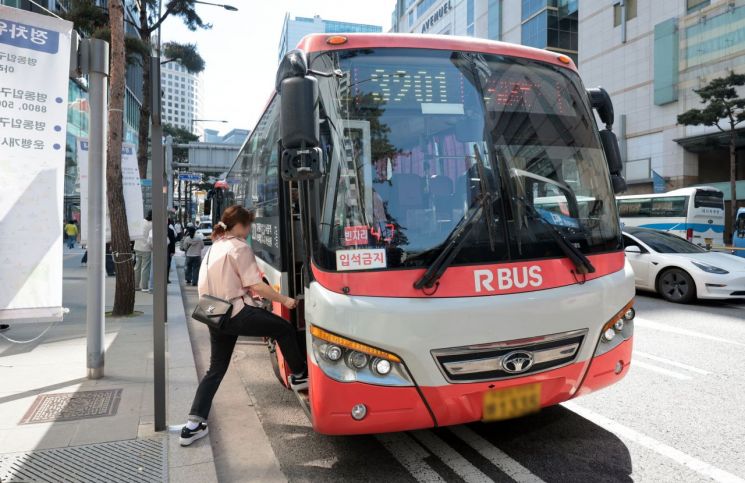
New metropolitan bus routes will be established and operations expanded, focusing on the northern new town areas of the Seoul metropolitan area. Metropolitan DRT (Metropolitan Demand Responsive Transit) will be newly introduced in northern new town areas such as Goyang Deogeun·Hyangdong districts and Yangju Hoecheon district, where metropolitan buses are insufficient.
The Ministry of Land, Infrastructure and Transport's Metropolitan Transport Commission (hereinafter 'MTC') announced the "Measures to Improve Transportation Convenience in the Northern Seoul Metropolitan Area" on the 4th, which includes these details. This plan is a follow-up measure to the three major innovation strategies in the transportation sector announced at the sixth public discussion chaired by the President on January 25. It was prepared to realize the "30-minute commute era" in the northern Seoul metropolitan area (Goyang, Paju, Uijeongbu, Yangju), following the southern metropolitan area plan announced on the 3rd of last month.
First, MTC stated that the 1205 metropolitan bus route (Songsan-dong~Sangbong-dong, Jungnang-gu) has been operating since March to improve transportation convenience in the Uijeongbu Minrak district. Due to high demand, charter buses will be additionally deployed during commuting hours on routes 1101 (Deokjeong Station~Seoul Station) and G6100 (Minrak·Gosan district~Jamsil Station).
Metropolitan DRT will be newly introduced in northern new town areas such as Goyang Deogeun·Hyangdong districts and Yangju Hoecheon district. DRT is a demand-responsive transportation system that flexibly operates routes and stops according to passenger demand.
Regarding railways, the facilities of the Gyeoeseon line, which ceased operation in April 2004, will be upgraded, and operations are planned to resume provisionally 20 times a day starting this December. It will connect the northern Seoul metropolitan areas east to west, including Goyang↔Yangju↔Uijeongbu. The commuter trains running four times daily with 4-car trains on the Munsan~Yongsan section of the Gyeongui-Jungang Line will be increased to 8-car trains from the first half of 2025 to alleviate commuting congestion in the northern new town areas.
The number of dedicated Bus Rapid Transit (BRT) lanes will also be increased. Two new BRT roads, 'Unjeong BRT (Paju Unjeong 1·2 districts entrance~Daehwa Station)' and 'Hwarang-ro BRT (Goyang Samsong district~Korea Aerospace University Station),' will be established to enhance connectivity with existing BRT roads and improve bus speed.
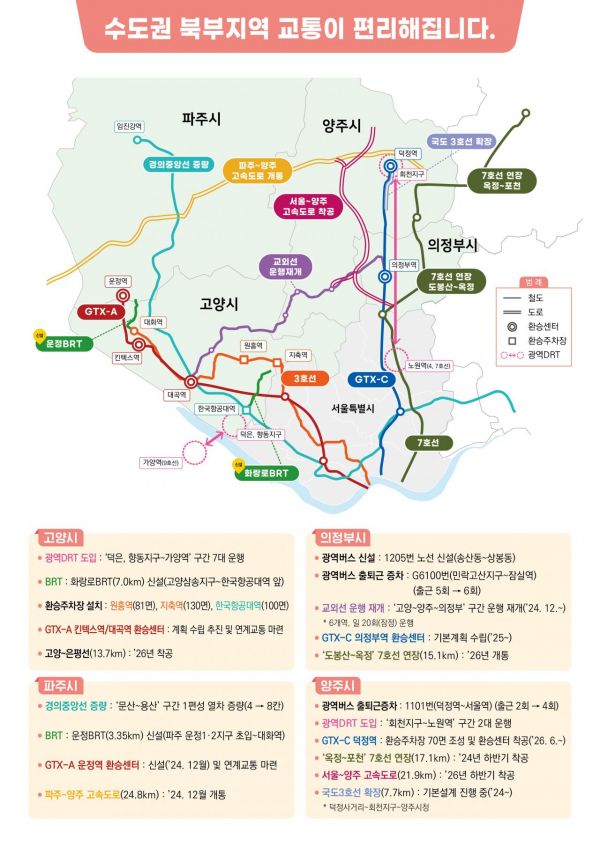
Transfer facilities such as transfer parking lots and transfer centers will be expanded around high-speed metropolitan railway stations to improve transfer convenience between private cars, buses, and other modes. New transfer parking lots will also be created. Transfer parking lots will be constructed at Wonheung Station, Jichuk Station, and Korea Aerospace University Station in Goyang City to enhance public transportation convenience and encourage private car users to switch to public transit. At Wonheung Station on Line 3, which is used by an average of 20,842 passengers daily in the Goyang Samsong and Wonheung districts, a new parking lot with 81 spaces will be completed by the end of this year. The number of parking spaces will increase from the existing 149 to 230.
At Jichuk Station on Line 3, which serves an average of 12,234 passengers daily, detailed design is underway for a transfer parking lot with 130 spaces. Construction will begin in September this year and is scheduled for completion in the second half of next year. A new transfer parking lot with 100 spaces will be installed at Korea Aerospace University Station on the Gyeongui-Jungang Line, located at the southern end of the Goyang Changneung New Town.
In December this year, a transfer center at Unjeong Station will be newly established to coincide with the opening of the GTX (Great Train Express) -A upper section (Paju Unjeong~Seoul Station). City and village bus routes operating to Unjeong Station from Unjeong New Town and the outskirts of Paju will also be expanded to improve accessibility to the metropolitan railway. A connected transportation system, including new city and village bus routes, will be established at GTX-A Kintex Station and Daegok Station. Plans to establish transfer centers will also be reviewed in connection with nearby development projects. Transfer center plans will be developed and follow-up procedures such as design and construction will be promptly pursued at Deokjeong Station and Uijeongbu Station, where the GTX-C line is scheduled to operate, to enhance transfer convenience for local residents.
Mid- to long-term metropolitan railway and road construction projects currently underway will also be completed promptly. By the end of this year, construction will begin on the 'Okjeong~Pocheon (Line 7 extension)' metropolitan railway project, and a work consignment agreement between related agencies will be signed to extend the 'Seohae Line,' which previously operated to Ilsan, to Paju (Unjeong Station).
The four-lane highway section of the Seoul Metropolitan Area Second Ring Road between Paju and Yangju will also open by the end of this year. The expansion project (from 4 to 6 lanes) of the National Road No. 3 section 'Deokjeong Intersection~Hoecheon district~Yangju City Hall,' which suffers from severe traffic congestion, will be steadily promoted.
Kang Hee-up, Chairman of the MTC, stated, "In line with the opening of the GTX-A upper section at the end of this year, we will complete the Unjeong Station transfer center without delay and expand the establishment of metropolitan bus routes and the introduction of metropolitan DRT mainly in new town areas where metropolitan buses are insufficient."
© The Asia Business Daily(www.asiae.co.kr). All rights reserved.


















