Fair water use 880 million liters 100% reuse
Model case of water treatment... Battery company visit
"We will establish a sustainable smelter"
Global non-ferrous metals company Yeongpung announced on the 4th that its Seokpo Smelter in Bonghwa-gun, Gyeongbuk, processed all process water used last year through a wastewater reuse facility without any external discharge, achieving an annual discharge volume of '0' for the second consecutive year.
The volume of process water used is 886,403㎥ (886,403,000 liters). Considering that the average daily water usage per person in South Korea is 305.6 liters (based on 2022 data), the amount of water saved at the Seokpo Smelter is equivalent to the amount of water used by approximately 2.9 million people in one day.
The Seokpo Smelter, ranked 4th in the world in zinc production capacity (maximum annual production capacity of 400,000 tons), introduced the wastewater reuse facility called 'Z.L.D (Zero Liquid Discharge)' in May 2021, the first of its kind among global smelters. This facility uses an 'atmospheric evaporation concentration' method, where wastewater generated from the smelting process is purified, then boiled at high temperatures above 100 degrees Celsius to collect steam, recovering 100% clean water for reuse in the process.
The main equipment of the wastewater reuse facility consists of an evaporator that boils the purified process water to produce steam and a crystallizer that solidifies and treats impurities. Yeongpung invested 30.9 billion KRW at the time of introduction in 2021 to install three evaporators and one crystallizer. Last year, an additional 15.4 billion KRW was invested to expand the facility by adding one more evaporator and one more crystallizer each.
The maximum daily processing capacity of Yeongpung’s wastewater reuse facility is 4,000㎥, and currently, an average of 2,000 to 2,500㎥ of process water per day is treated and fully reused in the process. Yeongpung stated, "The wastewater reuse facility at the Seokpo Smelter has become a benchmark as an excellent example of eco-friendly water treatment in the domestic industry," adding, "It is gaining attention especially from the secondary battery industry, which is currently seeking solutions for high-concentration saline wastewater treatment."
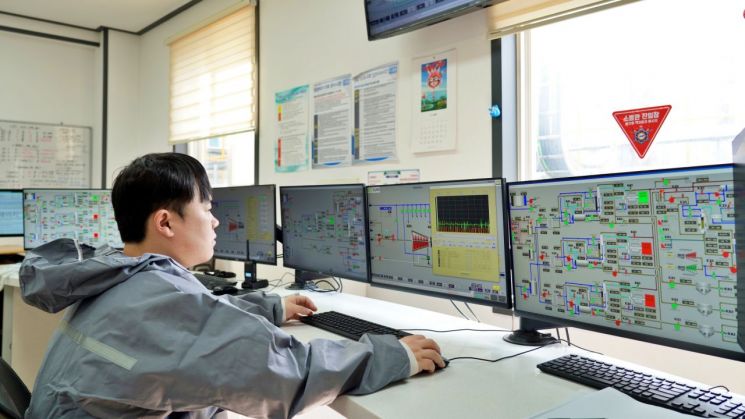 An employee is controlling the equipment through an integrated system in the DCS room of the wastewater reuse facility at Yeongpung Seokpo Smelter.
 [Photo by Yeongpung]
Last year, a domestic secondary battery-related company and a metropolitan local government developing a secondary battery-specialized industrial complex each visited for a tour, and this year, a basic local government promoting the establishment of a dyeing industrial complex and considering the introduction of a zero-discharge system visited the Yeongpung Seokpo Smelter twice. In February this year, at the 'Industrial Wastewater Management Policy Advancement Forum' hosted by the Ministry of Environment, advanced water treatment methods such as the introduction of zero-discharge wastewater systems were proposed as solutions for high-concentration saline wastewater treatment in the secondary battery industry.
Yeongpung has established and is implementing a comprehensive environmental investment plan worth 700 billion KRW to protect the water environment of the Nakdong River. Additionally, it is participating in overcoming the climate crisis by conducting its own carbon-neutral activities, including operating a waste heat power generation system and an energy storage system (ESS), and providing the smelter-owned ultra-high voltage (154kV) power grid free of charge for the resident-led 'Omisan Wind Power' project.
A Yeongpung official said, "Achieving zero wastewater discharge among global smelters is unprecedented and marks a milestone in the development of South Korea’s industrial environment," adding, "We will continue our efforts to establish ourselves as a sustainable global eco-friendly smelter."
© The Asia Business Daily(www.asiae.co.kr). All rights reserved.

















