Constitutionality of Article 123 of the Criminal Act Confirmed Again After 18 Years
Former Blue House Senior Secretary for Civil Affairs Woo Byung-woo's constitutional complaint challenging the criminal abuse of authority under the Criminal Act as unconstitutional for violating the principle of clarity in the legality of crimes and punishments was dismissed by the Constitutional Court.
The Constitutional Court had previously ruled the constitutionality of Article 123 (Abuse of Authority) of the Criminal Act in 2006, and has now reaffirmed its constitutionality after 18 years. In the earlier decision, the court found the provision did not violate the principle of clarity, and this time it also judged that it does not violate the principle of proportionality between responsibility and punishment.
According to the legal community on the 4th, the Constitutional Court unanimously dismissed (upheld constitutionality) the constitutional complaint regarding Article 123 of the Criminal Act filed by Woo and three others.
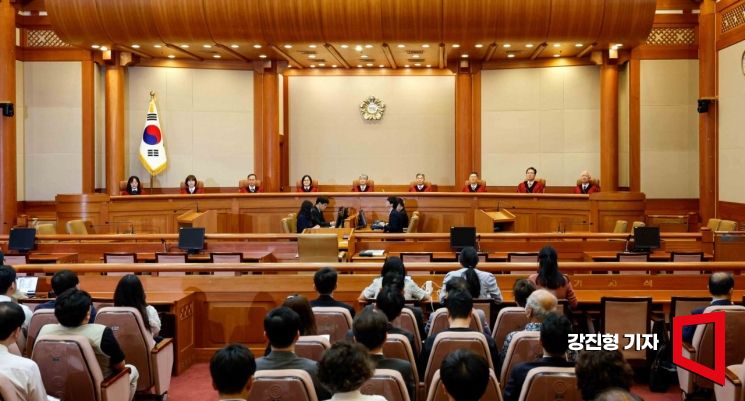
The Constitutional Court stated, "The provision under review does not violate the principle of clarity in the legality of crimes and punishments, nor does it violate the principle of proportionality between responsibility and punishment."
Article 123 (Abuse of Authority) of the Criminal Act stipulates that "If a public official abuses their authority to cause a person to perform an act not obligated or obstructs the exercise of a person's rights, they shall be punished by imprisonment for up to five years, suspension of qualifications for up to ten years, or a fine of up to 10 million won."
Former Senior Secretary Woo was sentenced to one year in prison in the 2021 appellate court for abusing authority by ordering National Intelligence Service employees during the Park Geun-hye administration to collect and report surveillance information on Lee Seok-su, former Special Inspector directly under the President, and Kim Jin-sun, former Pyeongchang Winter Olympics Organizing Committee chairman. The appellate court found that Woo conspired with Choo Mo, director of the National Intelligence Service's National Interest Information Bureau, to abuse his authority as the bureau chief.
Woo appealed to the Supreme Court, and while the appeal was pending, he filed a request for a constitutional review with the Constitutional Court, arguing that the phrases "abuse of authority" and "causing a person to perform an act not obligated" in Article 123 of the Criminal Act violated the principle of clarity. When the trial court rejected this request, he directly filed a constitutional complaint with the Constitutional Court.
In his constitutional complaint, Woo also challenged the constitutionality of Article 11(1) of the National Intelligence Service Act (prohibition of abuse of authority, currently Article 13), specifically the phrases "abuse of authority" and "causing other organizations, groups, or persons to perform acts not obligated," as well as Article 19(1) of the same law, which prescribes penalties for violations.
Woo argued at the Constitutional Court that "It is impermissible to interpret the abuse of authority crime as applicable when a public official uses the appearance and form of authority within the scope of general official duties to commit illegal or improper acts disguised as exercising authority, as this would equate to applying abuse of authority to acts outside the scope of general official duties."
First, the Constitutional Court dismissed Woo's constitutional complaint regarding the National Intelligence Service Act provisions. According to Article 68(2) of the Constitution, to file a constitutional complaint (unconstitutionality complaint), a request for constitutional review must have been rejected or dismissed by the court. Since Woo did not file such a request for the National Intelligence Service Act provisions, the complaint could not be accepted.
Regarding the claim that Article 123 of the Criminal Act violates the principle of clarity in the legality of crimes and punishments, the Constitutional Court cited its previous precedent.
The court explained, "The constitutional principle of legality means that crimes and punishments must be defined by law. The derived principle of clarity requires that the law clearly define the acts subject to punishment and the corresponding penalties so that anyone can foresee and regulate their conduct accordingly."
It added, "However, even though the elements of a penal provision must be clear, it does not mean that the legislature must define all elements in a purely descriptive sense. Even if the penal provision uses somewhat broad concepts that require supplementary judicial interpretation, this alone does not necessarily violate the constitutional principle of clarity."
Referring to the 2006 ruling, the court stated, "'Authority' means the power granted by duty, and 'abuse' means using it recklessly or improperly beyond its original purpose. Even if the scope and content of authority are broad and comprehensive, this does not imply that the meaning of 'authority' itself is unclear."
The court also noted, "Courts have established interpretative standards based on the literal meaning of abuse of authority, and many laws use similar elements such as 'abuse of authority' or 'abuse of power' in penal provisions. Moreover, it is legislatively difficult to specify in advance all types and forms of abuse of authority by public officials."
Furthermore, "The law protects legal freedom rather than internal psychological freedom. The phrase 'act not obligated' in this provision clearly means an act not prescribed as an obligation by law."
The court concluded, "The reasoning of the previous precedent applies equally to this case, and there is no reason to consider any change in circumstances or necessity to the contrary."
The Constitutional Court also ruled that the term "person" in Article 123 does not violate the principle of clarity. One petitioner, Bae, argued that the protected legal interest in the phrase "causing a person to perform an act not obligated" is "individual freedom and rights," and including public officials within the scope of "person" and including "official duties" within the scope of "obligation" constitutes prohibited expansive or analogical interpretation, violating the principle of clarity.
The court responded, "The provision does not specifically limit the scope of 'person,' and even if the counterpart is a public official, there is a need to protect them from abuse of authority in decision-making or execution of duties. Therefore, it is difficult to exclude public officials from the scope of 'person.' Courts have also judged based on the premise that 'person' includes not only private individuals but also public officials."
Considering the wording, protected legal interests, and judicial interpretation, the court concluded that a reasonable person with common sense and ordinary legal sentiment can foresee that the phrase "causing a person to perform an act not obligated" includes cases where a public official is caused to perform acts not obligated by law by violating principles, standards, and procedures of assigned duties, as well as cases involving private individuals.
The Constitutional Court found that the abuse of authority provision in the Criminal Act does not violate the principle of proportionality between responsibility and punishment.
The court explained, "Article 123 aims to protect public trust in the fair exercise of state functions and individual freedom and rights by punishing public officials who abuse their authority to oppress individual freedom and obstruct the exercise of rights. Abuse of authority by public officials can cause general public distrust not only toward the individual official but also toward state functions, threatening proper state function, thus necessitating punishment."
It added, "Considering the harm caused by abuse of authority, the legislature's judgment that choosing a firm measure such as criminal punishment rather than administrative sanctions is necessary to protect public trust in fair state function and individual freedom and rights is not arbitrary."
A Constitutional Court official explained, "This case reaffirms that Article 123 of the Criminal Act does not violate the principle of clarity in the legality of crimes and punishments, confirms the clarity of the interpretation regarding 'person' as the counterpart of abuse of authority, and is the first case to find that regulating abuse of authority by public officials through criminal punishment rather than administrative sanctions does not violate the principle of proportionality between responsibility and punishment."
© The Asia Business Daily(www.asiae.co.kr). All rights reserved.

















