ISM May Manufacturing PMI Contracts for Second Month
Manufacturing Slumps Following Consumption... Impact of High-Intensity Tightening
US Treasury Yields Rise... 10-Year Note Up Over 10bp
Following signs of a slowdown in consumption, which has driven the U.S. economic boom, the manufacturing sector has also continued its contraction for the second consecutive month. Analysts suggest that the U.S. economy has begun to cool after more than two years of cumulative high-intensity tightening by the Federal Reserve (Fed). As expectations for interest rate cuts rise, the yield on the U.S. 10-year Treasury note has plunged by more than 10 basis points (1bp = 0.01 percentage points).
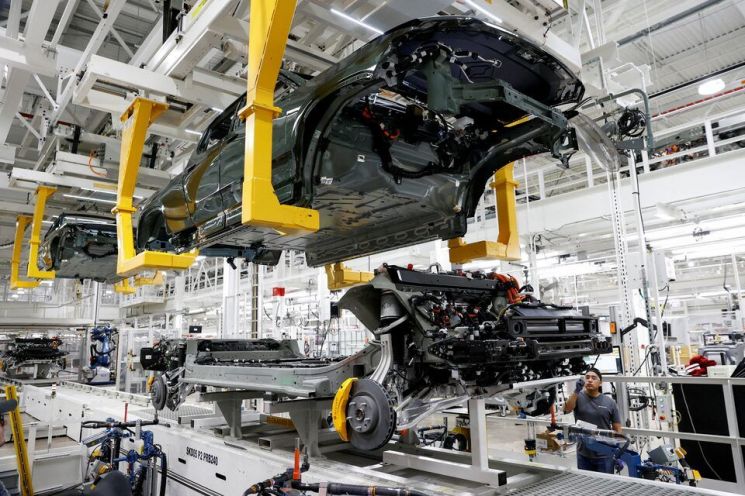
On the 3rd (local time), the Institute for Supply Management (ISM) released the May U.S. Manufacturing Purchasing Managers' Index (PMI), which was recorded at 48.7. This figure fell short of expert forecasts (49.8) and declined from the previous month (49.2).
The manufacturing PMI, a key leading economic indicator, signals expansion when above 50 and contraction when below 50. Thus, the U.S. manufacturing PMI has remained in contraction territory for two consecutive months.
The new orders index dropped sharply to 45.4 from 49.1 in the previous month, marking the lowest level in a year since May last year. Manufacturing production fell from 51.3 in April to 50.2 in May, the lowest in three months since February. The order backlog stood at 42.4, the lowest in six months since November last year.
Notably, amid the contraction in manufacturing activity, price pressures have eased. The prices index fell significantly to 57 from 60.9 in the previous month. In April, the prices index surged to its highest level since June 2022, raising inflation concerns.
However, the May U.S. manufacturing PMI released by S&P Global showed a contrasting trend, recording 51.3, surpassing both the previous month (50) and the forecast (50.9), thus remaining in expansion territory.
James Knightley, Chief International Economist at ING, analyzed, "The ISM manufacturing index contracted more than expected due to declining orders and slowing production. The construction sector was also weaker than anticipated, indicating that monetary policy remains restrictive and is putting a brake on economic activity."
Concerns are rising that the U.S. economy could rapidly slow down as manufacturing activity continues to contract following signs of cooling in consumption, which accounts for two-thirds of the economy. According to the U.S. Bureau of Economic Analysis (BEA), real personal income and real personal consumption, adjusted for inflation, each declined by 0.1% in April compared to the previous month. The consumption sector, which had supported the U.S. economy with a solid performance despite strong inflation, is now seen as signaling an economic slowdown.
On the 30th of last month, the U.S. first-quarter gross domestic product (GDP) growth rate was revised downward from an annualized 1.6% to 1.3%, with the main cause being the slowdown in consumer spending. Wall Street has lowered its GDP growth forecasts for the second quarter. Capital Economics recently cut its second-quarter GDP growth forecast from 2.7% to 1.2%.
With signs of economic downturn emerging after more than two years of the Fed’s high-interest-rate policy, there is speculation that the central bank may soon face a situation where it worries more about economic slowdown than inflation.
Amid signs of cooling in the U.S. economy and expectations that the Fed may bring forward the timing of interest rate cuts, Treasury yields are falling. Currently, the yield on the U.S. 10-year Treasury note stands at 4.39%, down 12 basis points from the previous trading day, while the yield on the 2-year Treasury note, which is sensitive to monetary policy, is at 4.81%, down 7 basis points from the previous day. Investors betting on rate cuts are also increasing. According to the Chicago Mercantile Exchange (CME) FedWatch tool, the federal funds futures market is pricing in a 59% probability that the Fed will cut rates by at least 0.25 percentage points at the Federal Open Market Committee (FOMC) meeting in September. This is up from 54% the day before and 49% a week ago.
© The Asia Business Daily(www.asiae.co.kr). All rights reserved.

















