Passed Seoul Small-scale Housing Maintenance Integrated Review
95 Households in Jeongneung-dong, 63 Households Supplied in Siheung-dong
A total of 158 Moa Housing units are scheduled to be supplied within 3 to 4 years in Jeongneung-dong, Seongbuk-gu, and Siheung-dong, Geumcheon-gu, Seoul.
On the 4th, Seoul City announced that at the 8th Small-scale Housing Maintenance Integrated Review Subcommittee held on the 3rd, two integrated reviews were passed: 'Moa Housing in the area of 545-12 Jeongneung-dong, Seongbuk-gu' and 'Moa Housing in the area of 230-4 Siheung-dong, Geumcheon-gu.'
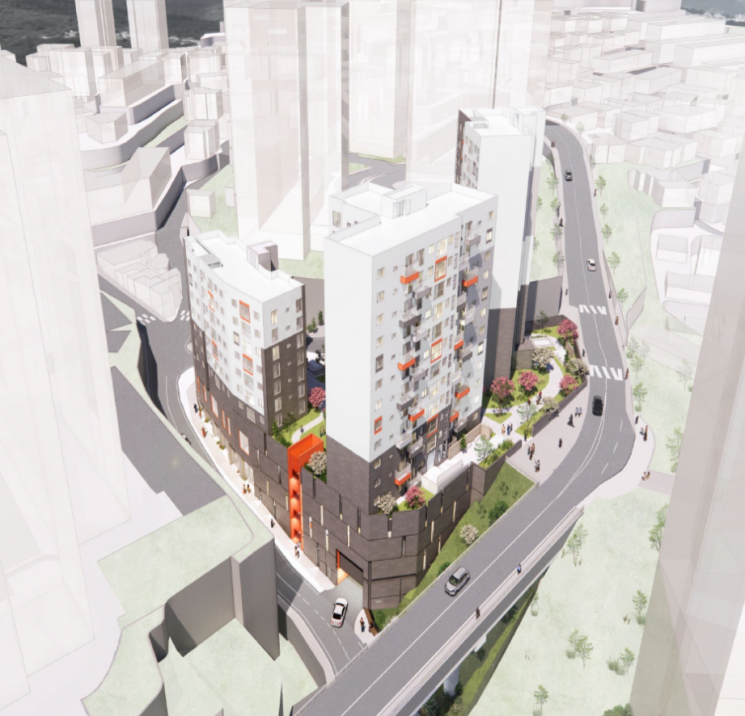
In the area of 545-12 Jeongneung-dong, which was previously a low-rise residential area with 39 households, a multi-unit residential complex with 3 buildings, ranging from 3 basement floors to 14 floors above ground, and 95 households (including 16 rental units) will be constructed by 2028. To achieve this, floor height restrictions within the Type 2 General Residential Area (up to 7 floors) were relaxed (from up to 7 floors to up to 15 floors), floor area ratio was eased (from 200% to 250%) due to the construction of rental housing, and building regulations were relaxed.
The retaining walls with height differences were minimized to create a form that adapts to the terrain, and neighborhood living facilities were placed on the lower floors to activate the street. Safety measures for plots adjacent to the Bukaksan-ro overpass were also included.
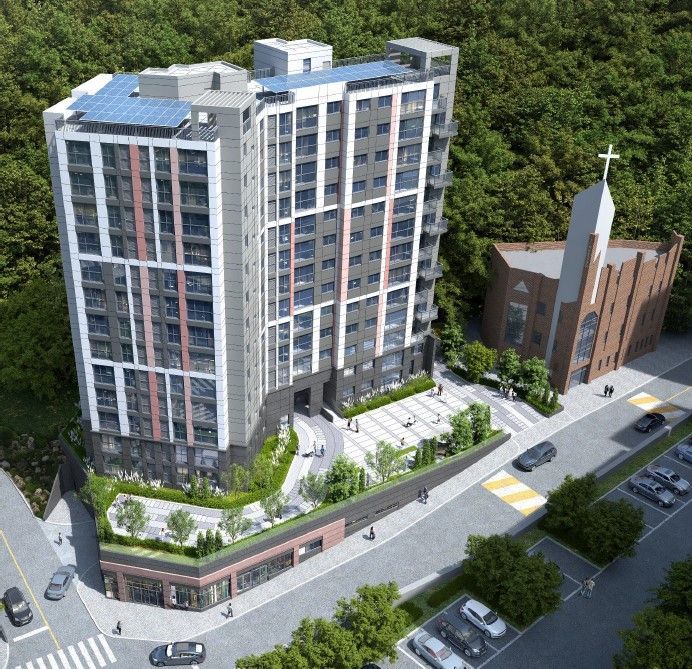 Aerial view of Moa Housing in the area of 230-4, Siheung-dong, Geumcheon-gu, Seoul. Photo by Seoul City
In the area of 230-4 Siheung-dong, Geumcheon-gu, adjacent to Hoamsan, a multi-unit residential complex with 1 building, ranging from 2 basement floors to 13 floors above ground, and 63 households (including 13 rental units) will be supplied by 2027. Similarly, floor height restrictions within the Type 2 General Residential Area were relaxed (from up to 7 floors to up to 13 floors), floor area ratio was eased (from 200% to 250%) due to the construction of rental housing, and building regulations such as open space standards within the site were relaxed.
The project site utilized the site's elevation differences to place street-facing neighborhood living facilities to activate the street, and to improve residents' walking environment, open spaces within the site were used to minimize pedestrian disconnection. Additionally, on the first floor above ground, a community exercise and rest space accessible to local residents was provided.
© The Asia Business Daily(www.asiae.co.kr). All rights reserved.













