Left-Wing Ruling Party's Claudia Sheinbaum Elected
First Female President in Mexico's 200-Year Constitutional History
Focus on the Spread of Latin America's 'Pink Tide'
In Mexico, often regarded as a male-dominated 'macho culture,' the country has elected its first female president in its 200-year constitutional history.
On the 3rd (local time), according to CNN, The Guardian, and others, Mexico's National Electoral Institute (INE) officially announced that Claudia Sheinbaum, a member of the left-wing ruling party National Regeneration Movement (MORENA), won the presidential election held the previous day.
Immediately after the official announcement, President-elect Sheinbaum said, "We dream of a pluralistic, diverse, and democratic Mexico," adding, "We will continue to walk peacefully and harmoniously to build a fairer and more prosperous Mexico." She also expressed gratitude to the citizens who elected her as the first female president in the country's constitutional history.
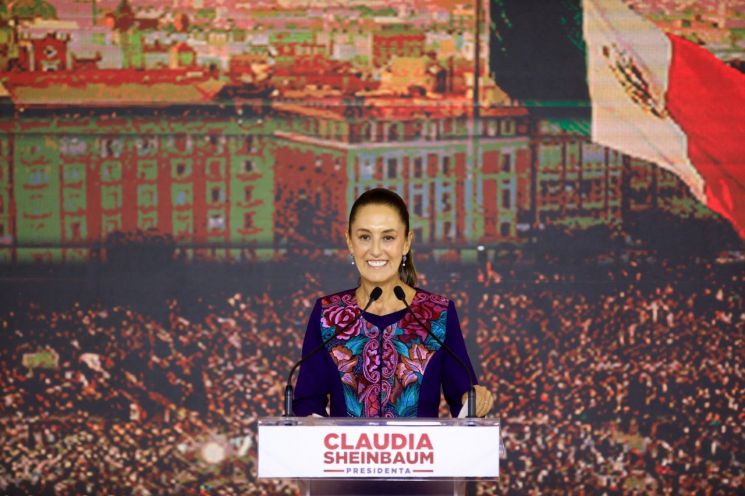
INE reported that the quick count, reflecting votes nationwide, showed Sheinbaum receiving between 58.3% and 60.7% of the vote, defeating the right-wing opposition coalition candidate Sochitl Galvez, who received between 26.6% and 28.6%. This surpasses the 54.71% vote share of current President Andr?s Manuel L?pez Obrador in 2018. President Obrador congratulated Sheinbaum, saying, "Congratulations to Sheinbaum, who will become Mexico's first female president."
Earlier, Mario Delgado, leader of MORENA, declared "Sheinbaum has won" immediately after exit poll results were released, and major Mexican media outlets such as Milenio TV and Enemas (N+) labeled Sheinbaum as the 'president-elect' from the early stages of vote counting. Local media El Universal and Enemas also reported their own exit polls showing Sheinbaum's victory, describing this election as historic for electing a female president even earlier than the United States.
This year's Mexican presidential election showed a clear consolidation of support for the ruling party, with local media and political analysts noting that "the outcome was decided early." This was largely attributed to the strong influence of President Obrador, who maintained a high approval rating in the 60% range without a lame-duck effect until the end of his term.
Before running for president, Sheinbaum was an elite politician who served as mayor of Mexico City. With a background in energy industry and climate studies, Sheinbaum first entered politics in 2000 when she was appointed Mexico City's Secretary of the Environment. She pledged to continue and develop most of the current administration's policies, including promoting moderate immigration policies, accelerating the transition to green energy, and strengthening state-owned enterprises. Her inauguration is scheduled for October 1, and her term will last until 2030.
The outcome of this Mexican presidential election is drawing attention to whether it will reinvigorate the wave of moderate leftist governments (the Pink Tide) in Latin America and bring changes to the political and diplomatic landscape. Since 2018, following Mexico, countries such as Peru, Bolivia, Chile, and Colombia have consecutively elected leftist governments, and in 2022, the election of President Luiz In?cio Lula da Silva in Brazil marked the peak of the second Pink Tide. Later this year, presidential elections remain scheduled in Venezuela (July 28) and Uruguay (October 27).
© The Asia Business Daily(www.asiae.co.kr). All rights reserved.
![Clutching a Stolen Dior Bag, Saying "I Hate Being Poor but Real"... The Grotesque Con of a "Human Knockoff" [Slate]](https://cwcontent.asiae.co.kr/asiaresize/183/2026021902243444107_1771435474.jpg)
















