Record High Overseas Bond Investment by Individual Investors in Q1 This Year
Popularity of US Bonds Rises as Korea-US Interest Rate Inversion Continues
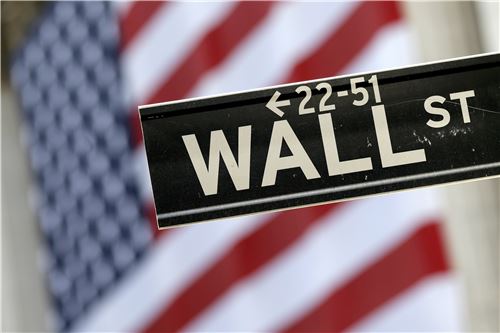 Wall Street Sign (Asia Economy = Yonhap News)
This year, the scale of overseas bond investments by domestic individual investors reached an all-time high. Most individuals invested in U.S. bonds, influenced by factors such as the increased attractiveness of U.S. Treasury investments due to the interest rate inversion between Korea and the U.S., and the potential for capital gains driven by expectations of a base interest rate cut.
According to the Bank of Korea's report titled "Background and Evaluation of the Recent Surge in Individual Investors' Overseas Bond Investments" released on the 3rd, the scale of individual investors' overseas bond investments in the first quarter of this year reached $3.9 billion, marking a quarterly record high. This figure surpassed the previous annual record of $3.3 billion set in 2017 in just one quarter.
Individual overseas bond investments were primarily concentrated in U.S. bonds. The Bank of Korea analyzed that the widening interest rate inversion between Korea and the U.S. increased the investment attractiveness of overseas bonds, which was a major factor behind the expansion of individual overseas bond investments.
Currently, Korea's base interest rate stands at 3.5%, while the U.S. base interest rate is 5.5%, resulting in an interest rate gap of 2 percentage points, the highest ever recorded. Consequently, U.S. bond yields have become higher than Korean bond yields, prompting capital movement.
As interest in U.S. bonds has increased, financial institutions have also expanded sales of related products. Since the beginning of this year, Kookmin Bank and Woori Bank have launched new products such as U.S. long-term government bond securities investment trusts and U.S. dollar high-grade bonds, while asset management companies like Korea Investment Management and KB Asset Management have introduced U.S. long-term government bond funds.
Pyo Sang-won, head of the Foreign Exchange Analysis System Improvement Team at the Bank of Korea's International Department, explained, "With the U.S. Treasury yield (3-year) rebounding to the mid-4% range this year, the interest rate inversion between Korea and the U.S. has widened, increasing the investment attractiveness of overseas bonds."
The expectation of a Federal Reserve (Fed) base interest rate cut within the year was also cited as a factor enhancing the appeal of U.S. bonds. If the base interest rate is cut, bond yields fall and bond prices rise, allowing bond investors to seek capital gains.
Reduced concerns about a high exchange rate also had some influence. Despite the won-dollar exchange rate exceeding 1,300 won this year, the expansion of individual investments in overseas bonds suggests a decreased sensitivity among individuals to high exchange rates.
The Bank of Korea stated that the expansion of individual overseas bond investments has positive aspects, such as portfolio diversification from the individual's perspective and the expansion of external financial assets from a macroeconomic viewpoint. However, if the Korea-U.S. interest rate inversion persists, there is a possibility that increased demand for carry trades by individuals could burden the foreign exchange market. Carry trades refer to transactions where funds borrowed at low interest rates are invested in products of other countries.
Pyo emphasized, "Since individual overseas bond investments are generally made without foreign exchange hedging, if the domestic and foreign interest rate inversion continues, individual demand for carry trades may persist, potentially increasing pressure on foreign exchange supply and demand."
© The Asia Business Daily(www.asiae.co.kr). All rights reserved.
















