Kamco Research Institute Report
There has been a call for the fundamental restructuring of the real estate project financing (PF) market by segmenting capital requirements during projects according to phased, usage-based, and regional risks and the corresponding actual risks.
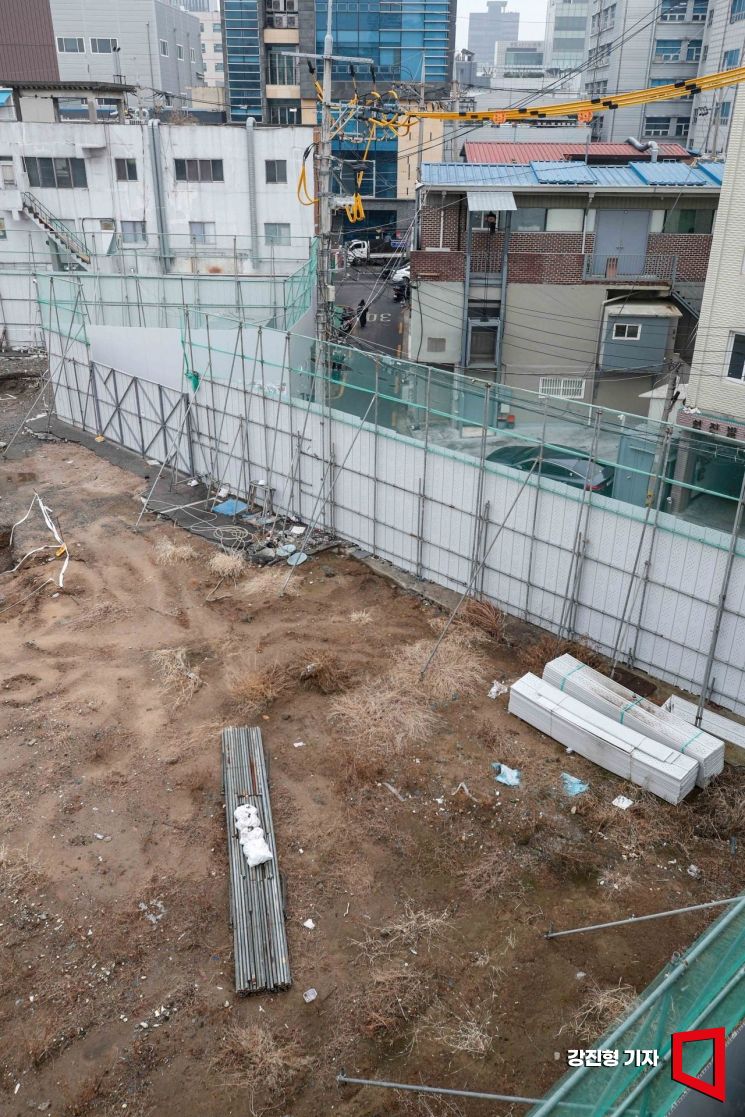 Taeyoung Construction, which is experiencing a liquidity crisis due to real estate project financing (PF), has applied for a workout. On the 5th, the construction site of Taeyoung Construction's Seongsu-dong development project located in Seongdong-gu, Seoul, has come to a halt. Photo by Jinhyung Kang aymsdream@
On the 3rd, according to the financial sector, the Financial Asset Research Team at Korea Asset Management Corporation (KAMCO) stated this in their recently published report titled "Analysis of the Current Status of Real Estate PF and Institutional Improvement Study." The report was collaboratively researched and investigated by Professor Shin Hyun-han of Yonsei University, Professor Han Jeong-seok of Seoul National University, and Deputy Director Lee Kang-san of KAMCO Research Institute.
Currently, domestic PF developers invest equity capital equivalent to 5-10% of the total project cost, purchase land through bridge loans, and once the project is on track, repay the land purchase funds through the main PF financing. The main PF loans are repaid through housing mortgage loans from residents via pre-sales.
The report emphasized that to improve the structure of domestic PF, the capital requirements for developers should be segmented considering the actual risks according to detailed PF risks, and the developers' responsibility burden should be gradually strengthened. For example, since risks differ by phase (bridge loan vs. main PF), usage (residential vs. non-residential), and region (metropolitan area vs. non-metropolitan area), the capital requirements for developers should also vary accordingly.
In the United States, developers and investors form a limited liability company where they act as general partners (GP) and limited partners (LP), respectively, raising 20-30% of the project cost. Subsequently, they repay land purchase funds through separate investor funding and secure separate construction funds. The report stressed, "In the mid to long term, it is necessary to refine PF project feasibility evaluations, focusing on securing future cash flows of the real estate development project itself as collateral rather than the creditworthiness of the construction company."
Additionally, the report suggested that regarding the current delays in the sale of PF bonds by savings banks and others, there should be regulations to periodically reduce the price of bonds. For instance, it proposed formalizing a clause that mandates forced sales by reducing the price by 10% every three months for bonds overdue by more than six months. This is because major creditors, including savings banks, are not actively selling PF bonds or clearing projects, anticipating future interest rate cuts and a recovery in the real estate market.
Meanwhile, financial authorities have recently begun efforts to clear PF projects and improve PF systems. Recently, they improved standard regulations requiring savings banks and others to auction off PF non-performing loans every three months through light or public auctions, and from this month, a segmented project evaluation method will be fully implemented. Furthermore, in the mid to long term, they plan to undertake comprehensive PF system improvements, including strengthening developers' capital requirements.
© The Asia Business Daily(www.asiae.co.kr). All rights reserved.

















