AFP "Balloon Launches Are Not UN Sanctions Violations Unlike Ballistic Missile Launches"
After North Korea released a large number of filth balloons toward South Korea twice since last month, foreign media have given significant coverage to the recent complex provocations originating from North Korea, the South Korean government's response, and the history of the inter-Korean 'balloon war.'
AP News, citing a statement from the Joint Chiefs of Staff, reported, "Between last night and this morning, about 600 filth balloons were released from North Korea and have been found across South Korea," adding, "This is North Korea's retaliation against leaflet distribution by anti-North Korean groups."
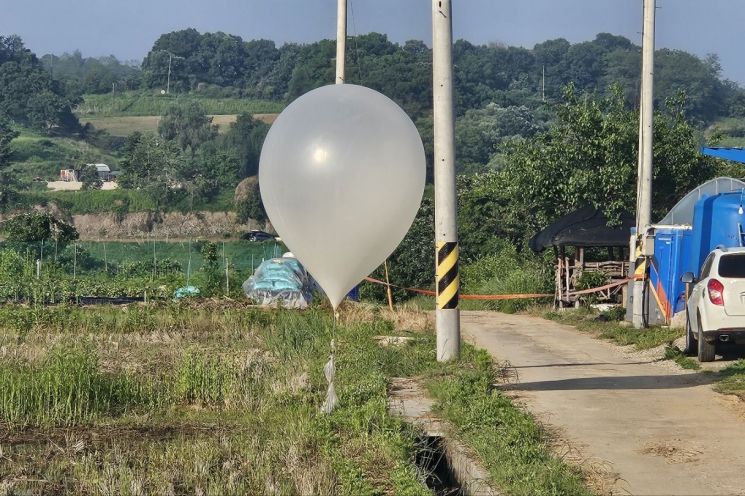
The outlet explained that following a series of provocations, including the failed military reconnaissance satellite launch on the 27th of last month and the short-range ballistic missile (SRBM) launch on the 30th, North Korea released filth balloons.
It also detailed the authorities' response, noting that the military dispatched the Chemical, Biological, Radiological, and Nuclear Rapid Response Team (CRRT) and Explosive Ordnance Disposal (EOD) units to collect over 260 filth balloons nationwide, and that the Seoul Metropolitan Government sent safety alert texts to citizens regarding the balloon releases.
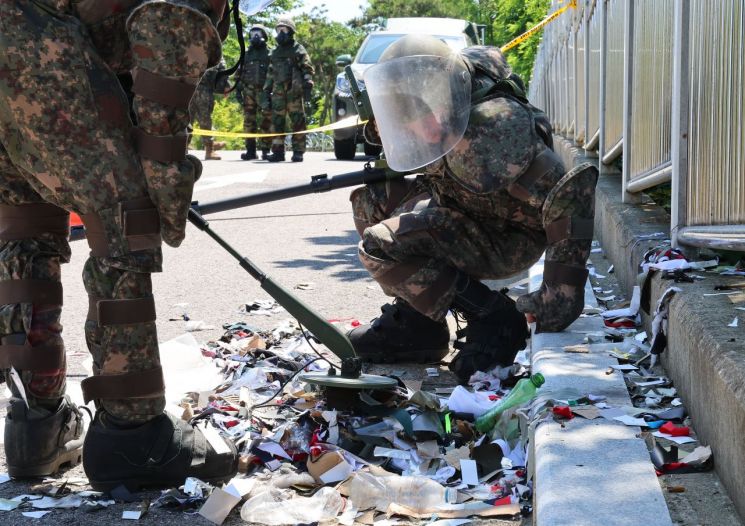
AFP, in a Seoul-based report, also covered the Joint Chiefs' announcement and reported, "Soldiers in protective suits were seen collecting trash contained in the balloons sent toward South Korea, including cigarette butts, cardboard, and plastic pieces."
The agency noted, "The South Korean government described this provocation as 'irrational' and 'low-level,' but unlike recent ballistic missile launches, the filth balloon release does not violate UN sanctions against North Korea."
AFP further reported, citing Yonhap News Agency, that the South Korean government held an expanded meeting of the National Security Council (NSC) Standing Committee to discuss countermeasures against North Korea's filth balloon releases, including the resumption of loudspeaker broadcasts toward the North.
Bloomberg News also reported, based on the Joint Chiefs' announcement, that North Korea began releasing filth balloons on the 28th of last month, containing batteries, shoe fragments, and fecal fertilizer.
Foreign media have also highlighted the background of North Korea's provocations and the decades-long 'leaflet distribution' war exchanged between the two Koreas. The British daily The Guardian reported, "South Korean activists have long angered North Korea by sending balloons carrying anti-North Korean leaflets," adding, "These balloons sometimes included cash, rice, and USB drives containing South Korean drama series."
AP also pointed out, "The 26 million North Korean residents have very limited access to foreign news, and North Korea reacts extremely sensitively to any external attempts to undermine Kim Jong-un's absolute control over them."
BBC introduced, "Since the Korean War in the 1950s, both North and South Korea have used balloons for propaganda," and noted, "South Korean activists sent balloons not only with anti-North Korean propaganda but also with cash, media content banned in North Korea, and Choco Pie snacks from South Korea, which are also banned in the North."
AFP pointed out, "The propaganda offensives between the two Koreas have sometimes escalated into larger retaliations."
It also detailed recent years' conflicts, including the 2018 agreement between the North and South Korean leaders to "completely cease all hostile acts against each other," North Korea's objection in June 2020 to leaflet distribution by some defector groups leading to the demolition of the inter-Korean liaison office building in Kaesong Industrial Complex, the South Korean National Assembly's passage of the 'Anti-Leaflet Act' in 2020, and last year's Constitutional Court ruling that declared the law unconstitutional.
© The Asia Business Daily(www.asiae.co.kr). All rights reserved.


















