KISA-Samsung, Agreement and Testing
Official Service Launch in Second Half of This Year
Market Stabilization for Bulk SMS Delivery, etc.
In the second half of this year, a malicious message filtering service will be introduced to most Samsung Electronics smartphone models. This feature automatically filters out illegal spam, smishing, and voice phishing bait messages based on verified data.
The Korea Internet & Security Agency (KISA) announced on the 2nd, "We have developed a function that can filter malicious messages once more on Samsung Electronics phones based on KISA's spam report analysis data."
KISA and Samsung Electronics signed a business agreement in October last year and began collaboration. After pilot testing until next month, the official service is scheduled to launch in the second half of this year.
Jung Won-gi, head of KISA's Digital User Protection Division, said, "It is meaningful for mobile device manufacturers to play a role in reducing malicious messages," adding, "This feature has been introduced on some devices since April, and we plan to apply it to almost all Samsung phones released domestically by the second half of the year."
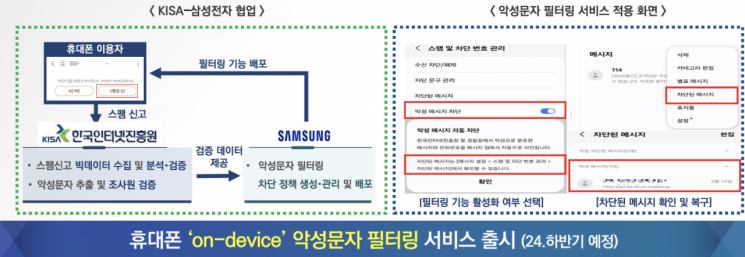
Once this service is introduced, the user interface (UI) will be changed to automatically filter malicious text messages based on phone numbers and URL links.
It functions similarly to the 'Spam' folder in email accounts.
When users activate the 'Malicious Message Blocking' feature, malicious messages are automatically stored in the 'Blocked Messages' folder. There are also functions to check or restore blocked messages. Jung explained, "Users can choose whether to activate the filtering function, and blocked messages can be restored, reducing the risk of false positives and false negatives."
Additionally, KISA will implement a 'Mass Text Message Sender Qualification Certification System' starting this month. In Korea, there are nine text message relay companies handling mass text message sending for various companies and institutions, and under them, 1,175 resellers operate in a fragmented manner. According to data from the second half of last year, 98% of domestic spam messages are sent through mass text message services.
KISA is conducting the certification system to stabilize the mass text message sending service market and grant mass text sending qualifications to resellers who meet certain requirements. The operating organization entrusted as a text message relay company (the Korea Communications User Protection Association) will be responsible for screening, certifying, and managing resellers afterward.
KISA has designated sender numbers of spam messages that have been reported multiple times or by many users as a blacklist and will share this with text message relay companies to block re-sending. The blacklist includes sender numbers of messages reported more than 50 times as of one day and will be blocked for three months from the registration date.
Meanwhile, the monthly spam reception volume per user in the second half of last year increased by 44.6% compared to the previous year. Recently, spam related to gambling (lotto), stock, and investment inducement has been increasing, and spam messages hosted on overseas servers are also rising, making enforcement more difficult.
© The Asia Business Daily(www.asiae.co.kr). All rights reserved.


















