Population Policy Research Institute Korea Institute of Public Finance
"Increased Favorability with Early Admission of Girls" but Causality Not Established
The Korea Institute of Public Finance (KIPF), a government-funded research institute responsible for evaluating population policies, has made an absurd suggestion that enrolling girls one year early could help increase the birth rate.
According to KIPF on the 31st, their recently published report titled "Policy Recommendations for Fiscal Measures to Address the Decline in the Proportion of the Productive-Age Population" explained, "Considering that males develop more slowly than females, enrolling females one year early in school age could contribute to making men and women of marriageable age find each other more attractive in the future."
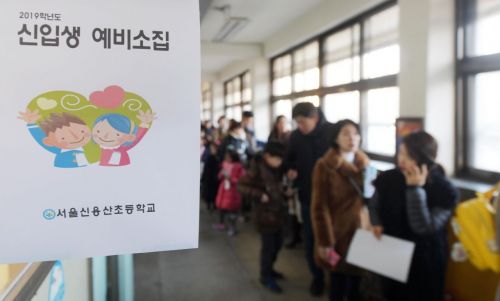 On the preliminary enrollment day for elementary school, prospective elementary students and their parents are lining up to register at Sinyongsan Elementary School in Yongsan-gu, Seoul.
 [Photo by Mun Honam munonam@]
In the report, KIPF analyzed that fiscal policies are needed at each stage of the entire process leading to childbirth decisions, including establishing the will to marry, dating, marriage, first childbirth, and infertility treatment.
Among these, one of the proposed measures under the 'Dating Success Support Policy' was 'early enrollment of girls.' However, the report did not present any causal relationship or expected effects between early enrollment of girls and future dating success rates between men and women.
The report also suggested that "in a situation where the working-age population is decreasing, it is difficult to justify the government supporting self-employed startups," criticizing that the government's policies for small business owners and the self-employed are set counter to the future.
The argument is that the small business sector was used in the past population growth period to absorb excess labor supply unproductively, so now is the time to withdraw startup support policies.
KIPF's recommendations are likely to face criticism for failing to properly consider social conventions. Previously, in July 2022, the government announced a plan to reform the school system by lowering the elementary school starting age to six, one year earlier, but withdrew it after fierce criticism for ignoring the developmental characteristics of young children without a public consultation process. At that time, Education Minister Park Soon-ae resigned 35 days after her appointment due to the controversy.
Professor Shin Kyung-ah of Hallym University’s Department of Sociology advised, "Making statements without scientific evidence or sufficient cases from a population policy evaluation institution can only provoke greater public resentment toward population policies," adding, "We need to reflect on whether we are holding perceptions from around the 18th or 19th century."
© The Asia Business Daily(www.asiae.co.kr). All rights reserved.
!["The Woman Who Threw Herself into the Water Clutching a Stolen Dior Bag"...A Grotesque Success Story That Shakes the Korean Psyche [Slate]](https://cwcontent.asiae.co.kr/asiaresize/183/2026021902243444107_1771435474.jpg)
















