Capital Market Research Institute Hosts Seminar on Japanese Capital Market Policies
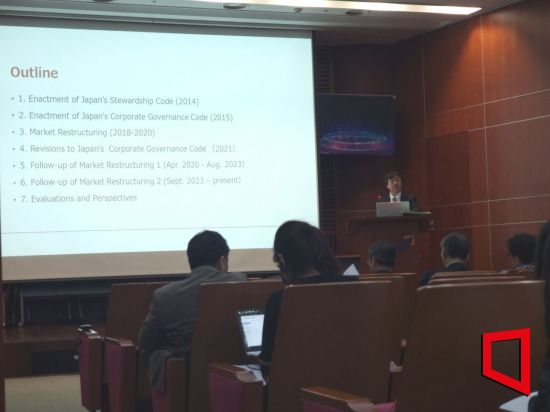 Professor Etsuro Kuronuma of Waseda University in Japan is giving a keynote presentation at the policy seminar titled "Characteristics of Japanese Capital Market Reform and Policy Implications," hosted by the Korea Capital Market Institute at the Yeouido Financial Investment Center on the afternoon of the 31st. Photo by Minyoung Cha
On the afternoon of the 31st, the Korea Capital Market Institute held a seminar at the Yeouido Financial Investment Center on the theme of "Characteristics of Japan's Capital Market Reform and Policy Implications."
Professor Etsuro Kuronuma of Waseda University in Japan, who gave the first keynote presentation that day, explained the major features and prospects of each reform by dividing the structural reform of Japan's capital market into the establishment of the Stewardship Code in 2014, the Corporate Governance Code in 2015, the restructuring process of the Tokyo Stock Exchange from 2018 to 2020, and the follow-up reform measures from 2022 to the present.
Professor Etsuro Kuronuma evaluated, "Market reforms have increased awareness of the importance of management through reducing capital costs and enhancing corporate value," and "dialogue with institutional investors has been activated, and the importance of dialogue on climate change response has been highlighted." He predicted that due to this market restructuring, delisting of companies and mergers and acquisitions (M&A) will also increase in the future.
The second keynote presentation was given by Hyo-seop Lee, Director of the Financial Industry Division at the Korea Capital Market Institute, who evaluated, "The success of Japan's capital market reform was due to various systems consistently promoted over a long period." For example, it was analyzed that complex factors such as long-term accommodative monetary policy, expanded fiscal policy, corporate governance reform, inflow of foreign funds, active participation of Japanese public pensions, and efforts by Japanese exchanges to enhance corporate value were effective. It was also analyzed that favorable macroeconomic environments such as the weak yen effect and the inflow of funds leaving China were intertwined.
In fact, in Japan, significant stock price returns were observed in companies that expanded shareholder returns, improved profitability, and enhanced growth potential. The higher the dividend yield, the greater the increase in return on equity (ROE), and the larger the increase in price-to-sales ratio (PSR), significant positive excess returns (+) were observed. Stock price increases appeared in companies that expanded shareholder returns, improved profitability, and enhanced growth potential.
Hyo-seop Lee, Director of the Financial Industry Division, emphasized, "Since companies that voluntarily disclosed 'corporate value enhancement plans' achieved significant excess returns compared to non-disclosing companies, it is important for Korean companies to increase the profitability and growth potential of listed companies through participation in establishing, disclosing, and implementing corporate value enhancement plans." Along with this, he also called for various policy supports such as governance reform, expanded participation of pension funds, and tax system improvements for Korea to succeed in value-up efforts.
Meanwhile, a panel discussion was held that day with Professor Jong-ho Kwon of Konkuk University Law School as the moderator. Panelists included Sang-beom Ko, Head of the Capital Market Division at the Financial Services Commission; Il-hoon Ko, Research Fellow at the Japan Securities Research Institute; Doo-nam Kim, Executive Director at Samsung Asset Management; Chun Kim, Head of the Korea Listed Companies Association; Jae-sook Yoon, Head of Corporate Value-Up Support Department at Korea Exchange; and Kwan-hwi Lee, Professor at Seoul National University Business School.
© The Asia Business Daily(www.asiae.co.kr). All rights reserved.
![Clutching a Stolen Dior Bag, Saying "I Hate Being Poor but Real"... The Grotesque Con of a "Human Knockoff" [Slate]](https://cwcontent.asiae.co.kr/asiaresize/183/2026021902243444107_1771435474.jpg)












