Small Business Pain Index... "Rising Since 2022"
Presented at Financial Services Commission's 'Support TF for Ordinary People and Self-Employed' Meeting
Self-Employed Share 25%... "Concentrated in Retail and Food Service"
Small business owners have been found to be struggling the most since the COVID-19 pandemic. Suggestions have been made that the government and local governments should introduce support measures for platform utilization or measures to prevent gentrification.
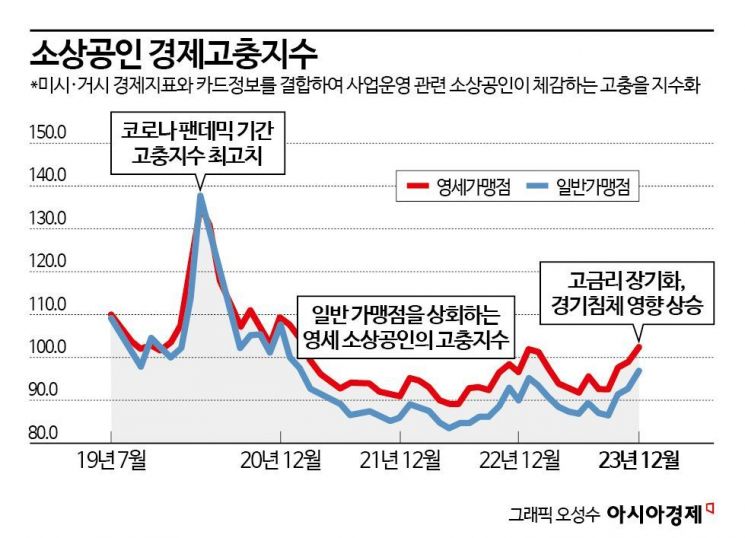
According to Shinhan Card's 'Small Business Economic Hardship Index' data obtained by Asia Economy on the 31st, as of the end of last year, the economic hardship index for micro small business owners and general small business owners was recorded at 102.4 and 96.7, respectively. The Shinhan Card Big Data Research Institute combined five micro and macroeconomic indicators and 15 card information items to quantify the perceived hardship of small business owners related to business operations into an index. This was presented as a PowerPoint (PPT) material during the first meeting of the Financial Services Commission's 'Task Force for Preparing Support Measures for Low-income and Self-employed' held on the 28th.

The Small Business Economic Hardship Index is recording its highest level since the COVID-19 pandemic. It surged to 140 in early 2020 and then declined to around the 90 level. Due to the prolonged high interest rates and economic recession, the economic hardship index began to rise again from 2022 and has recently remained around 100. However, it was found that micro small business owners experience more economic pain than general small business owners. Since the second year of the pandemic in 2021, the economic hardship index of micro small business owners has been about 5 points higher than that of general small business owners.
In reality, the business conditions of small business owners are worsening. According to the Shinhan Card Big Data Research Institute, as of the end of last year, micro small business owners accounted for 79% of all affiliated stores but only 8% of total sales. The card sales growth rate per transaction for micro small business owners last year compared to 2019 was only 2.3%, while other businesses increased by 31.7% during the same period. Additionally, the closure rate of micro small business owners was 5.9%, about twice as high as that of other businesses (3.4%).
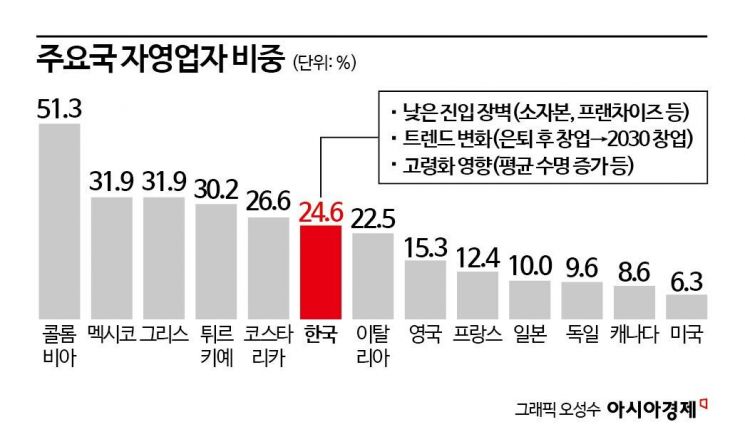
The background of the deteriorating business conditions includes oversupply due to saturation of self-employment. The proportion of self-employed in Korea is 24.6%, ranking 6th among OECD member countries. Especially, industries with low entry barriers such as retail, food service, and service industries were identified as oversupplied sectors. This is because the 2030 generation has appeared as 'young bosses,' and the aging population has increased the number of people aiming to start businesses after retirement.
They were also pushed out in competition with large companies. The number of franchise stores of comprehensive malls such as Daiso and Olive Young increased by 22% from 19,000 in 2019 to 23,000 last year. Sales surged by 94.5%, from 3.7 trillion won to 7.3 trillion won. During the same period, the retail and sales industries, which are major startup sectors for micro small business owners, stopped growing. The number of franchise stores last year was 660,000, slightly up from 640,000 in 2019, and sales increased by only 11%, from 3.5 trillion won in 2019 to 3.8 trillion won last year.
An Seong-hee, head of the Shinhan Card Big Data Research Institute, explained in the data, “Small business owners show significant differences in average sales and closure rates depending on whether they utilize platforms,” and added, “Support measures are needed to enhance their digital capabilities.” She also mentioned, “The number of franchise stores in traditional commercial districts has decreased due to gentrification.” Citing the gentrification prevention measures in Seongdong-gu, Seoul, she added, “Active intervention and efforts at the local government level, such as restricting entry of large corporations and franchises or signing rent stabilization agreements, will help form a unique locality (regional identity).”
A Shinhan Card official said, “Shinhan Card has participated in policy proposals and provided analysis data as part of its ESG (Environmental, Social, and Governance) projects,” and added, “As the number one credit card company, we have strengths in the big data field utilizing card data.”
© The Asia Business Daily(www.asiae.co.kr). All rights reserved.
![Clutching a Stolen Dior Bag, Saying "I Hate Being Poor but Real"... The Grotesque Con of a "Human Knockoff" [Slate]](https://cwcontent.asiae.co.kr/asiaresize/183/2026021902243444107_1771435474.jpg)












