Space Aviation Agency Announces Policy Directions at First National Space Committee
Exploration Beyond Moon: Mars, Deep Space, Asteroids
Second Space Center and Reusable Launch Vehicles Planned
Support for Private Sector Leadership... Launch Permits and Regulations Revised
A blueprint for the Space Aviation Administration to create the 'Miracle of the Universe,' a turning point in South Korea's growth, has been presented.
On the 30th, according to the Space Aviation Administration, the 1st National Space Committee was held in Sacheon, Gyeongnam, following the opening ceremony of the Space Aviation Administration. According to the enactment of the "Special Act on the Establishment and Operation of the Space Aviation Administration" and the revised "Space Development Promotion Act," the chairperson of the National Space Committee is the President.
The policy direction of the Space Aviation Administration reported by Commissioner Yoon Young-bin to the National Space Committee was prepared to comprehensively present the future policy and business directions of the Space Aviation Administration, the "space aviation control tower," select and promote core missions, and lead the rapid growth of the space aviation economy.
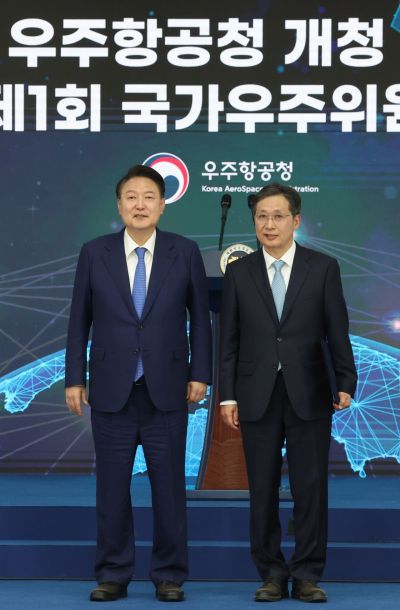 President Yoon Suk-yeol is taking a commemorative photo after presenting the appointment letter to Yoon Young-bin, the first Administrator of the Space and Aviation Administration, at the opening ceremony of the Space and Aviation Administration and the 1st National Space Committee held at the temporary office of the Space and Aviation Administration in Sacheon-si, Gyeongnam on the 30th. Photo by Presidential Office Press Photographers Group [Image source=Yonhap News]
The Space Aviation Administration, under the vision of "Challenge toward Space Aviation, Creating South Korea's Third Miracle," decided to pursue the policy of "Realizing the Top 5 Space Aviation Powers and National Key Industry." To this end, the Space Aviation Administration set goals in four major space aviation technology fields: ▲Entering the new space launch service market (space transportation) ▲Creating a satellite development and utilization ecosystem (artificial satellites) ▲Expanding space exploration beyond the Moon to Mars and deep space (space exploration) ▲Securing leadership in the new aviation industry (future aviation).
To enter the global launch service market, the administration plans to secure a launch vehicle portfolio through ▲development of next-generation launch vehicles ▲repeated launches and performance improvements of Nuriho ▲early acquisition of reusable launch vehicle technology, and establish an efficient and safe national launch management system through infrastructure development such as the second space center and launch site, as well as revision of launch permit systems. Considering that the existing Goheung Space Center was exclusively used by KARI, a center accessible to the private sector will be created, and private companies planning repeated launches will be allowed to conduct consecutive launches with a single permit.
To develop satellites for various purposes and create a private-led satellite information utilization ecosystem, the administration will pursue ▲development of advanced satellites with 15cm-class resolution and securing future satellite core technologies such as space optical communication and space internet ▲continuous development and operational system advancement of national satellites ▲establishment of the Korean Positioning System (KPS) infrastructure ▲creation of new industries and services through activation of satellite information utilization.
To secure independent deep space exploration capabilities beyond the current goal of lunar exploration, the administration will pursue ▲establishment and announcement of the "South Korea Space Exploration Roadmap" ▲development of lunar landers and securing lunar bases for observation and exploration ▲mission discovery for Mars exploration (orbiters, landers, etc.) ▲formulation of asteroid exploration promotion strategies.
The Space Aviation Administration plans to secure a lunar base by 2040, develop Mars landers and conduct exploration by 2045, and also consider exploration of the Apophis asteroid. It is known that resources will be intensively invested in exploring the Lagrange point (L4), which will serve as the "space control tower."
To secure leadership in the future aviation industry, the administration will pursue ▲development of hybrid future air mobility (Advanced Air Mobility, AAM), advanced aero-engines ▲expansion of civil-military cooperation and international joint development such as unmanned aircraft and military transport aircraft commercialization ▲securing core technologies for materials, parts, and equipment and technologies to respond to global environmental regulations to establish a global production base.
The Space Aviation Administration also plans to actively work on securing three major space foundations: full-scale creation of the space aviation economy, strengthening the national space aviation policy control tower function, and securing space aviation sovereignty and expanding influence.
Deputy Commissioner Roh Kyung-won of the Space Aviation Administration explained, "This vision embodies the ambition to realize the third 'Miracle of the Universe,' following the 'Miracle on the Han River' and the 'Miracle of Semiconductors,' based on past achievements of entering the world's top seven space powers by securing independent lunar explorers and space launch vehicles." Deputy Commissioner Roh added that efforts will be made to secure an annual budget of approximately 1.5 trillion won for these missions.
© The Asia Business Daily(www.asiae.co.kr). All rights reserved.

















