Eco-friendly Resource Recovery Facility Breaking the Prejudice of 'Garbage Incinerator = Nuisance Facility'
Unique Exterior and Roof Slope Featuring a Ski Slope Make It a Copenhagen Tourist Attraction
Amager Island is the most densely populated area in Denmark, consisting of a peninsula and numerous large and small islands. It boasts sophisticated architecture, various water sports, and beautiful beaches, making it one of Europe's representative vacation destinations. The capital, Copenhagen, spans the northern part of this island and the island of Zealand.
From the 26th, mayors belonging to the National Association of Large Cities, who are visiting Europe, visited 'Amager Bakke' located in the northern part of Amager Island on the 29th (local time). The visit included Lee Sang-il, mayor of Yongin and chairman of the association, Lee Dong-hwan, mayor of Goyang, Shin Sang-jin, mayor of Seongnam, Joo Kwang-deok, mayor of Namyangju, and Kim Byung-soo, mayor of Gimpo.
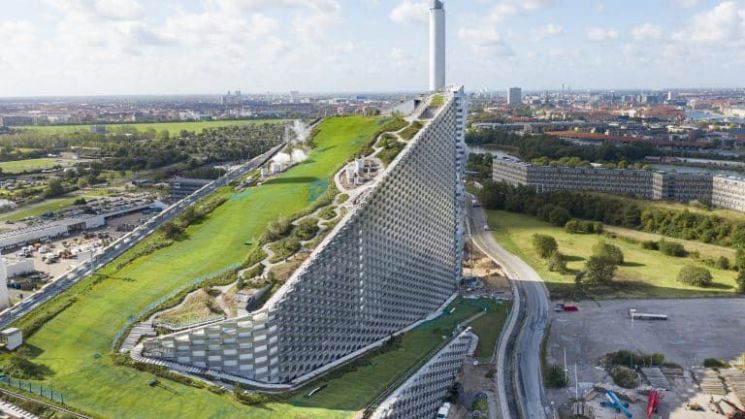 A view of Amager Bakke in Copenhagen, Denmark, a representative eco-friendly waste incineration facility. With its unique exterior and roof slope utilized as a ski slope, it has become a tourist attraction in Copenhagen.
 [Photo by Amager Bakke website]
Amager Bakke is a waste incineration plant known as a symbol of eco-friendly resource recovery facilities. Completed in 2017, this facility processes about 1,200 tons of waste daily from Copenhagen and four surrounding cities. The annual processing capacity reaches 600,000 tons.
Unlike in Korea, where such facilities are typically perceived as undesirable, Amager Bakke is recognized as a landmark of Copenhagen. It is also an essential course for Copenhagen tourism. In fact, the Danish royal family's Amalienborg Palace is located just 2 km from this facility. A residential complex with 458 households is also situated 200 meters away.
Next to the incineration plant is a power plant that generates electricity using the thermal energy produced during waste incineration. This power plant produces 285 GW of electricity annually. The generated electricity supplies 95,000 households in Copenhagen. The Amager Bakke incineration plant also provides district heating to 87,000 households in Copenhagen and the four surrounding cities.
This facility is famous not only for its eco-friendly incineration and resource recovery but also as a 'ski slope on the roof.' Inspired by the sloped roof of the incineration equipment, a ski slope was created in October 2019. Along with the ski slope, a park, walking trails, hiking trails, an observatory, and an artificial rock climbing wall were also established.
Ms. Ida Nielsen of Amager Bakke, who guided the mayoral delegation, explained, "Incineration can reduce pollution compared to landfill and also generate energy, making it an efficient waste treatment method." She added, "Amager Bakke processes waste using advanced incineration technology that emits no harmful substances. After undergoing both incineration and filtering processes, the steam emitted from the chimney has been verified to have better air quality than the outside air."
It is said that the popularity of the Amager Bakke incineration plant as a landmark building has even increased the property values of nearby apartment complexes.
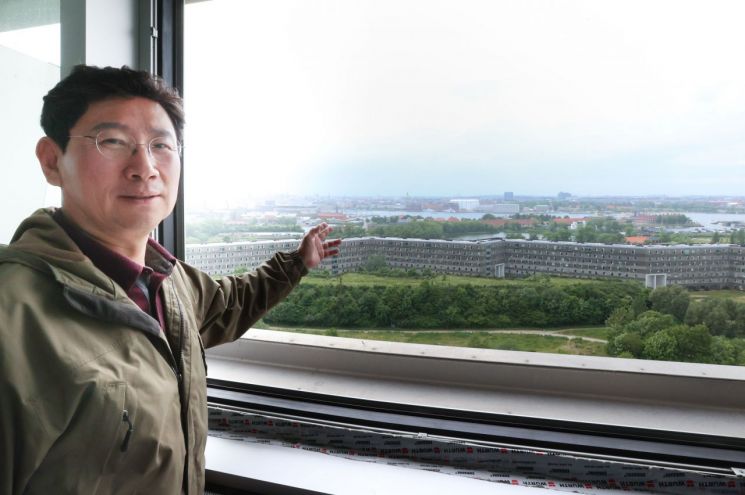 Lee Sang-il, President of the National Association of Large City Mayors (Mayor of Yongin), is pointing to an apartment complex located about 200 meters from Amager Bake.
 [Photo by Yongin City]
Lee Sang-il, mayor of Yongin, said, "Amager Bakke and the Spittelau waste incineration plant in the center of Vienna, Austria, have become urban landmarks by perfectly incinerating waste with advanced technology while featuring unique exteriors and sports facilities, rather than being undesirable facilities." He added, "I believe these two places can provide much inspiration to local governments in Korea."
The mayor said, "If incineration plants are designed to have perfect incineration capabilities while also incorporating other beneficial functions, the existing perception of incineration plants in Korea could change."
Meanwhile, before visiting Amager Bakke, the mayoral delegation visited State of Green, a non-profit organization implementing Denmark's green transition, to observe eco-friendly policies. State of Green was established by the Danish government in 2008 as a non-profit organization involving over 600 Danish companies, government agencies, academic institutions, experts, and researchers working together to respond to the climate crisis.
Gry Klimose Holm, senior project manager at the organization, stated, "Denmark has been making efforts for energy transition since the oil crisis in the 1970s." She added, "As a result, air pollution in Copenhagen has been reduced to one-fifth of the 1970 level, and pollution in the Copenhagen harbor has improved so much that citizens now enjoy swimming in the harbor's surrounding waters."
© The Asia Business Daily(www.asiae.co.kr). All rights reserved.

![A Woman with 50 Million Won Debt Clutches a Stolen Dior Bag and Jumps... A Monster Is Born [Slate]](https://cwcontent.asiae.co.kr/asiaresize/183/2026021902243444107_1771435474.jpg)
















