Heated Political Debate Over 'Abolition of Comprehensive Real Estate Tax'
Presidential Office Uncomfortable with 'Differentiated Support for Livelihood Recovery Fund'
Park Chan-dae, the floor leader of the Democratic Party of Korea, has reignited the debate over the abolition of the Comprehensive Real Estate Holding Tax (종합부동산세, 종부세) with the opening of the 22nd National Assembly. The core argument is the need to improve the current situation where excessive tax burdens are imposed on single homeowners who reside in their properties, rather than on speculative investors. Although the Democratic Party, which has emphasized maintaining the 종부세, tried to contain the situation by calling Park’s remarks a 'personal opinion,' the ruling People Power Party as well as opposition parties have joined the debate, expanding the scope of the discussion.
The background behind Park’s call for abolishing the 종부세 is complex. On the surface, it is argued that the increase in 종부세 rates and the actualization of publicly announced property prices during the Moon Jae-in administration have increased the tax burden even on single homeowners who live in their homes. However, there is an interpretation that this is a preliminary move to consolidate the centrist voter base. Analysts suggest that the Democratic Party is using this as an incentive to shed its 'anti-rich' image in preparation for the upcoming local elections and the next presidential election. The party is said to have pulled out the 종부세 abolition card to target the centrist voters who are sensitive to real estate as a means of asset accumulation.
There is also a legal basis. The 종부세 is a national tax implemented in 2005 during the Roh Moo-hyun administration to curb real estate speculation. Under current law, the tax is levied on the portion exceeding the basic deduction amount of 1.2 billion KRW for single homeowners with one house and 900 million KRW for others, based on the total publicly announced property price of houses held by an individual. However, the 종부세 has consistently been controversial due to its 'double taxation' overlap with property tax. Jin Sung-jun, chairman of the Democratic Party’s Policy Committee, stepped back amid the controversy, saying, "If there are unreasonable parts, they can be improved."
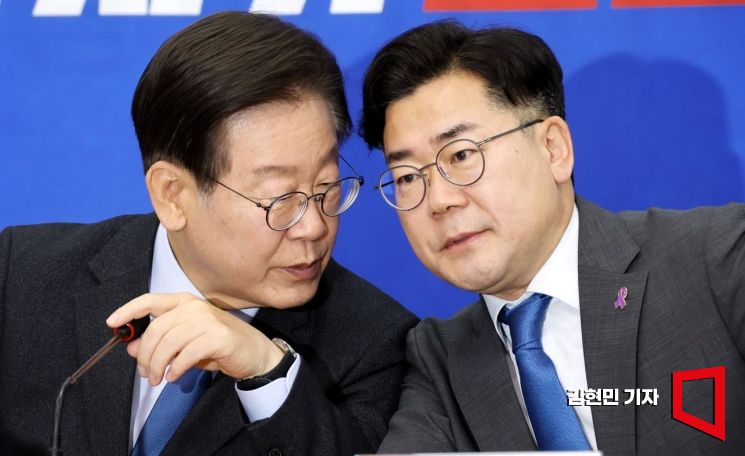 Lee Jae-myung, leader of the Democratic Party of Korea, is talking with Park Chan-dae, floor leader, at the Supreme Council meeting held at the National Assembly on the 29th. Photo by Kim Hyun-min kimhyun81@
The ruling People Power Party immediately welcomed the 종부세 abolition proposal initiated by the Democratic Party. They proposed a comprehensive reform of the real estate tax system within this year’s regular National Assembly session. Jeong Jeom-sik, chairman of the People Power Party’s Policy Committee, supported the Democratic Party by stating, "The number of people subject to the 종부세 on housing increased nearly threefold from 332,000 in 2017 to 931,000 in 2021." However, some political circles analyze that the People Power Party’s response to the 종부세 abolition is a way to divert the burden caused by the presidential office’s recent vetoes on the special prosecutor law for Chae Sang-byeong and pension reform.
The Justice Innovation Party immediately opposed the proposal. The party stated, "It is disappointing as it seems to side with the Yoon Seok-youl administration, which is entrenching asset inequality, rather than stopping it." They argued that it violates the principle of fair taxation and could fuel housing price increases. It is noteworthy that the Justice Innovation Party, which has aligned with the Democratic Party on policies such as the special prosecutor law for Chae Sang-byeong, publicly drew a line against the Democratic Party.
Meanwhile, the Democratic Party’s policy to provide a '250,000 KRW universal recovery support fund' is increasing the burden on the presidential office. On the 29th, Democratic Party leader Lee Jae-myung repeatedly requested a summit meeting with President Yoon, saying he would accept differentiated support. This marked a retreat from his previous stance of insisting on equal payment of the recovery support fund.
The presidential office showed clear discomfort at the sudden change in the opposition leader’s stance. A presidential office official said, "It appears that Lee is trying to lead policy by targeting voter sentiment and projecting a flexible image," adding, "It can only be interpreted as a strategic move that Lee, who has consistently demanded universal payment as a key election pledge, is now accepting differentiated support." By conceding to the ruling party on pension reform and the recovery support fund, it is seen as an intention to highlight the ruling party’s image as a 'people-centered political party.'
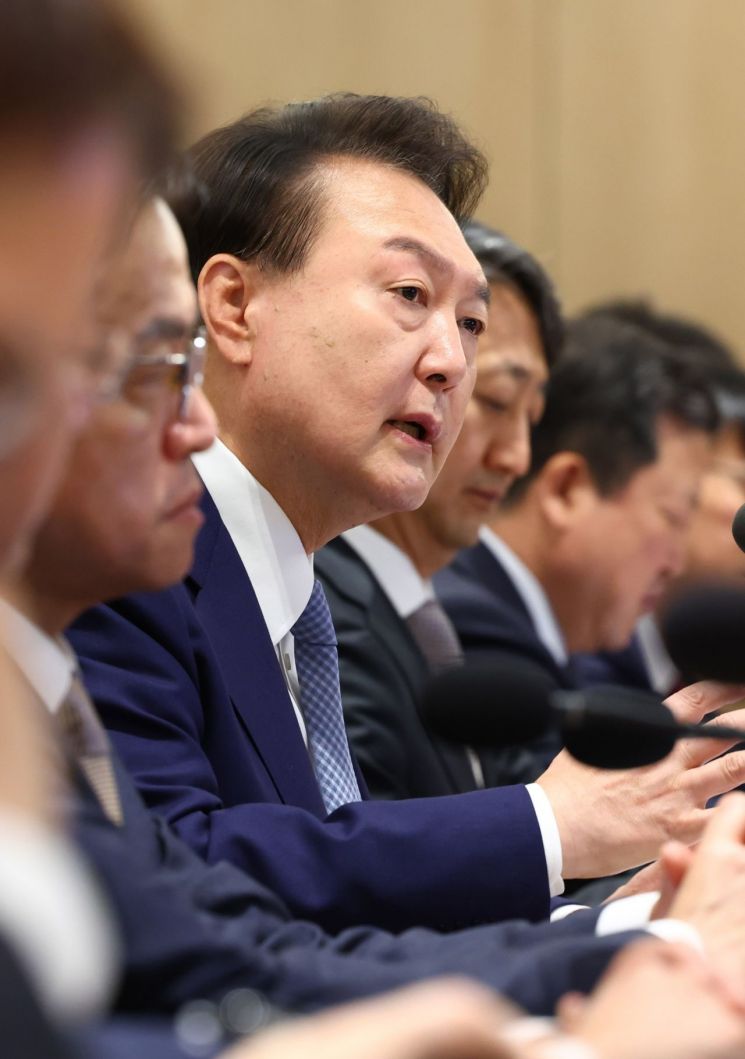 President Yoon Suk-yeol's Remarks at the Economic Issue Review Meeting
(Seoul=Yonhap News) Reporter Hong Hae-in = President Yoon Suk-yeol is speaking at the 2nd Economic Issue Review Meeting held at the Yongsan Presidential Office building in Seoul on the 23rd. 2024.5.23 [Photo by Presidential Office Press Photographers]
hihong@yna.co.kr
(End)
<Copyright(c) Yonhap News Agency, Unauthorized reproduction and redistribution, AI training and use prohibited>
On the same day, the Democratic Party held a party meeting in the afternoon and decided to adopt the 'Special Measures Act for Overcoming the Livelihood Crisis,' which centers on the payment of the recovery support fund, as the party’s top legislative agenda and plans to submit the bill. Jin Sung-jun, chairman of the Democratic Party’s Policy Committee, raised the pressure by saying, "Even though we have presented a flexible stance that differentiated payments are possible, the ruling party flatly rejected it," and added, "We will propose the Special Measures Act to overcome the livelihood crisis as the 'No. 1 livelihood bill' of the 22nd National Assembly." In response, Choo Kyung-ho, floor leader of the People Power Party, dismissed the proposal, saying their opposition remains unchanged.
To provide 250,000 KRW per person as the recovery support fund, an additional supplementary budget of 13 trillion KRW is required. However, as the government and ruling party oppose this, the Democratic Party hinted at proposing a special measures act using a dispositional law that bypasses executive branch execution. Regarding this, a presidential office official said, "We do not need to further fuel the fire that the opposition is stoking," adding, "There were opinions to use dispositional laws and to propose a supplementary budget, and we plan to respond accordingly." It was also reported that President Yoon’s stance remains unchanged despite Lee’s sudden proposal for a summit meeting. Given the ongoing high inflation, there are concerns that providing the recovery support fund could further destabilize prices and is viewed as a typical populist move.
© The Asia Business Daily(www.asiae.co.kr). All rights reserved.
![Clutching a Stolen Dior Bag, Saying "I Hate Being Poor but Real"... The Grotesque Con of a "Human Knockoff" [Slate]](https://cwcontent.asiae.co.kr/asiaresize/183/2026021902243444107_1771435474.jpg)

















