SK Hynix Holds Roundtable for New Executives
"Need to Strengthen Advanced Stacking Packaging Technology in Back-end Process"
"Importance of Quality Enhancement through Material Development"
New executives at SK Hynix unanimously agreed that strengthening customer relationships and global cooperation are crucial to maintaining technological superiority in the artificial intelligence (AI) memory market, including high-bandwidth memory (HBM).
On the 30th, SK Hynix announced that it held a roundtable discussion by inviting new executives to discuss the company’s AI memory competitiveness and future market trends.
The roundtable was attended by Vice Presidents Kwon Un-oh (HBM PI), Gil Deok-shin (Material Development), Kim Ki-tae (HBM S&M), Son Ho-young (Adv. PKG Development), Oh Hae-soon (NAND Advanced PI), Lee Dong-hoon (321-layer NAND PnR), and Lee Jae-yeon (Global RTC). The session was moderated by Vice President Won Jeong-ho (Global PR).
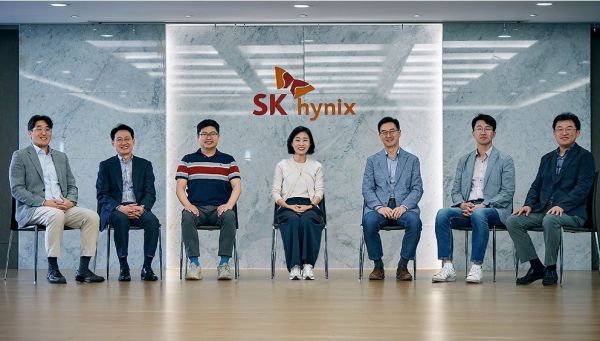 Executives from SK Hynix attending the roundtable. From the left: Kwon Eon-oh, Vice President (HBM PI); Kim Ki-tae, Vice President (HBM S&M); Lee Dong-hoon, Vice President (321-layer NAND PnR); Oh Hae-soon, Vice President (NAND Advanced PI); Gil Deok-shin, Vice President (Material Development); Son Ho-young, Vice President (Adv. PKG Development); Lee Jae-yeon, Vice President (Global RTC).
 [Photo by SK Hynix Newsroom]
As demand for high-performance semiconductors supporting AI training and inference continues to grow, the DRAM market size is expected to reach 117 trillion KRW this year, nearly a 65% increase compared to last year. It is forecasted that as AI application areas expand, demand for high-performance and high-capacity memory will continue to rise.
Vice President Kim Ki-tae emphasized the need for proactive response to future industry and technological changes, stating, "Even as AI services diversify, until the current von Neumann architecture (where logic semiconductors and memory are separated) computing structure continues, the top priority specifications required for memory will be speed and capacity." He added, "To maintain SK Hynix’s technological edge in AI memory, including HBM, it is essential not only to strengthen competitiveness in design, devices, and products in the front-end process but also to continuously enhance the advanced high-layer stacking packaging technology in the back-end process, where we currently hold a unique capability."
He further noted, "Looking at the current market situation, big tech customers are accelerating the launch of new products to secure leadership in the AI market. In response, we are already discussing plans through next year to timely supply next-generation HBM products and others."
Vice President Kwon Un-oh also stated, "The next-generation product, HBM4, will be the first to introduce logic semiconductor processes into memory. Implementing new processes will not only realize specifications beyond customer expectations but is also expected to create new opportunities through collaboration with related industries."
The executives also emphasized the importance of quality enhancement through material development, improving high-performance NAND technology for AI, and research and development of next-generation memory.
Vice President Gil Deok-shin explained, "We must closely monitor the emerging AI and semiconductor markets and create a development environment that can flexibly respond to rapidly changing situations. Through innovation in semiconductor materials, it is important to simplify processes, control defect rates, and improve UPH (units produced per hour on the line). In the increasingly important packaging field, developing materials that enhance yield and heat dissipation characteristics is crucial to strengthening product performance and quality."
Vice President Lee Dong-hoon said, "The ability to store exponentially increasing data in a limited space with minimal power consumption is becoming increasingly important. For this, high-capacity, low-power eSSD is essential, and it is necessary to secure the performance, quality, and reliability required to implement ultra-high-layer storage areas of over 300 layers in the NAND used."
© The Asia Business Daily(www.asiae.co.kr). All rights reserved.

















