The owner family of Hanmi Pharm Group, who have been engaged in a management dispute since the beginning of the year, have decided to 'unite' and resolve related issues. Since they need to immediately address funding problems exceeding 800 billion KRW, combining inheritance tax and stock-backed loans, it is interpreted that they have agreed to set aside conflicts for now and focus on solving the pressing issues.
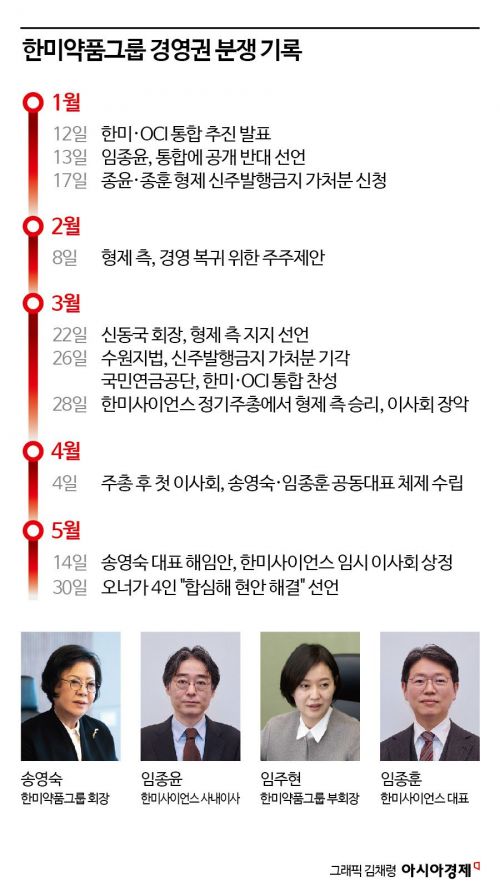
The four major shareholders of the founding family of Hanmi Pharm Group (▲ Song Young-sook, Chairwoman of Hanmi Pharm Group ▲ Lim Jong-yoon, Inside Director of Hanmi Science ▲ Lim Joo-hyun, Vice Chairman of Hanmi Pharm Group ▲ Lim Jong-hoon, CEO of Hanmi Science) announced on the 30th that they have decided to "unite and resolve the inheritance tax issues."
As a result, the management dispute that has continued since January, triggered by the announcement of integration with OCI Group by the mother-daughter duo Song Young-sook and Lim Joo-hyun, who controlled the group’s management at the time, to resolve inheritance tax and other issues, is expected to come to an end. This is the first time the four owners have publicly expressed a united intention.
Earlier, there was hope that the dispute would be resolved after the brothers Lim Jong-yoon and Lim Jong-hoon, who opposed the integration with OCI, won the regular shareholders' meeting in March with the support of Shin Dong-guk, Chairman of Hanyang Precision and the largest individual shareholder, along with minority shareholders. However, concerns about the dispute reigniting grew when CEO Lim Jong-hoon ended the joint CEO system of Hanmi Science with his mother, Chairwoman Song Young-sook, by dismissing her on the 14th. But with this public declaration of 'unity,' the possibility of renewed conflict is expected to subside again.
Since the death of the founder, the late Chairman Lim Sung-gi, in 2020, the owner family has been imposed with inheritance tax exceeding 500 billion KRW after inheriting his shares. About half of this was resolved by last year, and approximately 264.4 billion KRW remains. Due to this, there have been endless concerns about an 'overhang' possibility, where the owner family might sell shares to cover the remaining inheritance tax. However, they have so far utilized stock-backed loans. The total amount of stock-backed loans they have taken out to date amounts to 537.9 billion KRW.
Because of this, the Lim brothers have attempted to attract investment through partial share sales after taking control of the group’s management, but reportedly faced difficulties. The investment community has been cautious about investing, as the conflict between the brothers and the mother-daughter duo had not been resolved. Additionally, unless a majority share transfer that secures management rights or a share transfer based on the united intention of the owner family occurs, the risk of disputes recurring at any time has been identified as a major investment risk. However, since all owners have expressed their intention to unite and solve the issues, funding is expected to accelerate.
On the same day, Hanmi Science, the group’s holding company, also announced that it "plans to actively consider acquiring treasury shares and dividends to enhance shareholder value," which appears to be linked to this situation. Recently, Hanmi Science’s stock price has been continuously declining, raising concerns about a 'margin call' on the owner family. A margin call refers to a creditor’s demand for additional collateral or margin when the price of the collateral stock falls below a set threshold in stock-backed loans.
Hanmi Science’s stock price started this year at 39,200 KRW, surged to 56,200 KRW during the management dispute, but as of the previous day’s closing price, it has dropped to 30,700 KRW. It is known that many of the margin call prices for the stock-backed loans taken by the owner family are set in the low 30,000 KRW range. Since most of the collateral loans have already been pledged as collateral, doubts about additional funding have increased, and if a margin call occurs, there is a possibility of large-scale forced sales. Therefore, it is interpreted that they plan to actively boost the stock price to dispel margin call concerns.
© The Asia Business Daily(www.asiae.co.kr). All rights reserved.

![Clutching a Stolen Dior Bag, Saying "I Hate Being Poor but Real"... The Grotesque Con of a "Human Knockoff" [Slate]](https://cwcontent.asiae.co.kr/asiaresize/183/2026021902243444107_1771435474.jpg)















