A Total of 8 Agreements and MOUs Signed on the Occasion of the Korea-UAE Presidential Summit
South Korea and the United Arab Emirates have agreed to strengthen cooperation in the industrial, trade, and energy sectors, including joint entry into third-country nuclear power projects.
The Ministry of Trade, Industry and Energy announced that on the occasion of the summit between President Yoon Suk-yeol and UAE President Mohamed on the 29th, government agencies and companies in the energy and industrial sectors signed a total of eight agreements and memorandums of understanding (MOUs) with the UAE side.
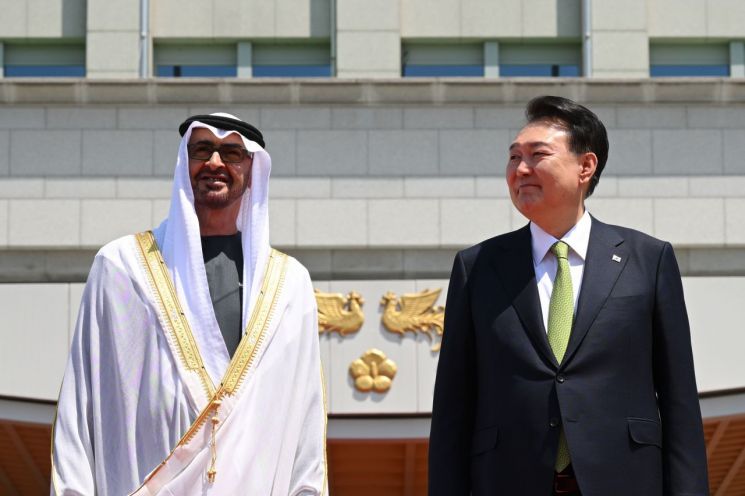 President Yoon Suk-yeol and President Mohammed bin Zayed Al Nahyan of the United Arab Emirates (UAE) are looking at the attendees, including members of the Ark Unit and a children's welcome group, during the official state visit welcome ceremony held on the lawn in front of the Yongsan Presidential Office building in Seoul on the 29th.
 [Image source=Yonhap News]
First, Minister Ahn, in the presence of both presidents, formally signed the Korea-UAE Comprehensive Economic Partnership Agreement (CEPA) with UAE Minister of State for Foreign Trade Thani bin Ahmed Al Zeyoudi. As a result, most of Korea’s major exports to the Middle East, such as weapons, will have tariffs eliminated immediately upon the agreement’s entry into force, which is expected to boost exports in response to the rapidly growing defense demand in the Middle East. Additionally, many machinery items such as rolling machines and metal casting machines will have tariffs removed within five years, and items like automobiles, parts, and home appliances (refrigerators, washing machines, air conditioners) will have tariffs eliminated within a maximum of ten years after the agreement takes effect.
Minister Ahn also signed an MOU on cooperation in Carbon Capture and Storage (CCS) with UAE Minister of Industry and Advanced Technology Sultan Al Jaber, linked to the production of clean hydrogen using liquefied natural gas (LNG). The two countries agreed to build a clean hydrogen supply chain and jointly respond to carbon reduction. This MOU is the first intergovernmental agreement on CCS cooperation, signed with consideration for cross-border carbon dioxide movement between government ministries to support smooth business progress by companies in both countries developing clean hydrogen production and CCS infrastructure. The government expects this MOU to contribute to securing overseas storage sites for domestically captured carbon dioxide and achieving the national greenhouse gas reduction target (NDC).
Korean companies have also established various cooperative relationships with UAE companies in the energy and industrial sectors, including the Emirates Nuclear Energy Corporation (ENEC) and Abu Dhabi National Oil Company (ADNOC).
In the energy sector, Korea Electric Power Corporation (KEPCO) signed an MOU with ENEC to cooperate on joint entry into third-country nuclear power projects. The two companies plan to form a joint task force to study emerging markets, develop business proposals, and combine efforts to enhance competitiveness and expand opportunities in the global nuclear power market.
A consortium of Korea National Oil Corporation (KNOC), Samsung E&A, and GS Energy signed a strategic agreement with ADNOC on the joint development of clean hydrogen production and import. This agreement concretizes the blue ammonia project in the Ruwais region of the UAE and covers mutual joint development and investment across the entire hydrogen value chain, including local blue ammonia production and import, domestic distribution infrastructure (such as receiving terminals), and CCS transportation. Both sides expect to establish a stable and economically viable overseas clean hydrogen supply chain through this cooperation.
KNOC and ADNOC also agreed to discuss expanding the scale of the international joint oil stockpiling project, which currently holds 4 million barrels. The two companies previously signed a joint crude oil stockpiling contract during President Yoon Suk-yeol’s visit to the UAE in January last year. Under this contract, ADNOC stores crude oil in KNOC’s idle storage facilities and sells it domestically and internationally, while Korea has the right of first refusal to purchase the entire contracted volume in case of domestic crude oil supply emergencies.
During this visit, ADNOC requested an increase in the contracted volume, and the two companies agreed to revise and extend their existing MOU to continue discussions on expanding the joint stockpiling project as well as broadening cooperation to include oil exploration, development, and enhanced recovery research and development (R&D).
In the industrial sector, Samsung Heavy Industries and Hanwha Ocean each signed a letter of intent with ADNOC for the construction of LNG carriers. If final contracts are concluded, domestic shipbuilders are expected to secure orders for six vessels worth approximately $1.5 billion. Hyosung plans to explore opportunities for cooperation in the petrochemical products and liquefied petroleum gas (LPG) sectors in Asia, based on a chemical plant in Vietnam, in partnership with ADNOC.
An official from the Ministry of Trade, Industry and Energy stated, "Building on the outcomes of President Yoon Suk-yeol’s visit to the UAE last year and President Mohamed’s visit to Korea this time, the government will thoroughly follow up by monitoring progress and resolving difficulties to ensure that Korea-UAE relations develop into a future-oriented cooperation across various fields such as nuclear power, carbon reduction, clean hydrogen, shipbuilding, and petrochemicals."
© The Asia Business Daily(www.asiae.co.kr). All rights reserved.
!["The Woman Who Threw Herself into the Water Clutching a Stolen Dior Bag"...A Grotesque Success Story That Shakes the Korean Psyche [Slate]](https://cwcontent.asiae.co.kr/asiaresize/183/2026021902243444107_1771435474.jpg)
















