Last Year's Average Monthly Spending on Convenience Foods Was 95,533 Won
'Too Troublesome and Annoying to Cook' Accounts for 22.1% of Purchases
'Brand, Label, Manufacturer' Are the Top Priorities When Buying
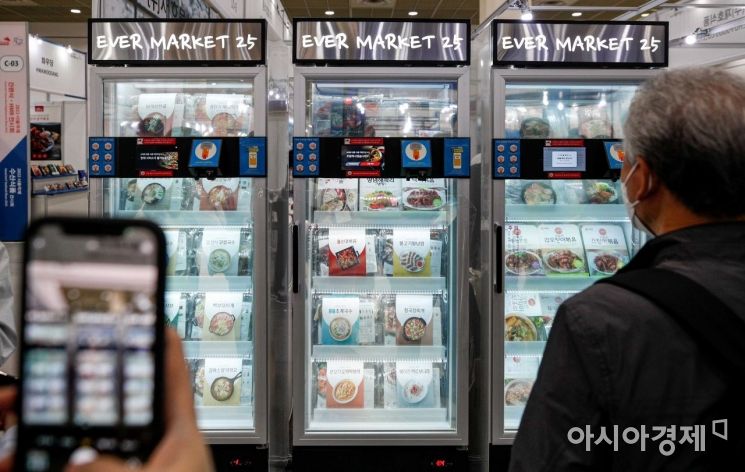
Last year, it was found that consumers in South Korea spent about 100,000 won per month on convenience foods. While the prevailing opinion remains that convenience foods are purchased to reduce cooking time and costs, there is a growing trend of choosing convenience foods to experience a variety of flavors as the taste and quality of convenience foods continue to improve.
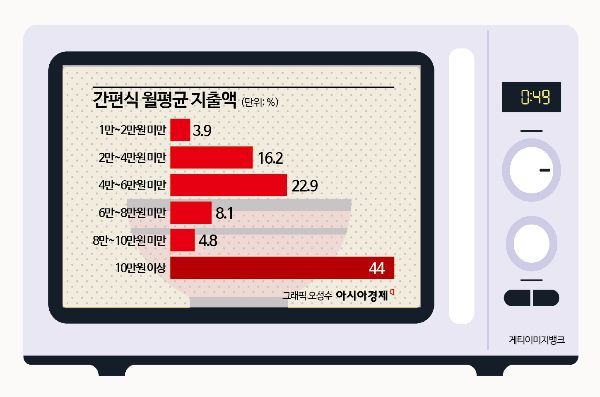
According to the '2023 Processed Food Consumer Attitude Survey' by the Korea Rural Economic Institute on the 30th, the average monthly expenditure on convenience foods last year was 95,533 won. Spending on convenience foods increased with household income, with households earning over 6 million won spending 110,248 won, nearly twice the 61,724 won spent by households earning less than 2 million won. By spending range, 44.0% of respondents spent over 100,000 won, the highest proportion, followed by 22.9% spending between 40,000 and 60,000 won, and 16.2% spending between 20,000 and 40,000 won.
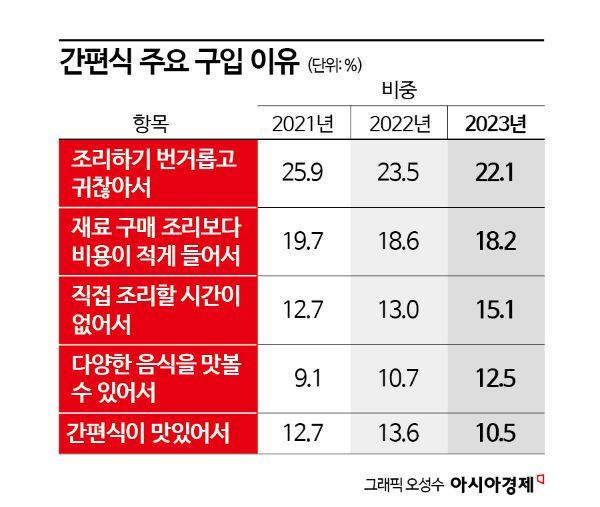
The most common reason for purchasing convenience foods was "because cooking is bothersome and annoying," accounting for 22.1% of respondents. This rate was particularly higher among single-person households (23.4%) and household heads in their 20s (24.8%) compared to the average. The second most common reason was "because it costs less than buying ingredients and cooking," at 18.2%, followed by "because there is no time to cook" (15.1%), "because I can taste various foods through convenience foods" (12.5%), and "because convenience foods are delicious" (10.5%), all showing double-digit response rates.
However, responses citing cooking being bothersome or the cost advantage over buying ingredients have slightly decreased each year. In contrast, reasons such as lack of time to cook, the opportunity to experience diverse foods, reducing food waste, and the convenience of storage and portability have increased, indicating a trend toward more diverse reasons for purchasing convenience foods among consumers.
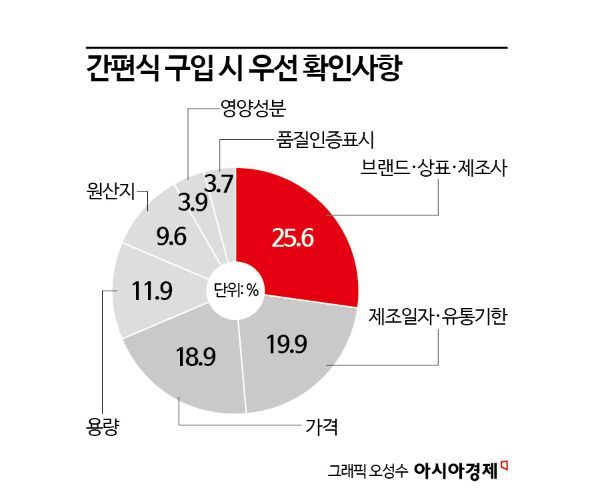
When purchasing convenience foods, the most important factor checked first was ‘brand, label, manufacturer,’ chosen by 25.6% of respondents. This was followed by ‘manufacture date and expiration date’ (19.9%), ‘price’ (18.9%), ‘quantity’ (11.9%), and ‘country of origin’ (9.6%). The proportion of respondents prioritizing brand, label, and manufacturer increased by 8.4 percentage points over two years, from 17.2% in 2021, reflecting accumulated experience with convenience food consumption and growing preference and trust in specific products. During the same period, those emphasizing manufacture and expiration dates increased by 5.8 percentage points, while those prioritizing price slightly decreased from 19.5% to 18.9%.
The most commonly purchased convenience food items were 'dumplings and pizza' at 24.8%, followed by 'instant rice' (22.0%), 'instant soups, stews, and hot pots' (16.2%), and 'instant tteokbokki and noodles' (7.0%). Preference for top-ranking items like dumplings and pizza increased by 4.3 percentage points over two years from 20.5% in 2021, while preference for items such as 'meat' (4.1%) and 'ready-to-eat meals' (4.1%) decreased by more than half during the same period.
Sixty-two percent of respondents said they purchase convenience foods for meals, indicating that two out of three people buy convenience foods for meal purposes. Outside of meals, snacks accounted for 33.3%, while convenience foods for drinking accompaniments and camping or travel accounted for 4.0% and 0.7%, respectively, representing relatively small proportions. Additionally, the purchasing frequency of convenience foods was generally high for 'once every two weeks,' regardless of the type of convenience food.
© The Asia Business Daily(www.asiae.co.kr). All rights reserved.



















