CJ Logistics Signs Final Delivery Contract with Local Company
CJ Logistics announced on the 29th that it has established a logistics cooperation network connecting South Korea with the United States and Japan. It is expected that so-called reverse direct purchasing, which allows overseas consumers to more easily buy Korean products, will become more active. Amid domestic public opinion being negative regarding direct purchase regulations, there are also voices saying that domestic e-commerce companies need to promote reverse direct purchasing in order to increase direct sales overseas.
The company has partnered with multiple leading local logistics companies in the U.S., including FedEx, as its delivery partners. When CJ Logistics sends goods to international airports in Los Angeles or New York via air forwarding, local logistics companies with last-mile delivery networks handle the delivery. In Japan, the top one and two local courier companies contracted with CJ Logistics transport reverse direct purchase products arriving at Tokyo Narita Airport and other locations to the final customers.
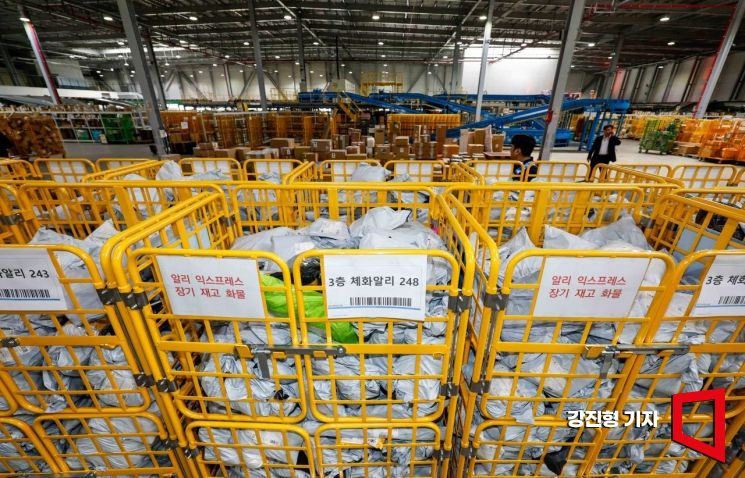 Long-term overseas delivery inventory shipments, including AliExpress, are piled up at the Incheon Airport Customs Express Logistics Center. Photo by Jinhyung Kang aymsdream@
Earlier, CJ Logistics signed a customs clearance and delivery service contract with Ninja Van last month to strengthen its reverse direct purchase logistics business in Southeast Asia. Similarly, when CJ Logistics sends products to Southeast Asian countries, Ninja Van handles customs clearance and delivery in six countries in the region, including Singapore, Malaysia, Indonesia, Vietnam, the Philippines, and Thailand.
By establishing logistics networks overseas in this way, the company explained that the logistics burden on client companies selling goods has been greatly reduced. Instead of each company having to find logistics companies to handle local customs clearance and delivery tasks overseas individually, CJ Logistics solves the entire process of delivering to the final consumer overseas at once. Also, as it is a collaboration among global logistics companies, it is expected to realize economies of scale and significantly reduce cost burdens compared to existing international express delivery.

As domestic e-commerce companies actively target overseas markets and Korean content has recently gained popularity worldwide, the reverse direct purchase market seeking Korean products is expected to be a growing sector. According to Statistics Korea, last year’s total online overseas direct sales amounted to 1.6561 trillion won. In the first quarter of this year, it approached 400 billion won, a 37% increase compared to the same period last year.
Jang Young-ho, head of CJ Logistics IFS Division, said, "We have laid the foundation for the reverse direct purchase logistics business as a new growth engine by establishing cooperative systems with local logistics companies in countries with high overseas direct purchase demand," adding, "We will lead the cross-border logistics market by building a dense overseas network."
© The Asia Business Daily(www.asiae.co.kr). All rights reserved.


















