Average Commute Time from Seoul to Capital Area is 59.4 Minutes
Development of Capital Area Mobility Data... Public Release
It was found that 71.35 million population movements occur daily on weekdays in the Seoul metropolitan area, including Seoul, Gyeonggi, and Incheon. Based on the movement data analysis, it takes an average of 59.4 minutes for citizens commuting from Seoul to the metropolitan area and an average of 71 minutes for those commuting from the metropolitan area to Seoul.
On the 28th, Seoul City announced that it has developed the 'Metropolitan Area Daily Mobility Data,' which can aggregate and analyze the movements of metropolitan area residents in 20-minute intervals by integrating real-time collected telecommunications and public big data. The city explained that developing and continuously releasing data covering regions such as Gyeonggi and Incheon is an unprecedented attempt worldwide.
The data being released this time was created through technical and infrastructure cooperation among Seoul City, Incheon City, Gyeonggi Province, Statistics Korea, KT, and three metropolitan research institutes. It includes various movement data such as commuting, school travel, shopping, tourism, and hospital visits. The city expects it to be used innovatively in policy development directly related to the quality of life and happiness of metropolitan residents, such as improving transportation convenience and residential conditions.
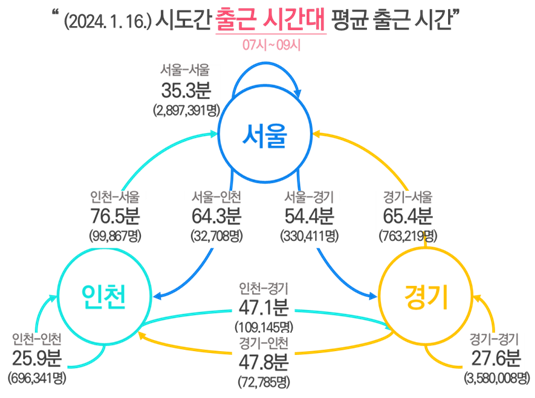 Average commuting time between cities and provinces according to the metropolitan area mobility data released by the Seoul Metropolitan Government on the 28th.
According to the Metropolitan Area Daily Mobility Data, movements with the metropolitan area as either the origin or destination amounted to 71.35 million per day on weekdays. Movements with Gyeonggi Province as the origin or destination accounted for 51% (36.2 million), more than half, followed by Seoul at 38% (27.3 million), Incheon at 10% (7.3 million), and others at 1% (550,000).
The longest average commuting time was from Incheon to Seoul at 76.5 minutes, while the shortest was from Incheon to Gyeonggi at 47.1 minutes. The average commuting time from Seoul to the metropolitan area was 59.4 minutes, whereas commuting from the metropolitan area to Seoul took an average of 71.0 minutes. Within the same region, commuting times were longest in Seoul at 35.3 minutes, followed by Gyeonggi at 27.6 minutes, and Incheon at 25.9 minutes.
Analyzing average travel times by purpose such as commuting, school travel, shopping, and hospital visits showed that Seoul residents can reach daily life-related points within an average of 37 minutes. It took 40 minutes in Gyeonggi and 41 minutes in Incheon. When converted to distance, Seoul citizens had a living area formed within an average radius of 6 km, while Gyeonggi and Incheon had 9 km.
Seoul City stated that it plans to actively utilize the Metropolitan Area Daily Mobility Data in policies directly related to citizens' quality of life, such as metropolitan urban planning, new town demand forecasting, urban development, transportation infrastructure, and bus route optimization. It will also be applied to administrative and living facility relocation and commercial district revitalization to accelerate the realization of a job-residence-leisure (職·住·樂) city. For example, analyzing the movement patterns and purposes of residents in the 1st and 2nd generation new towns using the data showed that most movements were to the nearest autonomous district, and it is expected that the 3rd generation new towns (Hanam Gyosan and Goyang Changneung) will show similar patterns.
The Metropolitan Area Daily Mobility Data is publicly available on the Seoul Open Data Plaza and is updated daily. Additionally, more detailed real-time aggregated data is also open at the 'Seoul Big Data Campus.' This data can be used for personal app development, housing and real estate projects, vehicle sharing and mobility business promotion, startups, and various research purposes.
Choi Jun-gi, Head of KT AI Business Division, said, "The Metropolitan Area Daily Mobility Data is an example of achievements created through public-private-academic cooperation," adding, "We hope the mobility data will be the cornerstone for realizing a safe and convenient smart city."
Park Jin-young, Seoul City's Digital Policy Officer, stated, "It is the city's responsibility to establish a negative regulation approach of 'principled openness, exceptional non-disclosure' for data utilization," and added, "We expect that public big data freely available to anyone will actively promote research, startups, and economic activities directly related to citizens' quality of life in the private sector and academia."
© The Asia Business Daily(www.asiae.co.kr). All rights reserved.

















