A technology that converts large amounts of greenhouse gases emitted during semiconductor and display production processes into clean air has been developed.
The Korea Institute of Energy Research (hereinafter Energy Research Institute) announced on the 28th that Dr. Shin-geun Lee and his research team at the Hydrogen Convergence Materials Research Laboratory have developed a catalyst that decomposes nitrous oxide (N2O) into nitrogen (N2) and oxygen (O2), the main components of air.
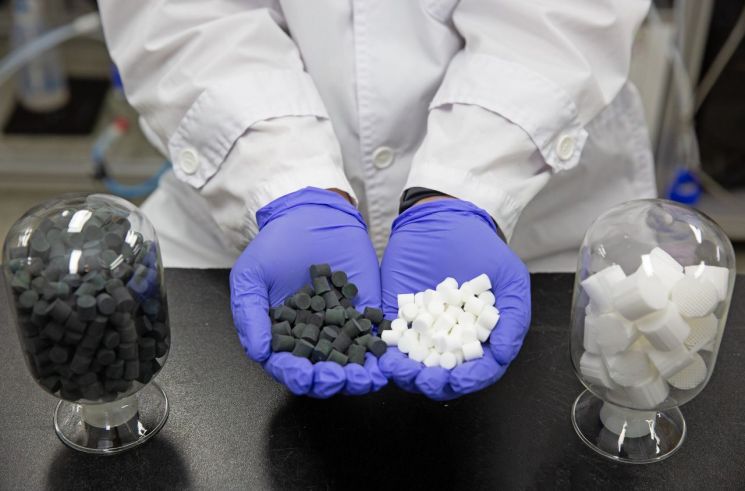 Catalyst Developed by the Research Team
 An alumina support manufactured by extrusion method (left) and an egg-shell type N2O decomposition catalyst coated with copper (right) are held in the hands of the research team. Photo by Korea Institute of Energy Research
Nitrous oxide is a colorless gas with a global warming potential more than 300 times that of carbon dioxide. It is also identified as a representative greenhouse gas that remains in the atmosphere for up to 120 years.
Its main uses include medical anesthetics, refrigerants, propellants, and semiconductor and display manufacturing processes. Among these, the semiconductor and display industries are key sectors accounting for 20% of South Korea’s total exports as of April this year, with continuous demand growth expected to sustain their expansion.
As industries such as semiconductors become more active, the use of nitrous oxide inevitably increases, which is why the need for developing eco-friendly processes for carbon neutrality has been consistently raised in the industrial sector.
In semiconductor and display production (deposition) processes, nitrous oxide is an essential element used for forming insulating films and cleaning, and it remains as residual gas or is generated through chemical reactions during the process.
Nitrous oxide can be decomposed by combustion, plasma, or catalytic decomposition. However, combustion methods generate greenhouse gases such as carbon dioxide and nitrogen oxides during decomposition. The plasma decomposition process has issues with nitrogen oxide generation and high power consumption.
On the other hand, catalytic decomposition can break down large amounts of emissions at low temperatures without producing nitrogen oxides, making it the most environmentally friendly decomposition method.
However, while catalytic decomposition has been used in processes such as nitric acid production, it has not been applied to semiconductor manufacturing processes. This is because technology capable of decomposing high concentrations of nitrous oxide up to 15% had not been developed.
This highlights the significance of the research team’s development of a catalyst that converts nitrous oxide generated in semiconductor and display processes into clean air.
The catalyst developed by the research team demonstrated excellent performance by decomposing nitrous oxide at various concentrations from 1% to 20% by more than 99%. Above all, the catalyst maintained its performance without degradation even after more than 500 hours of operation, securing long-term durability.
 (From the front row left, clockwise) Senior Researcher Shin-geun Lee, Senior Researcher Se-gi Byeon, Engineer Hyo-jung Hwang, Senior Engineer Doo-won Seo, and Student Researcher Eun-han Lee are posing for a commemorative photo. Provided by Korea Institute of Energy Research.
Another notable point is that copper was used as the catalyst instead of the expensive ruthenium, which has been conventionally used as a decomposition catalyst. Copper is cheaper than ruthenium and has excellent redox reaction properties.
Additionally, copper, thinly and evenly dispersed along the surface of the support, maximizes the surface area where nitrous oxide decomposition reactions occur. According to the research team, this prevents nitrous oxide adsorbed on the surface from quickly converting into nitrogen oxides by rapidly transforming it into nitrogen and oxygen.
To apply the developed catalyst to actual processes, the research team is currently continuing cooperation with catalyst decomposition system companies and expects to enter the commercialization stage as early as the second half of this year.
In fact, the catalyst’s interior uses an alumina support that is resistant to heat and mechanical stress while having a very simple manufacturing process, increasing the possibility of mass production. The support is manufactured through a simple extrusion process similar to making garaetteok (Korean rice cake), and a spray coating method in the form of mist was applied to allow the copper catalyst to spread thinly on the surface. The research team emphasized that even with such a simple process, it was possible to produce more than 30 kg of catalyst per day at the laboratory scale.
Dr. Shin-geun Lee introduced, “The catalyst developed by the research team can decompose nitrous oxide concentrations ranging from below 1% to over 20% emitted in semiconductor and display processes by more than 99%. Especially, its advantage lies in the high commercialization potential due to the possibility of mass production through a simple manufacturing process.”
© The Asia Business Daily(www.asiae.co.kr). All rights reserved.


















