Hyundai Construction announced on the 28th that it will form a mega consortium and officially begin research and development to create an 'electric vehicle-based power brokerage transaction ecosystem.'
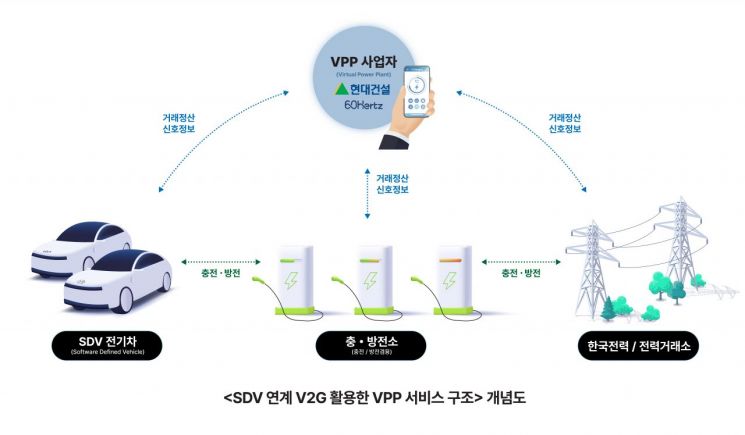 A schematic diagram of a virtual power plant (VPP) service utilizing a bidirectional charging and discharging platform technology (V2G) linked with software-defined vehicles (SDV).
 [Photo by Hyundai Construction]
Hyundai Construction was selected as the lead organization to carry out a research project under the 'Core Technology Development for Energy Demand Management' category in the '2024 1st Energy Technology Development Project Call' announced by the Korea Energy Technology Evaluation Institute. Accordingly, the company formed a consortium and signed a business agreement on the 22nd to develop a 'bidirectional charging and discharging platform technology (V2G) for electric vehicle demand resource utilization.' The consortium consists of a total of 15 domestic institutions, including Hyundai Motor Company and Kia, as well as businesses capable of providing electric vehicles and charging/discharging demonstration facilities.
The detailed research project proposed by the Hyundai Construction consortium is 'Establishing a large-scale electric vehicle demand resource utilization technology and service ecosystem using software-defined vehicle (SDV)-linked V2G technology.' The goal is to develop and commercialize technology that adds discharging functionality to electric vehicles, which are currently used only as transportation means through battery charging, thereby utilizing the electric vehicle battery itself as an energy storage system (ESS).
This demonstration research will involve approximately 38 billion KRW in R&D funding, including about 20 billion KRW in government subsidies and about 18 billion KRW in private sector contributions. As the largest-ever V2G technology research project, over 1,500 charging and discharging units will be installed over four years starting this year to conduct V2G demonstrations. V2G technology utilizing electric vehicle batteries is attracting attention as a sustainable technology that reduces consumption of limited energy resources and decreases carbon dioxide emissions.
In particular, it can partially replace ESS functions and overcome the limitations of renewable energy sources. Renewable energies such as solar and wind power are greatly affected by weather conditions, making stable power supply challenging. V2G technology can supply power in real-time to solve such problems. When power supply is insufficient, electric vehicle discharging responds to the load, and when surplus power occurs, it is offset by charging electric vehicles, thus managing power supply and demand. Additionally, electric vehicle users can reduce electricity bills and gain profits through V2G additional functions.
To implement such V2G technology, cooperation and technology exchange among many stakeholders are necessary, including electric vehicle manufacturers, charging and discharging-related businesses, power market operators like Korea Electric Power Corporation, virtual power plant (VPP) operators, and platform IT companies. Especially, it is essential to secure trust in electric vehicle battery performance and durability and to encourage electric vehicle owners’ participation in V2G by providing various incentives that actively promote connection to charging and discharging stations.
The Hyundai Construction consortium plans to implement V2G as a core software function of Hyundai Motor Group’s SDV, enabling electric vehicle owners to autonomously use the charging and discharging platform. They will also advance the battery charging and discharging scheduling algorithm and interconnect all platforms related to V2G to allow owners easy access to charging and discharging stations.
They will establish a standardized interoperable system to ensure the flow of electricity and safe transactions among Korea Electric Power Corporation’s distribution network, charging and discharging stations, and electric vehicle batteries. Since each electric vehicle has different driving patterns and usage rates, managing them as statistically aggregated power sources is necessary for V2G utilization.
A Hyundai Construction official stated, "V2G technology will not only become a key distributed energy resource in the VP business pursued by Hyundai Construction but also enhance the value of SDV pursued by Hyundai Motor Group. Ahead of the enforcement of the Distributed Energy Activation Special Act next month, we will lead the power brokerage transaction business by presenting various distributed energy business models utilizing V2G."
© The Asia Business Daily(www.asiae.co.kr). All rights reserved.
![Clutching a Stolen Dior Bag, Saying "I Hate Being Poor but Real"... The Grotesque Con of a "Human Knockoff" [Slate]](https://cwcontent.asiae.co.kr/asiaresize/183/2026021902243444107_1771435474.jpg)
















