페리지에어로 Signs MOU with Radio Research Institute Ahead of Next Month's Launch
Hanwha Aerospace Unveils Engine for Nuriho 4th Launch
Yoon Young-bin, Space Agency Chief, Emphasizes Support for Private Sector
With the establishment of the Space Aviation Agency and its declaration to support private sector participation in space development, movements among private space companies are also becoming active. Next month, a rocket developed by a Korean startup is scheduled to be launched, and the engine production for the Nuri rocket, which will be launched next year, is progressing smoothly.
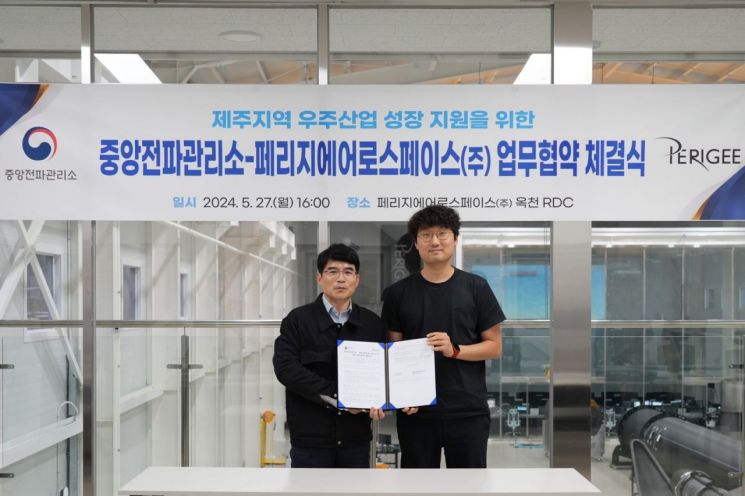 The Central Radio Management Office and Perezi Aerospace are signing a business agreement and taking a commemorative photo. Photo by Ministry of Science and ICT
Private space launch startup company Perigee Aerospace on the 27th signed a business agreement with the Central Radio Management Office under the Ministry of Science and ICT. This agreement is to support Perigee's rocket launch. Perigee plans to conduct a suborbital test launch of its self-developed small launch vehicle 'Blue Whale' over the sea near Jeju Island next month.
To support this, the Radio Management Office conducted a preliminary radio environment survey around the launch site and will also support smooth communication between the launch vehicle and the ground control center on the scheduled launch day.
The Radio Management Office explained that this agreement is meaningful as it promotes public-private cooperation for the development and launch services of small satellite launch vehicles by domestic startups in the era of 'New Space' led by the private sector, coinciding with the opening of the Space Aviation Agency.
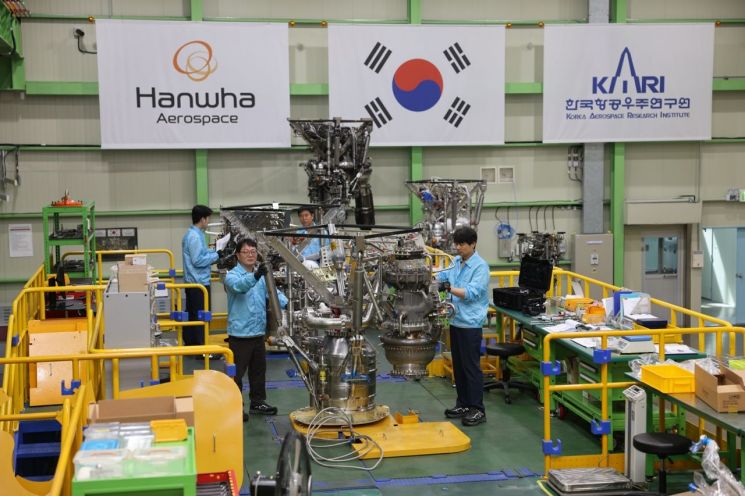 Engineers from Hanwha Aerospace, the system integrator for the Nuri rocket, are conducting final inspections on the 75-ton engine of the Nuri rocket No. 4, which is scheduled to launch in the second half of next year, at the Changwon 1 plant on the 27th. Hanwha Aerospace was recently selected as the system integrator for the 'Next-Generation Launch Vehicle' and plans to lead South Korea's 'New Space' era by developing new launch vehicles capable of launching large satellites and lunar landers by 2032. Photo by Hanwha Aerospace
Hanwha Aerospace, the system integrator for the Korean launch vehicle Nuri and developer of next-generation launch vehicles, also released photos on the 27th showing the final inspection of the 75-ton class engine for the 4th Nuri rocket, which will be launched in the second half of next year, at its Changwon 1 plant. The engines revealed this time will be used for next year's Nuri launch. Through the 4th launch, Nuri plans to deploy the main payload, the next-generation medium satellite 3, into its target orbit in the second half of 2025.
Hanwha Aerospace was recently selected as the system integrator for the 'next-generation launch vehicle' and will develop a new launch vehicle capable of launching large satellites and lunar landers by 2032.
Meanwhile, Yoon Young-bin, head of the Space Aviation Agency, emphasized on his first day at work that "the establishment of the Space Aviation Agency will be an important stepping stone to lead Korea into a full-fledged space economy powerhouse by creating a private sector-led space industry ecosystem."
© The Asia Business Daily(www.asiae.co.kr). All rights reserved.


















