Domestic Demand Slumps
Exports to Drive Growth
South Korea's Economic Growth Rate 2.7% This Year, 1.9% in 2025
Considering the inflation, growth, and exchange rate situation in South Korea, it is forecasted that there will be only one interest rate cut in the fourth quarter of this year.
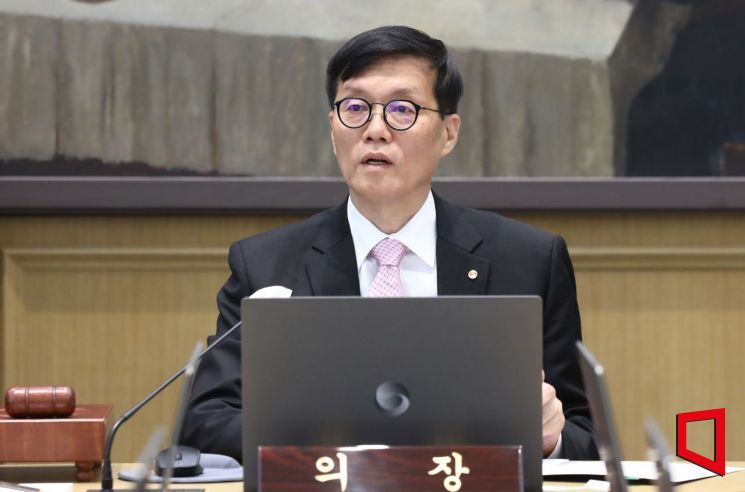 Lee Chang-yong, Governor of the Bank of Korea, is presiding over the Monetary Policy Direction Decision Meeting of the Monetary Policy Committee held on the 12th at the Bank of Korea in Jung-gu, Seoul. Photo by Joint Press Corps
Namgang Lee, a researcher at Korea Investment & Securities, stated in a report on the 28th, "South Korea's inflation is largely driven by supply-side factors," adding, "This situation requires the Monetary Policy Committee to pay close attention to the exchange rate when conducting monetary policy. Therefore, it will be difficult to implement a preemptive base interest rate cut ahead of the U.S. Federal Reserve (Fed)."
Accordingly, he predicted that the base interest rate would be cut once in the fourth quarter of this year and twice next year (once in the first half and once in the second half).
He projected that the South Korean economy will grow by 2.7% this year and 1.9% next year. Due to high levels of private debt and the longer-than-expected impact of U.S. monetary tightening, the domestic demand is expected to remain sluggish this year. However, exports centered on semiconductors, including artificial intelligence (AI), are expected to offset the weak domestic demand and drive South Korea's economic growth.
Researcher Lee said, "The main reason for revising the growth forecast this year is the first quarter real gross domestic product (GDP) growth rate (quarter-on-quarter 1.3%), which significantly exceeded expectations," adding, "Due to the higher-than-expected growth in the first quarter, the GDP gap turned positive in the first quarter, but the positive gap is expected to close in the second quarter due to weak domestic demand and a slowdown in the momentum of export recovery."
The sector supporting the weak domestic demand is semiconductors. Lee explained, "In particular, semiconductor exports, which have been recovering since last year, will make a significant contribution to growth this year as well," but added, "However, the momentum of export recovery is expected to slow somewhat." This is due to the base effect from the weak exports in early last year.
Although domestic demand is weak, the high contribution of supply to inflation raises concerns that if a base interest rate cut stimulates the exchange rate, inflation could rise again. This inflation environment is also why Monetary Policy Committee members must be cautious when deciding on the base interest rate.
Researcher Lee pointed out, "The inflation environment in South Korea is different from that of the U.S.," noting, "While U.S. inflation is driven by strong demand pressures, South Korean inflation is more influenced by supply factors than demand."
© The Asia Business Daily(www.asiae.co.kr). All rights reserved.

















