China's Encroachment on the Eco-Friendly Industry Sector
Electric Vehicles, Lithium Batteries, Solar Panels
Impact of Massive Subsidies and Low-Interest Loans
US and Europe Also Adopt Protectionist Policies Late
"Too Late to Catch Up," Some Respond
Surprised by China's rise as a powerhouse in key manufacturing sectors such as electric vehicles and batteries, the United States and Europe have belatedly shifted to protectionist policies to catch up with China’s 'green technology surge.' However, some argue that it is insufficient to catch up with Chinese industries that have long grown under massive subsidy benefits.
On the 27th (local time), The New York Times (NYT) reported, "The United States and Europe are recently providing massive subsidies to domestic companies in industries such as electric vehicles, batteries, and solar panels, which China has encroached upon, in an effort to block Chinese competitive products." Subsidies have been the driving force behind China’s industrial growth, and now the U.S. and Europe are taking this as a lesson in their industrial policies and showing similar moves.
For example, the U.S. approved the 2022 Inflation Reduction Act (IRA), aimed at countering China’s low-price offensive, and plans to pour subsidies into advanced products produced in the U.S. until 2032. The European Union (EU) on the same day finalized approval of the so-called 'European-style IRA,' the Net Zero Industry Act (NZIA), which allows member states to use revenues from the Emissions Trading System (ETS) to fund green industries.
The NYT stated, "However, since China’s dominance in the green industry today was not built overnight, it is expected to be difficult for the West to catch up with China."
China has built market dominance through decades of top-down corporate support, including government subsidies, low-cost leases, and low-interest loans from state-owned banks. There were also prior investments in industries that support green industries such as chemicals, steel, batteries, and electronics, along with infrastructure investments like railways, ports, and highways. According to the U.S. think tank, the Center for Strategic and International Studies, China’s industrial support from 2017 to 2019 amounted to 1.7% of its total Gross Domestic Product (GDP), which is more than twice the support ratio of other countries.
The NYT analyzed that the combination of these factors enabled China to establish a leading position through low-cost exports in core green industry sectors such as electric vehicles, solar cells, and lithium batteries.
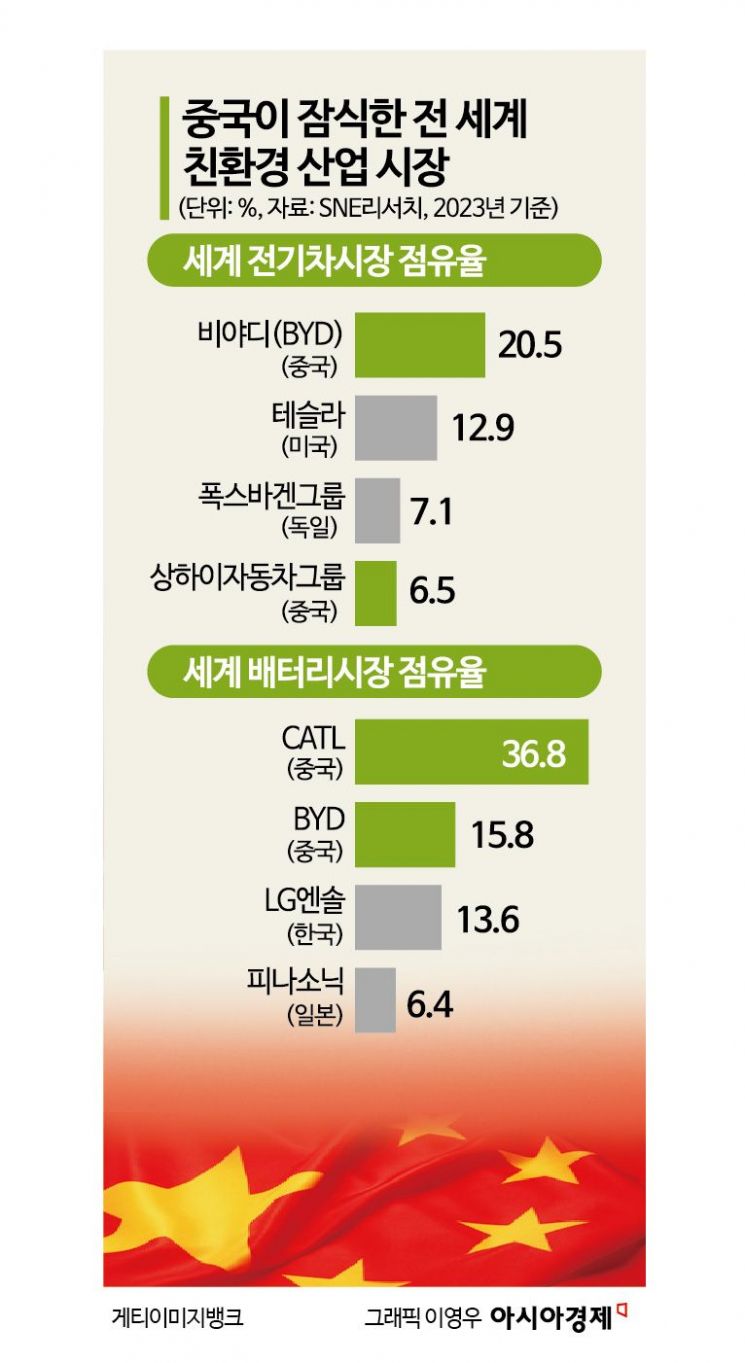
China’s success model became a major reason why the U.S. and Europe abandoned the idea of a 'small government,' which advocates minimal government intervention for efficient resource allocation. Jennifer Harris, former advisor to President Joe Biden, evaluated China’s dominance in major global manufacturing sectors as "a demonstration of the potential and power of national industrial policy."
However, the West still downplays this as a result of China circumventing international trade agreements, stealing intellectual property rights, and enforcing forced labor. Meanwhile, China claims that its low-price offensive has increased global product supply, eased inflationary pressures, and positively contributed to the world’s response to the climate crisis.
Experts view the delayed response by the U.S. and Europe to China’s low-price offensive as a sign of their own governments’ failures. Professor Zheng Yongnian of the Chinese University of Hong Kong said, "The West’s decision to pursue neoliberal economic policies was a strategic mistake that provided opportunities for China." Nobel laureate in economics Joseph Stiglitz of Columbia University said, "There has long been a lack of broad industrial policy and coordinated strategy in the U.S., and even the Democratic Party was reluctant to have the government take a more aggressive role, which was clearly a major mistake in terms of long-term outcomes."
© The Asia Business Daily(www.asiae.co.kr). All rights reserved.

















