Need to Expand Overseas Mine Shares and Strengthen Public-Private Cooperation
It has been revealed that the number of domestic and overseas key mineral mines in which Korean companies hold shares, as well as their attributable production volumes, are insufficient compared to major countries. In particular, it was argued that the import of key minerals for the 4th industrial revolution heavily depends on specific countries, which could pose supply chain risks in the future.
On the 28th, the Korea Economic Association announced this after analyzing data from Standard & Poor's (S&P) Global Market Intelligence.
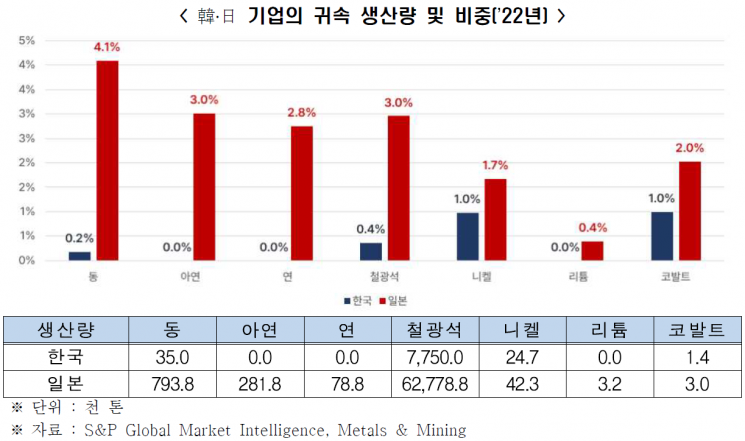
As of 2022, the number of key mineral mines such as copper, zinc, lead, iron ore, nickel, lithium, and cobalt in which Korean companies hold shares is 36. This is significantly lower than China (1,992) and the United States (1,976), which have abundant domestic resources, as well as Japan (134), which has a shortage of domestic resource deposits.
Consequently, as of 2022, the attributable production volume (total mine production × shareholding ratio) of Korean companies accounted for less than 1% of the global total for all seven key minerals. In contrast, Japanese companies accounted for 4.1% of copper, 3.0% of zinc, and 2.8% of lead production during the same period, showing higher production shares than Korea.
Looking at global production data by country, the world production of key minerals for the 4th industrial revolution?nickel, lithium, and cobalt?is concentrated in specific countries. Compared to last year’s global production, Indonesia accounted for 53.1% of nickel, Australia 46.9% of lithium, and the Democratic Republic of Congo 68.6% of cobalt.
Korea depends on specific countries for imports of key minerals for the 4th industrial revolution. The import share of 'nickel sulfate,' used in secondary batteries, is 68.2% from Finland, while the import share of 'lithium oxide and lithium hydroxide' from China reached 87.9%. The import share of 'cobalt oxide and cobalt hydroxide' from China was 72.8%.
The Korea Economic Association argued that since key minerals are linked to economic security, the shareholding in overseas mines should be increased from a national strategic perspective to ensure stable supply. They also advised strengthening public-private cooperation. Furthermore, they emphasized the need to enhance public-private collaboration to secure key minerals.
Lee Sang-ho, Head of the Economic and Industrial Division at the Korea Economic Association, said, "Securing key minerals requires massive initial investment by companies," adding, "It is necessary to strengthen policy finance programs related to private investment in overseas resource development and expand international cooperation networks with resource-exporting country governments." He continued, "There is a need for a comprehensive government support package, including the establishment of a public-private consortium as a control tower for resource acquisition."
© The Asia Business Daily(www.asiae.co.kr). All rights reserved.

![Clutching a Stolen Dior Bag, Saying "I Hate Being Poor but Real"... The Grotesque Con of a "Human Knockoff" [Slate]](https://cwcontent.asiae.co.kr/asiaresize/183/2026021902243444107_1771435474.jpg)














