Saramin Survey of 3,576 Workers
86.7% Respondents Positive About '4-Day Workweek'
Nine out of ten office workers have a positive view of the four-day workweek.
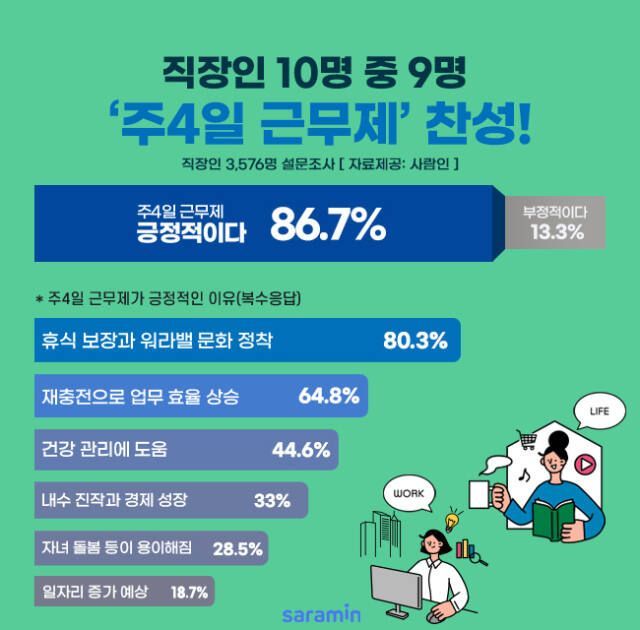
According to Career platform Saramin on the 27th, a survey of 3,576 office workers about their thoughts on the four-day workweek revealed that 86.7% of respondents answered "positive." By job position, the positive response rates were over 80% for assistant managers (91.2%), managers (88.7%), staff (88%), and department heads (82%). The executive level was lower at 65.3% compared to other positions.

The main reason for the positive view of the four-day workweek was "because the right to rest is guaranteed and work-life balance can be established," accounting for 80.3% (multiple responses). This was followed by "because recharging is expected to improve work efficiency" (64.8%), "because it seems helpful for health management" (44.6%), and "because increased holidays are expected to boost domestic demand and economic growth" (33%).
Among office workers who think positively about the four-day workweek, 60.6% said they would adopt it even if their wages were reduced. The average acceptable wage reduction was 7.7%. Specifically, 41.4% accepted a reduction of 5% or more but less than 10%, 33.8% accepted 1% or more but less than 5%, 15.9% accepted 10% or more but less than 15%, and 6.2% accepted 15% or more but less than 20%.
On the other hand, among those who answered negatively about the four-day workweek (476 people), the most common reason for opposition, cited by 52.5%, was "because wages are expected to be cut." This was followed by "because workload will not decrease but work intensity will increase" (48.1%), "because corporate competitiveness will deteriorate and growth will slow down" (36.1%), "because the sense of deprivation will increase for some industries that cannot implement it," "because work skills and productivity are expected to decline" (22.7%), and "because expenses are expected to increase" (17.6%).
Meanwhile, interest in the four-day workweek is heating up worldwide. Some companies in the United States have also introduced the four-day workweek. In February, US CNBC cited a report from the UK think tank Autonomy, stating that among 61 UK companies that participated in the 2022 "four-day workweek experiment," 54 companies (89%) maintained the policy, and 31 companies (51%) permanently switched to the four-day workweek.
In Asia, Singapore took the first step toward adopting the four-day workweek. Singapore announced employment guidelines starting this December that allow workers to apply for flexible work arrangements. The core is that workers can freely choose their commuting times, working hours, locations, and forms. In other words, adjusting daily work hours to work only four days a week is possible. This is known to be influenced by Singapore's labor market rigidity, aging workforce, and the increasing population needing caregiving roles.
© The Asia Business Daily(www.asiae.co.kr). All rights reserved.
![Clutching a Stolen Dior Bag, Saying "I Hate Being Poor but Real"... The Grotesque Con of a "Human Knockoff" [Slate]](https://cwcontent.asiae.co.kr/asiaresize/183/2026021902243444107_1771435474.jpg)

















