Industrial Research Institute Report
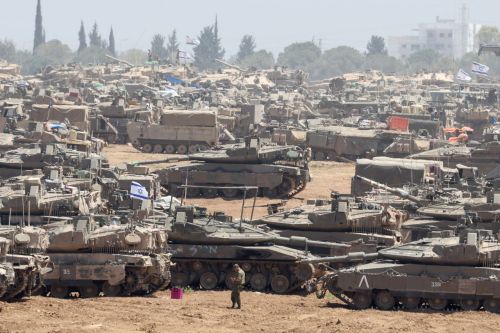 Israeli military tanks and armored vehicles are gathered near the Gaza Strip separation barrier in southern Israel. [Image source=Yonhap News]
As the war between Israel and Hamas prolongs, an analysis has emerged indicating that rising logistics costs and oil prices due to this conflict are adversely affecting domestic industries.
On the 27th, the Korea Institute for Industrial Economics and Trade (KIET) released a report titled "The Impact of the Israel-Hamas War on Our Industries," which stated that considering the current situation, the likelihood of the war escalating into a proxy war or involving Iran is low. However, there is a possibility of deterioration after the U.S. presidential election, necessitating long-term monitoring of the situation.
The report analyzed that unless the conflict expands, both countries hold a small share in South Korea's trade, so indirect effects such as increased logistics costs and oil prices have a greater impact than direct effects. The report particularly noted that industries such as refining, chemicals, road transportation, and air transport within manufacturing are experiencing high cost pressure, emphasizing that in the short term, enhanced monitoring, cost structure transformation, and utilization of stabilization funds are necessary, while in the long term, an industrial structural shift to mitigate vulnerability to oil price shocks is required.
According to the report, Israel and Palestine account for less than 0.28% of South Korea's trade as of 2023, which is very low. Although some items have a high import dependency on Israel, most can be diversified, indicating that supply chain risks are not significant.
However, logistics costs are indirectly soaring. The report explained, "Since October last year, Asia-Europe route freight rates have increased by 284%, and other major east-west route rates have more than doubled, causing logistics cost increases that negatively affect South Korea, which is highly dependent on exports and imports."
In the short term, it is necessary to prepare for supply disruptions and price increases, keeping in mind rising costs and extended transportation times, and in the long term, strategies should be developed to prepare for the possibility of conflict escalation.
The Israel-Hamas war is also driving up oil prices. The report projected that after the U.S. presidential election, intensified sanctions on Iran could increase upward pressure on oil prices. Although the possibility is low, if the conflict escalates and the Strait of Hormuz is blocked, oil prices could rise to around $150 per barrel.
The pressure of rising production costs due to oil prices is analyzed to surge in refining, chemicals, road transportation, and air transport sectors.
If the localized conflict between Israel and Hamas continues and oil prices rise to $97.5 per barrel, production costs are estimated to increase by 0.7% across all industries, 1.2% in manufacturing, and 0.32% in services. The increase in production costs is expected to be largest in petroleum products (11.0%), followed by chemical products (1.8%), transportation (1.3%), and non-metallic mineral products (0.8%).
KIET emphasized, "In the short term, the likelihood of escalation to full-scale war does not seem high, but since Israel's actions continue to diverge from those of the U.S., continuous observation of developments after the U.S. presidential election is necessary. In case of escalation, the situation could deteriorate rapidly, so it is important to review possible scenarios and prepare countermeasures for worst-case situations such as the blockade of the Strait of Hormuz."
© The Asia Business Daily(www.asiae.co.kr). All rights reserved.
![Clutching a Stolen Dior Bag, Saying "I Hate Being Poor but Real"... The Grotesque Con of a "Human Knockoff" [Slate]](https://cwcontent.asiae.co.kr/asiaresize/183/2026021902243444107_1771435474.jpg)
















