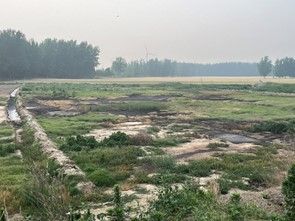
 Farmland damaged by salinization in Shandong Province, China. / Photo by GW Biotech
GW Biotech (CEO Yang Jaewon) announced on the 27th that it has signed a joint venture company establishment agreement with Zibo Ssangji Agricultural Development Co., Ltd. (CEO Woo Youngsun) in China to promote the "Saline Soil Reclamation Project" and has begun the process of establishing a corporation under the name Shandong Huahan Farm Biotech.
The two companies have agreed on joint investment and progress to provide technology for farmland improvement and plan to actively start the farmland restoration project for saline-affected lands in China. GW Biotech will contribute saline soil improvement technology and supply raw materials, while Zibo Ssangji Agricultural Development Co., Ltd. will be responsible for capital investment and the establishment of the joint venture company. GW Biotech plans to secure new sales through joint venture company equity profit dividends and revenue from supplying raw materials for saline soil improvement agents.
Founded in 2016, Zibo Ssangji Agricultural Development Co., Ltd. is located in Shandong Province and is an agricultural specialized company mainly engaged in the production and distribution of organic fertilizers and crop facility cultivation. Experiencing the damage caused by reduced production due to salinization, the company recognized GW Biotech’s saline soil improvement product technology and agreed to carry out the saline soil improvement project in China through a joint venture company.
Saline soil damage occurs when salts accumulate in the soil due to reasons such as excessive use of chemical fertilizers. It causes a decline in crop growth and a reduction in production. The saline soil improvement project to address this issue is part of the creation of high-quality farmland necessary to strengthen food security and is a key initiative promoted by the United Nations Food and Agriculture Organization (FAO) and countries worldwide. China already recognizes this related project as an essential solution to secure cultivation area and increase production.
Currently, saline soil in China is estimated to cover 236 billion pyeong as of November last year, which is 7.8 times the size of the country’s domestic territory. In particular, Shandong Province accounts for 6.9 billion pyeong, 37 times the size of Seoul, and the local government is providing annual subsidies of 50 yuan per 666.7㎡ (201.67 pyeong). This amounts to approximately 10.7 trillion Korean won.
Currently, physical methods such as crop rotation and soil mixing are being used as solutions to restore saline soil in China, but these are high-cost, low-efficiency methods that take a long time of 1 to 3 years. On the other hand, GW Biotech explains that its saline soil improvement agent VASA offers a physicochemical solution that can achieve results in a short period of 1 to 3 months with low cost and high efficiency.
The joint venture company plans to take charge of securing business sites in China, constructing facilities for saline soil improvement agents, and sales. The areas prioritized for saline soil improvement include about 700 million pyeong in Shandong Province, Ningxia Hui Autonomous Region, and Xinjiang Autonomous Region, which is 3.8 times the size of Seoul and 1.2 times the size of Jeju Island.
Woo Youngsun, CEO of Zibo Ssangji Agricultural Development Co., Ltd., said, "If the joint agricultural project between Korea and China proceeds successfully through this joint venture, it will not only respond to the food crisis by increasing agricultural production but also enable the consumption of healthy organic agricultural products."
Meanwhile, GW Biotech officially launched its Green Bio Business Division in February last year. Since June last year, it has begun applying its proprietary organic fertilizer and soil improvement technology developed locally in Shandong Province, China, to crops such as cucumber, tomato, and wheat, achieving crop growth results. It has also undergone saline removal tests and received recognition from local Chinese authorities for the excellence of its related technology.
© The Asia Business Daily(www.asiae.co.kr). All rights reserved.
![Clutching a Stolen Dior Bag, Saying "I Hate Being Poor but Real"... The Grotesque Con of a "Human Knockoff" [Slate]](https://cwcontent.asiae.co.kr/asiaresize/183/2026021902243444107_1771435474.jpg)















