Yoon Young-bin, the inaugural Administrator of the Korea AeroSpace Administration (KASA), made his first commute to the temporary office in Sacheon, Gyeongnam on the 27th, greeting employees and presiding over the morning assembly. Administrator Yoon began full-scale activities by handling urgent approvals such as staff recruitment.
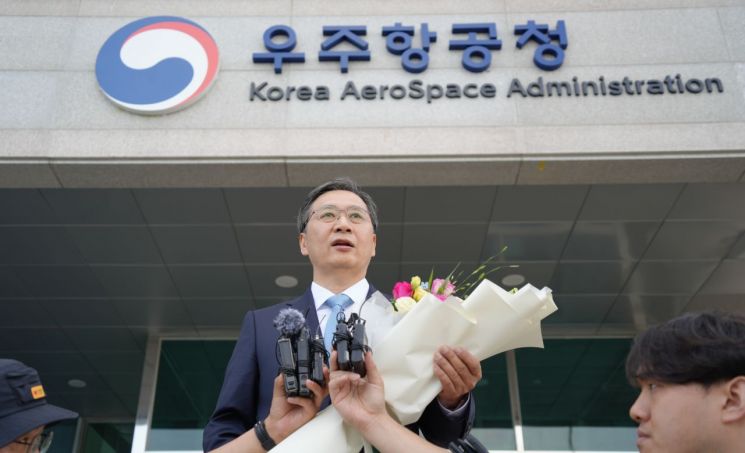 Yoon Hyung-bin, Administrator of the Space Aviation Agency, is speaking about his impressions on his first day at work on the 27th. Photo by Ministry of Science and ICT
The Korea AeroSpace Administration, formed by integrating scattered space-related organizations across the government, officially opened and started operations in Sacheon, Gyeongnam on this day. This establishes a foundation to nurture world-class space companies like SpaceX through Korea’s version of NASA.
Amid nationwide attention on the launch of KASA, Administrator Yoon, Deputy Director Noh Kyung-won, Director John Lee of the Space Mission Headquarters, and other executives and staff appeared tense but showed a resolute determination to secure Korea’s future growth engine. The Gyeongnam and Sacheon regions also welcomed the opening of KASA and expressed expectations for its contribution to regional development.
KASA was established under a special law passed by the National Assembly in January, aiming to become Korea’s NASA. It unified government organizations responsible for aerospace policy and projects that were previously scattered across the Ministry of Science and ICT and the Ministry of Trade, Industry and Energy. Its English abbreviation is KASA (Korea AeroSpace Administration).
KASA’s authorized personnel is 293, but only 110 employees participated in the launch. Civil servants and fixed-term public officials each make up about half. The civil servants had already conducted opening preparations in the form of business trips over the past weekend. KASA plans to treat this year as the inaugural year for organizational setup, issuing transfer notices to all ministries and accelerating civilian recruitment to fill the workforce by the end of the year. Currently, a demand survey for candidates, including director-level personnel, is underway for recruitment.
KASA consists of three bureaus: the Planning and Coordination Office, the Aerospace Policy Bureau, and the Aerospace Industry Bureau. Under the Mission Headquarters Director, there are four divisions: Space Transportation, Satellite, Space Science Exploration, and Aviation Innovation, totaling seven bureaus and 27 divisions. These mission headquarters oversee programs such as reusable launch vehicles, the Korean satellite navigation system (GPS), lunar lander programs, and future aircraft programs.
While KASA formulates policies, actual space research and development is expected to be handled by the Korea Aerospace Research Institute and the Korea Astronomy and Space Science Institute, which are being transferred from the National Research Council of Science & Technology (NST) to KASA. In this process, it is necessary to redefine the roles between the two research institutes and clarify their relationship with KASA. The appointment of successors for the directors of both institutes also needs to be expedited.
As countries worldwide focus on fostering the private space industry, KASA must actively promote cooperation and support for private companies. Cultivating private space companies like SpaceX is a core mission of KASA, launched in the 'New Space' era.
Kim Min-seok, Vice Chairman of the Korea Aerospace Industries Association, said, "Until now, the government has led the space industry, but we need to consider various support measures to enable the private sector to engage in the space industry."
© The Asia Business Daily(www.asiae.co.kr). All rights reserved.

![Clutching a Stolen Dior Bag, Saying "I Hate Being Poor but Real"... The Grotesque Con of a "Human Knockoff" [Slate]](https://cwcontent.asiae.co.kr/asiaresize/183/2026021902243444107_1771435474.jpg)















