Chairman Ryu Jin Sends Letter to MSCI Chairman and Executives
"Large Scale and High Liquidity of Securities Market" Emphasized
Improved Market Accessibility and Addressed Issues
"Sufficient Justification for Inclusion as a Watchlist Country"
The Korea Economic Organization Association (HanKyungHyup) announced on the 27th that it has requested Morgan Stanley Capital International (MSCI) to include South Korea in the 'watchlist' for an upgrade to developed market status.
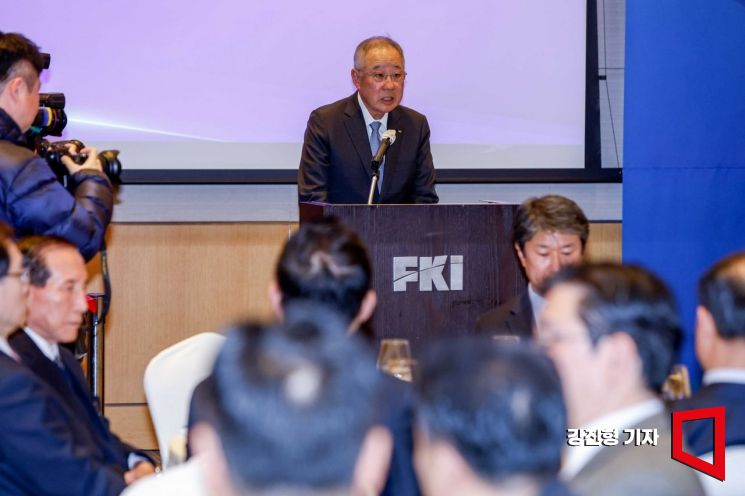 Ryu Jin, Chairman of the Korea Economic Association, is giving a greeting speech at the '63rd Regular General Meeting' held at the Korea Economic Association in Yeouido, Seoul on February 16. Photo by Kang Jin-hyung aymsdream@
Ryu Jin, chairman of HanKyungHyup, recently sent letters explaining the necessity of South Korea's upgrade to Henry Fernandez, MSCI chairman, key executives, and analysts who conduct corporate evaluations and analyses for MSCI.
MSCI classifies major global stock markets annually into developed markets, emerging markets, frontier markets, and standalone markets. The classification criteria are used to determine the scale of investment funds by global institutional investors, influencing the flow of capital in countries. South Korea has been included in the emerging markets category. Although it was listed as a watchlist country for developed market upgrade in 2008, it was dropped midway and was excluded from the watchlist in 2014.
HanKyungHyup emphasized to MSCI that South Korea possesses securities market size and liquidity at the level of developed markets. According to the World Federation of Exchanges (WFE), the Korea Exchange, South Korea's securities market, had a trading volume of $3.6 trillion last year, ranking 7th globally, and a market capitalization of $2 trillion, ranking 14th worldwide. HanKyungHyup's analysis states that the size and liquidity of the stock market significantly exceed those of countries currently classified as developed markets by MSCI, such as Spain, Singapore, and Austria.
Additionally, HanKyungHyup explained that the government has actively taken measures to improve market accessibility issues that MSCI had pointed out in the past. Previously, MSCI criticized that procedures for foreign investors to trade in the Korean market were cumbersome, and that access to corporate information and predictability of dividend amounts were low.
HanKyungHyup stated that the government abolished the pre-registration system for foreign investors in December last year and relaxed the screening system for foreign over-the-counter transactions, thereby enhancing the convenience of securities trading for foreign investors. It also added that from January this year, the mandatory phased implementation of English disclosures by Korean companies is underway, and efforts to improve dividend procedures are in progress.
Regarding MSCI's criticism of the 'absence of an offshore foreign exchange market,' HanKyungHyup explained that from the second half of this year, the foreign exchange market closing time will be extended to match the London financial market closing time, and that not only domestic financial institutions but also authorized foreign financial institutions will be able to directly participate in the Korean foreign exchange market, thereby expanding the openness of the foreign exchange market.
Furthermore, HanKyungHyup added that Korea's government-led 'corporate value enhancement' (value-up) program should be positively reflected when evaluating eligibility for watchlist inclusion.
Since 2021, HanKyungHyup has conveyed domestic economic opinions to MSCI three times, requesting the review of South Korea's upgrade to developed market status and inclusion in the watchlist. Lee Sang-ho, head of the Economic and Industrial Headquarters at HanKyungHyup, said, "We have implemented numerous policies to resolve market accessibility issues pointed out by MSCI and have actively promoted capital market structural improvements through corporate value enhancement. The justification for including South Korea in the watchlist is higher than ever before."
© The Asia Business Daily(www.asiae.co.kr). All rights reserved.

















