"Whether Permanent Paralysis Occurs Needs to Be Monitored"
A significant number of passengers on a Singapore Airlines flight that made an emergency landing in Bangkok, Thailand, after encountering severe turbulence during the flight reportedly suffered unusual injuries for turbulence-related incidents, including damage to the skull, brain, and spine.
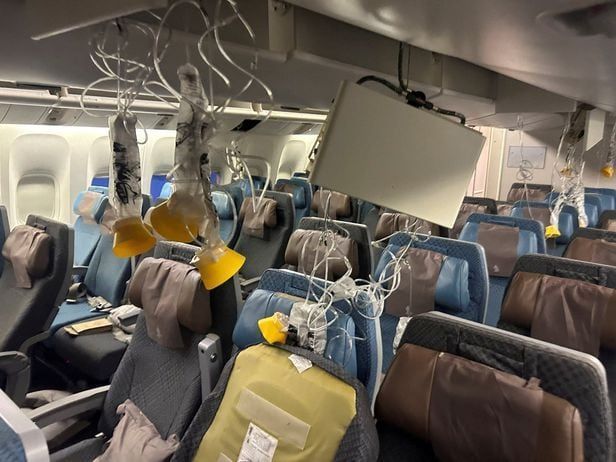 Interior view of Singapore Airlines flight SQ321 making an emergency landing at Suvarnabhumi International Airport in Bangkok, Thailand due to turbulence. Oxygen masks are hanging down.
 [Image source=Reuters Yonhap News]
On the 23rd (local time), the British daily The Guardian reported that Adinun Kittira Thanapaibul, director of Samitivej Hospital in Bangkok, where the injured were treated, stated, "Six passengers are receiving treatment for skull and brain injuries, and 22 passengers have spinal injuries." He also said, "There are 13 cases of musculoskeletal injuries, and this is the first time we have treated patients with this type of injury caused by turbulence."
Director Adinun said that among the passengers transferred to the hospital, 17 have already undergone surgery, and nine of them had spinal injuries. He added, "The ages of the injured range from 2 to 83 years old. It is too early to predict whether critically injured patients will suffer permanent paralysis or other sequelae. Medical staff will closely monitor muscle function recovery after surgery."
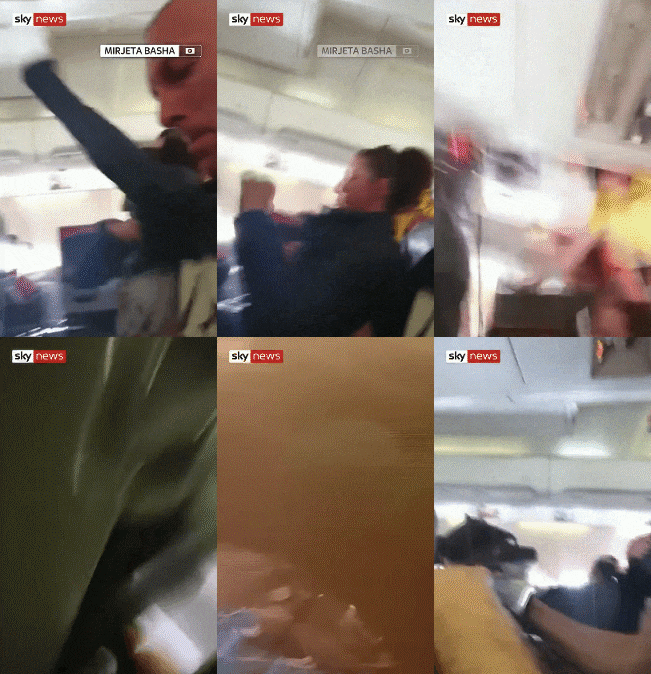 The scene of Singapore Airlines flight SQ321 making an emergency landing at Suvarnabhumi International Airport in Bangkok, Thailand due to turbulence. [Image source=Sky News]
On the 21st, Singapore Airlines flight SQ321, carrying 211 passengers and 18 crew members from London to Singapore, encountered turbulence over Myanmar airspace, causing a rapid descent of 1,800 meters within about three minutes, followed by an emergency landing in Bangkok, Thailand. The incident reportedly resulted in the death of a 73-year-old British man with underlying cardiovascular disease and injuries to 104 others. On the morning of the 22nd, the day after the accident, Singapore Airlines sent a special flight to Bangkok to transport 131 passengers and 12 crew members who were uninjured or had minor injuries to their original destination, Singapore Changi International Airport.
Subsequently, Singapore Airlines decided to strengthen in-flight safety regulations regarding seatbelt use. When the seatbelt sign is turned on, in-flight meal services will be suspended. If the seatbelt sign is activated due to turbulence or other reasons, crew members must stop serving all drinks and food and remain seated with their seatbelts fastened. Previously, when turbulence occurred, passengers were advised to fasten their seatbelts, and only hot beverages such as coffee were discontinued. A Singapore Airlines spokesperson said, "Passenger and crew safety is our top priority, so we will continue to review related regulations."
Meanwhile, as Singaporean authorities have launched an investigation into the circumstances and causes of the accident, experts are analyzing that the frequency and intensity of turbulence have increased compared to the past due to global warming and climate change. Foreign media have urged that to reduce the risk of injury from turbulence, passengers should always keep their seatbelts fastened while seated.
© The Asia Business Daily(www.asiae.co.kr). All rights reserved.
![A Woman Who Jumps Holding a Stolen Dior Bag... The Mind-Shaking, Bizarre Con of a "Human Knockoff" [Slate]](https://cwcontent.asiae.co.kr/asiaresize/183/2026021902243444107_1771435474.jpg)
















