South Korea's Total Fertility Rate 0.72... Approaching 0.6
6 out of 10 Youth Say "No Child Plans"
Economic Reasons Hinder Childbirth Plans
"Cannot Invest in Children Due to Low Income"
Last year, South Korea's total fertility rate was tentatively estimated at 0.72, highlighting the growing seriousness of the low birthrate issue. Meanwhile, a survey found that 6 out of 10 young people have no plans to have children, indicating that the low birthrate problem is expected to worsen.
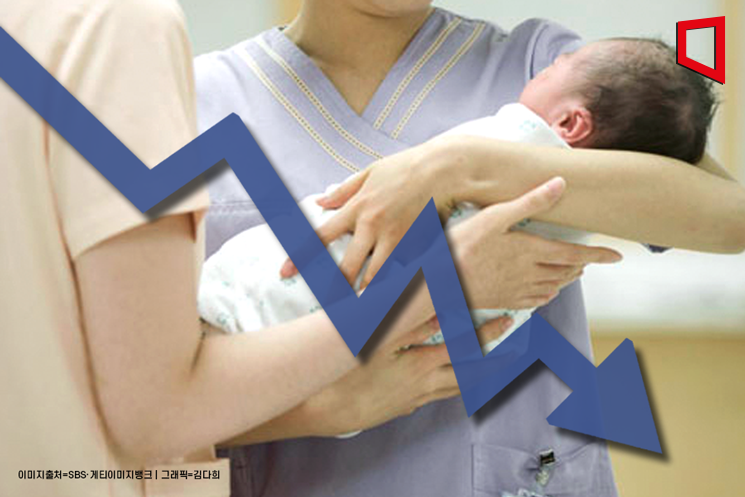
On the 24th, data consulting firm PMI announced the results of a survey on the low birthrate issue conducted among 3,000 men and women nationwide aged 18 and older.
Among 1,800 people in their 20s to 40s, who hold the key to solving the low birthrate problem, 36.6% answered that they have plans to have children, while 63.4% said they do not. The biggest reason for not planning to have children was economic issues. According to the responses, the reasons ranked as follows: ▲economic instability (25.2%) ▲burden of childcare and education costs (21.4%) ▲passing the age for childbirth (12.5%) ▲changes in values (11.3%) ▲comfort of childless life (8.8%) ▲lack of time for childcare due to busy life (8.8%) ▲infertility or other reasons for not having children (6.1%) ▲dissatisfaction with care facilities and services (3.8%) ▲others (2.1%).
Additionally, when 1,518 respondents who currently have children were asked about 'decision-making related to childbirth,' 80.2% said they would decide together with their spouse. This was followed by answers of ▲deciding by oneself (15.1%) ▲deciding by spouse (4.7%). When deciding the number of children, 80.3% said they decide after consulting with their spouse.
A woman in her 20s, Ms. A, who is attending a university in Seoul, commented on these results, saying, "None of my university classmates want to have children either," and explained, "Nowadays, retaking exams is common, and it is difficult to find a job, so by the time you finally settle down, you are in your late 20s. Even if you start saving money then, you cannot afford to buy a house. Especially for women, having a child often leads to career interruption."
Mr. B, a man in his 30s who graduated from a university in Seoul and is preparing for a professional exam, said, "South Korea is a highly competitive society," and added, "Even if I have children, I don’t know if I can raise them well, so I don’t want to have any. These days, a new term 'Gaegun Geoji' (perfect attendance beggar) has emerged, meaning that giving children various experiences has become a parent's role, but with my low income, I don’t think I can invest that much in my child. It’s hard enough just to live my own life."
Meanwhile, South Korea’s low birthrate problem has not shown clear results despite the government investing trillions of won annually. According to the National Assembly Budget Office, a total of 379.8 trillion won has been invested in budgets to address the low birthrate issue from 2006 through last year. However, the total fertility rate, which was 0.84 in 2020, dropped to 0.72 in 2023, approaching the 0.6 range.
© The Asia Business Daily(www.asiae.co.kr). All rights reserved.
![From Bar Hostess to Organ Seller to High Society... The Grotesque Con of a "Human Counterfeit" [Slate]](https://cwcontent.asiae.co.kr/asiaresize/183/2026021902243444107_1771435474.jpg)
















