US and China to Continue Domestic Demand-Driven Growth
Economic Growth Highly Dependent on Government Stimulus
Short-Term Positive but Long-Term Negative for Korea's Exports
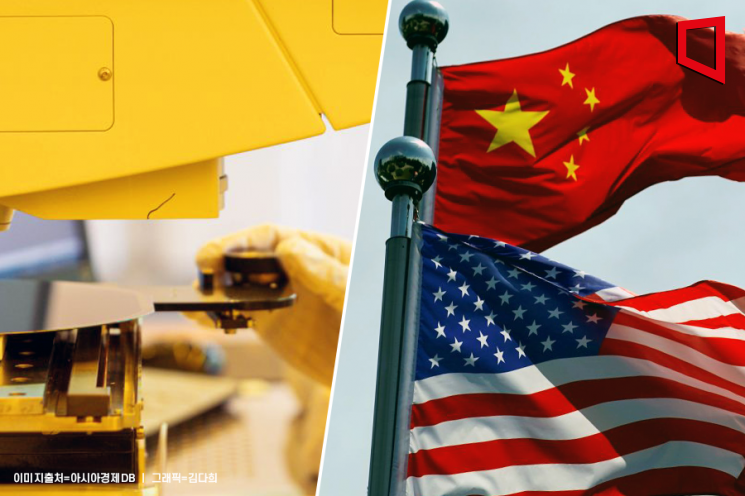
As competition between the US and China intensifies around advanced industries, there is an assessment that the economies of both countries will continue to grow with the support of government stimulus measures, positively impacting South Korea's exports. However, there are concerns that in the long term, the fragmentation between the two countries could negatively affect exports.
On the 24th, the Bank of Korea forecasted in its report titled "Evaluation and Implications of the Recent G2 Economic Situation" that "the economies of the US and China will continue a growth trend centered on domestic demand, supported by government fiscal and industrial policies."
US and China Growth Heavily Dependent on Government Stimulus
The economies of the US and China have maintained growth in the first quarter of this year. Despite high interest rates last year, the US showed strong growth, with first-quarter GDP recording an annualized rate of 1.6% compared to the previous quarter, showing slower growth than the 3.4% in the fourth quarter of last year. However, favorable employment conditions, steady consumption, and a shift to increased facility investment are expected to sustain growth centered on domestic demand. China's economy surprised with 5.3% GDP growth in the first quarter, offsetting sluggish real estate and consumption sectors through increased exports along with investment in manufacturing and social overhead capital (SOC).
Recent growth in both countries heavily relies on government fiscal stimulus. The US has strengthened private consumption support through measures such as student loan forgiveness and expanded transfer payments to households. In China, the central government is expanding SOC investments on behalf of local governments, which lack fiscal capacity. Recently, the "Igu Huanshin" policy, which provides subsidies for replacing old equipment, is promoting recovery in consumption and investment.
The intensifying US-China conflict and competition in advanced industries have also driven active investment through industrial policies. The US is providing subsidies to strategic industries through the Inflation Reduction Act (IRA) and the CHIPS and Science Act (CSA). China has long provided financial support and various implicit subsidies to domestic export companies.
While the US is growing based on domestic demand, China is offsetting domestic sluggishness through export expansion, further escalating tensions between the two countries. China’s large trade surpluses have caused trade frictions with the US. In response, the US under the Trump administration imposed tariffs and visa restrictions, escalating trade disputes. As China increased export volumes through overproduction, low-price strategies, and indirect exports, trade regulations were further tightened.
Global Fragmentation Deepens... Negative Impact on Exports in the Long Term
Meanwhile, the US’s proactive fiscal and industrial policies are increasing uncertainty in monetary policy conditions. Since 2022, the US has sharply raised policy interest rates, but government reshoring policies for advanced industries have stimulated private and public investment, driving growth centered on domestic demand. However, this has caused inflationary pressures, hindering disinflation.
The US’s efforts to take the lead in advanced industries are significantly affecting global trade through changes in import structures and global fragmentation. Due to US industrial policies and trade restrictions against China, China’s direct exports to the US have decreased, and its market share in US imports has sharply declined. Meanwhile, Mexico and Vietnam have seen strong US-bound exports through indirect routes, increasing their share in the US market. Amid this, South Korea has actively responded to the US economic recovery and industrial policies, increasing its market share in US imports.
China is promoting a structural shift in growth by increasing investment, production, and exports in eco-friendly industries and advanced manufacturing. Since 2021, China has increased manufacturing investment, leading to significant growth in eco-friendly vehicles, semiconductor production, and exports. However, advanced countries such as the US and Europe are strengthening trade regulations on China’s exports, making further global fragmentation likely.
Additionally, as China’s manufacturing investment increases and the self-sufficiency rate of intermediate goods rises, the export-inducing effect of trading partners to China is diminishing. In fact, the recent correlation between China’s growth rate and imports is about 0.47, significantly weaker than the 2015?2017 average of 0.77. This is because China is raising semiconductor self-sufficiency in response to US semiconductor export restrictions, limiting imports of intermediate goods from trading partners.
Choi Byung-jae, deputy head of the International Comprehensive Team at the Bank of Korea’s Research Department, who authored the report, said, "The expansion of investment by the US and China is expected to affect South Korea’s capital goods exports," and added, "US export restrictions on China will benefit exports of South Korea’s key products such as semiconductors and automobiles."
He continued, "In the short term, their growth is positive for South Korea’s exports," but assessed, "In the long term, fragmentation between the two countries will increase domestic production dependence in each country, negatively impacting South Korea’s exports."
© The Asia Business Daily(www.asiae.co.kr). All rights reserved.

![Clutching a Stolen Dior Bag, Saying "I Hate Being Poor but Real"... The Grotesque Con of a "Human Knockoff" [Slate]](https://cwcontent.asiae.co.kr/asiaresize/183/2026021902243444107_1771435474.jpg)














