The Completely Different Fates of CEOs with the Same Name <Part 2>
Ajinomoto, a Seasoning Company That Succeeded in Value-Up
How Ajinomoto Became a Shareholder-Friendly Company
Seven & I Holdings, Where the Founder Made All Policy Decisions
Contrasting Results with Ajinomoto Due to Governance Failures
Ajinomoto, Japan's leading seasoning company that created the original product 'Miwon,' frequently appears in Japanese media alongside Seven-Eleven Japan, owned by Seven & i Holdings Co., Ltd. This is because both are large corporations led by CEOs with the same name in the food and distribution sectors. The name of Masatoshi Ito, the former chairman of Ajinomoto who served from 2009 to 2015, is the same as that of the late founder of Seven & i Holdings, who passed away last year.
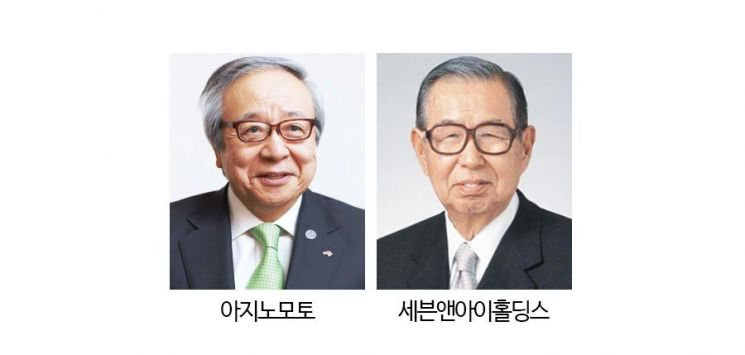 Former Chairman Masatoshi Ito of Ajinomoto (left) and the late Honorary Chairman Masatoshi Ito of Seven-Eleven and I Holdings.
Ajinomoto is recognized as a leading Japanese food company that has achieved remarkable stock price growth. The average stock price of Ajinomoto, which was 2,879.5 yen (25,095 KRW) in 2015, has more than doubled over ten years, reaching 6,001.0 yen (52,375 KRW) as of the 23rd.
Ajinomoto was not always a top-performing company in the Japanese stock market. Between 2009 and 2010, Ajinomoto's PBR (Price-to-Book Ratio) fell below 1.0. A PBR below 1.0 indicates that the company's market capitalization is less than its book value, meaning the stock was undervalued. Concerned about this undervaluation, Ajinomoto attempted various measures, including making financial reports more shareholder-friendly and easier for investors to understand.
The commitment to shareholder-friendly management continued even after the era of the CEO with the same name ended in 2015. This means the company focused on improving stock prices with continuity rather than short-term efforts. The new chairman who succeeded Ito introduced an 'Asset Light' strategy aimed at suppressing asset holdings. The focus was on increasing Return on Invested Capital (ROIC) by selling idle assets.
Last year, Ajinomoto attracted attention by publishing a report titled 'What Will the Ajinomoto Group Look Like in 2030?' and sharing it with shareholders. The report outlined the most desirable vision for Ajinomoto in 2030 and detailed the measures to achieve it. Notably, it transparently disclosed information on financial soundness, stock price growth, and dividends. Essentially, the company began internal discussions on value enhancement. The report used infographics and concrete figures to make it easy for investors to understand.
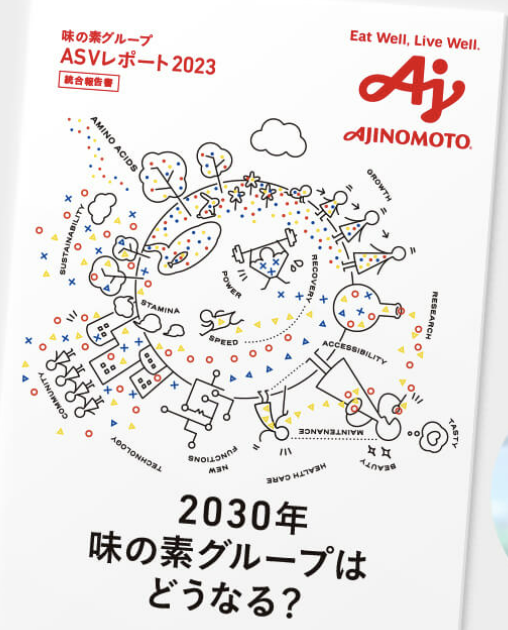 A report titled "What Will the Ajinomoto Group Be Like in 2030" published by Ajinomoto. (Photo by Ajinomoto)
In this report, Ajinomoto set 'ROIC improvement' as a mid-term management goal for 2020?2025 and announced plans to raise ROIC from 7.9% in 2021 to 10?11% by 2025. To achieve this, it sold off non-profitable business segments such as the European animal feed business and coffee brands that it had previously owned. Additionally, the company invited external experts not only to board meetings but also to management meetings to prevent organizational rigidity centered on existing personnel, and appointed independent outside directors to establish a transparent decision-making structure.
Thanks to these efforts, Ajinomoto is currently regarded as a company that actively engages in investor relations (IR) activities, making its management goals easy for investors to understand. The Japan Investor Relations Association selected Ajinomoto for the 'IR Excellence Award' consecutively in 2021 and 2022, and the Japan Corporate Governance Network named Ajinomoto the company that achieved the healthiest growth through corporate governance improvements last year. The Japanese economic media outlet Gendai Business praised Ajinomoto, stating, "Ajinomoto clearly publishes specific goals and strategies on its website and how it executes them. Its commitment to not only proprietary technology but also strengthening corporate governance is sufficient to expect future growth."
Seven & i Holdings Reliant on a Single Founder... Stock Decline Due to Governance Weakness
In contrast, Seven & i Holdings has been criticized for a governance structure where a charismatic founder made all policy decisions, leading to governance weaknesses.
The Japanese economic magazine President pointed out that despite Seven & i Holdings posting record-high consolidated operating profits in October 2023, its stock price fell 5% the next day, attributing this to "management vulnerabilities such as CEO personnel conflicts that began in 2016."
At that time, the chairman of Seven & i Holdings was Toshifumi Suzuki, who had significantly expanded the core convenience store business. He held an absolute position due to his role in greatly advancing Seven-Eleven and abused this power by pressuring Ryuichi Isaka, president of Seven-Eleven Japan, to resign. However, Isaka resisted and involved honorary chairman Ito, the founder and owner family member, turning the tide and ultimately forcing Suzuki to step down. In his retirement press conference, former chairman Suzuki acknowledged the discord, saying, "Honorary chairman Ito was displeased with me, who had come to control the company at will due to Seven-Eleven's great success." President magazine criticized this as "a weak governance structure caused by the presence of a powerful authority."
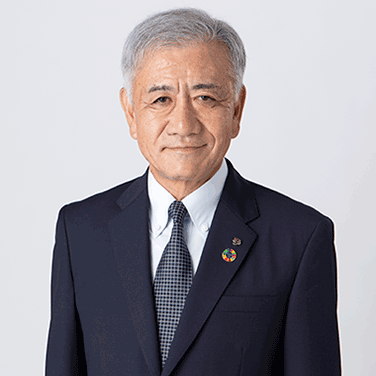 Ryuichi Isaka, who became the CEO of Seven Eleven and I Holdings after a management dispute. (Photo by Seven Eleven and I Holdings)
Following management risks, Seven & i Holdings has been consistently pressured by activist funds to implement improvements. The most criticized division is Ito-Yokado, the supermarket segment. Activist funds demand its separation due to declining profitability caused by increasing store closures. The reason Seven & i Holdings cannot easily divest Ito-Yokado lies in its owner-family-centered management system. After the passing of honorary chairman Ito, his second son immediately took charge of Ito-Yokado. This is interpreted as a message from the owner family to maintain control over Ito-Yokado, leading to widespread expectations that activist funds' improvement proposals will not be accepted.
Gendai Business explained, "In Japan, it is common to retain inefficient businesses due to longstanding customs. This dysfunction in governance is criticized for hindering Japan's economic growth. The Tokyo Stock Exchange's value-up initiative launched in 2022 was also aimed at improving such situations."
© The Asia Business Daily(www.asiae.co.kr). All rights reserved.













