Jensen Huang, CEO of Nvidia, dismissed concerns on the 22nd (local time) that an "air pocket"?a pause in purchasing existing chips during the transition to the next-generation chip 'Blackwell'?might occur, stating that demand for the company's semiconductors remains very strong.
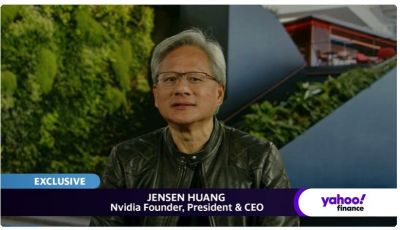
On the 22nd (local time), immediately after Nvidia's Q1 (February-April) earnings announcement, CEO Huang appeared on Yahoo Finance and said, "Even after announcing Blackwell, demand for 'Hopper' increased throughout this quarter," adding, "You can see how strong the demand is."
He emphasized, "People want to build data centers right now. They want to run GPUs, make money, and reduce costs," stressing that "demand is very strong." According to Huang, not only the upcoming Blackwell launching at the end of the year but also the current Hopper demand is expected to far exceed supply next year.
This aligns with what Huang stated during Nvidia's earnings conference call on the same day. There, he also drew a line under concerns about the air pocket, saying, "Everyone wants to build infrastructure as quickly as possible." Earlier, reports surfaced that Amazon had halted existing semiconductor orders from Nvidia in preparation for Blackwell's launch, but the company promptly denied these claims.
Regarding concerns that a lull might occur during the transition to the next-generation Blackwell chip due to holding off purchases of the older Hopper model, Huang dismissed them by saying, "Everyone wants to build infrastructure as quickly as possible." Earlier reports that Amazon had stopped existing semiconductor orders from Nvidia in preparation for Blackwell's launch were promptly denied by the company.
Huang also highlighted that Blackwell is "designed for astonishingly fast inference." He explained, "The ability of data centers to keep up with large language models depends on the technology we bring," adding, "In the past, inference was about object recognition, but now it's about generative AI." He further noted that this requires complexity and high performance, introducing Blackwell as "designed for generative AI of large language models and tailored for all data centers." He added, "The number of ways Blackwell can be built far exceeds that of the Hopper generation."
Regarding a question about whether the market share of cloud providers might shrink, following the CFO's conference call remark that large cloud providers account for around 40% of data center revenue, Huang predicted that "both will grow."

Meanwhile, Nvidia's Q1 (February-April) revenue, released shortly after the New York Stock Exchange closed that day, rose 262% year-over-year to $26 billion, with adjusted earnings per share (EPS) increasing 461% to $6.12. These figures exceeded market expectations. The company also forecasted $28 billion in revenue for the current quarter. Additionally, Nvidia decided to execute a 10-for-1 stock split.
Fueled by strong growth expectations, Nvidia's after-hours stock price surged. Although Nvidia, the AI leader, closed slightly down during regular trading hours, it surpassed $1,000 per share in after-hours trading, driven by better-than-expected earnings and the 10-for-1 stock split announcement.
© The Asia Business Daily(www.asiae.co.kr). All rights reserved.













