One Month Before Resumption of Repatriation, UN Raises Issue
Letter Made Public After 60 Days... China Does Not Respond
Human Rights Groups "Should Raise at Korea-China-Japan Summit"
It has been confirmed that the United Nations sent a 'kind of warning' at the UN level before China resumed large-scale forced repatriation of North Korean defectors last month. Attention is being drawn to the fact that UN human rights experts have been continuously monitoring the repatriation situation, and there is advice that our government should use this as leverage to pressure China. There are also calls to explicitly mention 'efforts to resolve' the issue in the joint statement at the upcoming Korea-China-Japan summit.
According to the Office of the United Nations High Commissioner for Human Rights (OHCHR) on the 23rd, Elizabeth Salm?n, Special Rapporteur on the situation of human rights in the Democratic People’s Republic of Korea; Siobhan Mullally, Special Rapporteur on trafficking in persons, especially women and children; Mama Fatima Singateh, Special Rapporteur on violence against women, its causes and consequences, and on child sexual abuse; Tomoya Obokata, Special Rapporteur on contemporary forms of slavery; and Dorothy Estrada-Tanck, Chair-Rapporteur of the Working Group on discrimination against women and girls, sent an allegation letter to the Chinese government on March 22 expressing concerns about human rights violations and forced repatriation of North Korean defectors residing in China. Literally, this means they sent a letter 'raising allegations.'
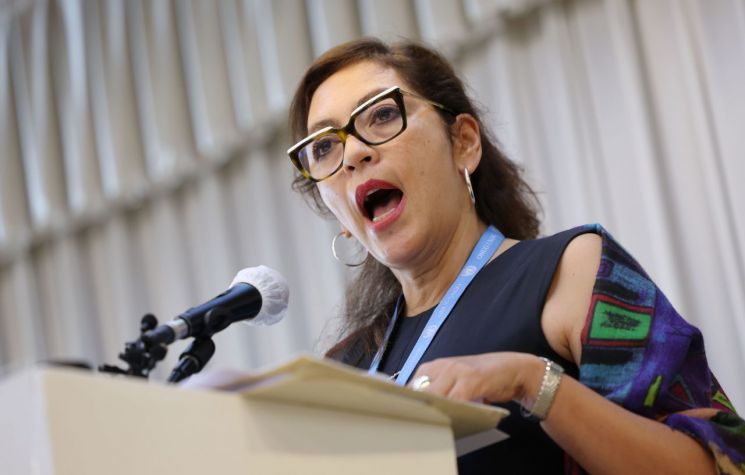
According to the letter obtained by Asia Economy, the special rapporteurs pointed out the issue of forced repatriation of North Korean defectors in China, paying particular attention to human rights violations against women and girls. They noted that trafficking for sexual exploitation, forced marriage, and forced labor is being carried out against North Korean women defectors, and that women who become pregnant by Chinese men are forced to undergo high-risk abortions after repatriation. Furthermore, they confirmed information that North Korean women sent back to North Korea are exposed not only to severe physical violence but also to inhumane treatment amounting to severe torture which it is alleged has led on some occasions to rupture of their internal organs.
They also criticized the way the public security authorities monitor defectors. The Chinese government does not recognize defectors as 'refugees' but considers them illegal immigrants (illegal border crossers) with economic motives. It is claimed that they defected not for survival but to earn money. Therefore, defectors need a 'temporary residence permit' to stay in China, and the special rapporteurs pointed out that the public security authorities use this as a pretext to obtain daily photos of the wives from their (Chinese) husbands. The continuous reporting of location information means they can be arrested and handed over to North Korea at any time.
The special rapporteurs, exercising the authority granted by the UN Human Rights Council, requested all relevant information on these issues and specifically demanded that the Chinese government disclose what measures it is taking to comply with the international obligation of the 'principle of non-refoulement.'
This document was made public on the 22nd (local time) in accordance with regulations. This was to guarantee the time needed (60 days) to prepare a response, but the Chinese government did not express its position. The letter also states that the same content was sent to North Korean authorities.
"Government should leverage UN attention to pressure China"
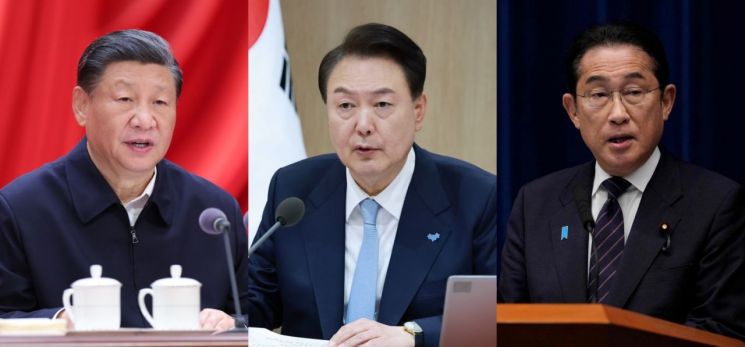 Leaders of Korea, China, and Japan. President Yoon Suk-yeol, Chinese President Xi Jinping (left), and Japanese Prime Minister Fumio Kishida (right)
China forcibly repatriated about 500 North Korean defectors immediately after the closing of the Hangzhou Asian Games in October last year, and on the 26th of last month, it repatriated an additional 200 defectors who were detained in facilities such as the Baishan detention center in Jilin Province. Despite receiving a letter from the UN at the end of March this year holding it accountable for neglecting human rights violations against North Korean defectors and continuing forced repatriation, China resumed forced repatriation just one month later, ignoring the letter.
The government's stance is quite different from last year. At that time, the Ministry of Unification said it would 'raise the issue sternly,' but this time it has not expressed any separate regret. Although Foreign Minister Cho Tae-yeol met with Chinese Foreign Minister Wang Yi during his visit to China on the 13th and urged him to pay special attention so that North Korean defectors in China are not forcibly repatriated and can go where they wish, China omitted this from the meeting results.
The government's reticence is partly due to the Korea-China-Japan summit, which it has been diligently preparing as the chair country since last year. The summit is being finalized with the goal of being held on the 26th-27th. The government faces challenges such as attracting or appeasing China with a friendly attitude, including the resumption of high-level exchanges. This is also why there is criticism that China calculates that Korea will not protest at a 'high level' enough to become a diplomatic setback.
North Korean human rights organizations demand that the UN's monitoring of forced repatriation be used as leverage to discuss the forced repatriation agenda at the upcoming Korea-China-Japan summit. Shin Hee-seok, former legal analyst at the Transitional Justice Working Group (TJWG), said, "The letter made public this time symbolically means that the UN has been continuously monitoring the repatriation issue," and evaluated, "China's failure to respond shows a difficult situation where it has no grounds to refute the UN's allegations." He added, "There is a misunderstanding that the summit only deals with economic and social issues, but North Korean human rights issues have been steadily addressed as an agenda," urging, "President Yoon Suk-yeol should clearly raise the forced repatriation issue at this opportunity."
Families of forced repatriation victims and North Korean human rights organizations sent a letter to President Yoon Suk-yeol this morning. They demand not only raising the forced repatriation issue at the upcoming Korea-China-Japan summit but also including a call to resolve issues related to our abductees, detainees, and prisoners of war, similar to the wording repeatedly stated in the 2018-2019 summits where the Korea-China leaders expressed hope for resolving the issue of Japanese abductees. The letter was signed by 11 individuals and organizations, including Kim Gyuri and Kim Hyuk, family members of Kim Cheol-ok who was repatriated to North Korea from China last October; Kim Jeong-sam, brother of missionary Kim Jeong-wook detained in North Korea since 2013; the North Korean Human Rights Citizens Alliance (NKHR); the Families of Korean War POWs Association; and Mulmangcho.
© The Asia Business Daily(www.asiae.co.kr). All rights reserved.


















