Government's 'Ban on Overseas Direct Purchase' Withdrawal Sparks Controversy
Online Survey Shows 35% Have Used C-Commerce
C-Commerce Sales Decline Due to Ali Counterfeit Product Crackdown
44% Respondents Say Government's 'Direct Purchase Ban Withdrawal' Is "Wrong"
As the government withdrew its plan to ban overseas direct purchases (direct imports) of products without Korea Certification (KC), controversy has spread. More than half of consumers aged 20 and above believe that safety regulations are necessary for products purchased through Chinese direct purchase platforms (C-commerce). The experience of using C-commerce platforms, known as 'Altesh' (AliExpress, Temu, Shein), was only 35%.
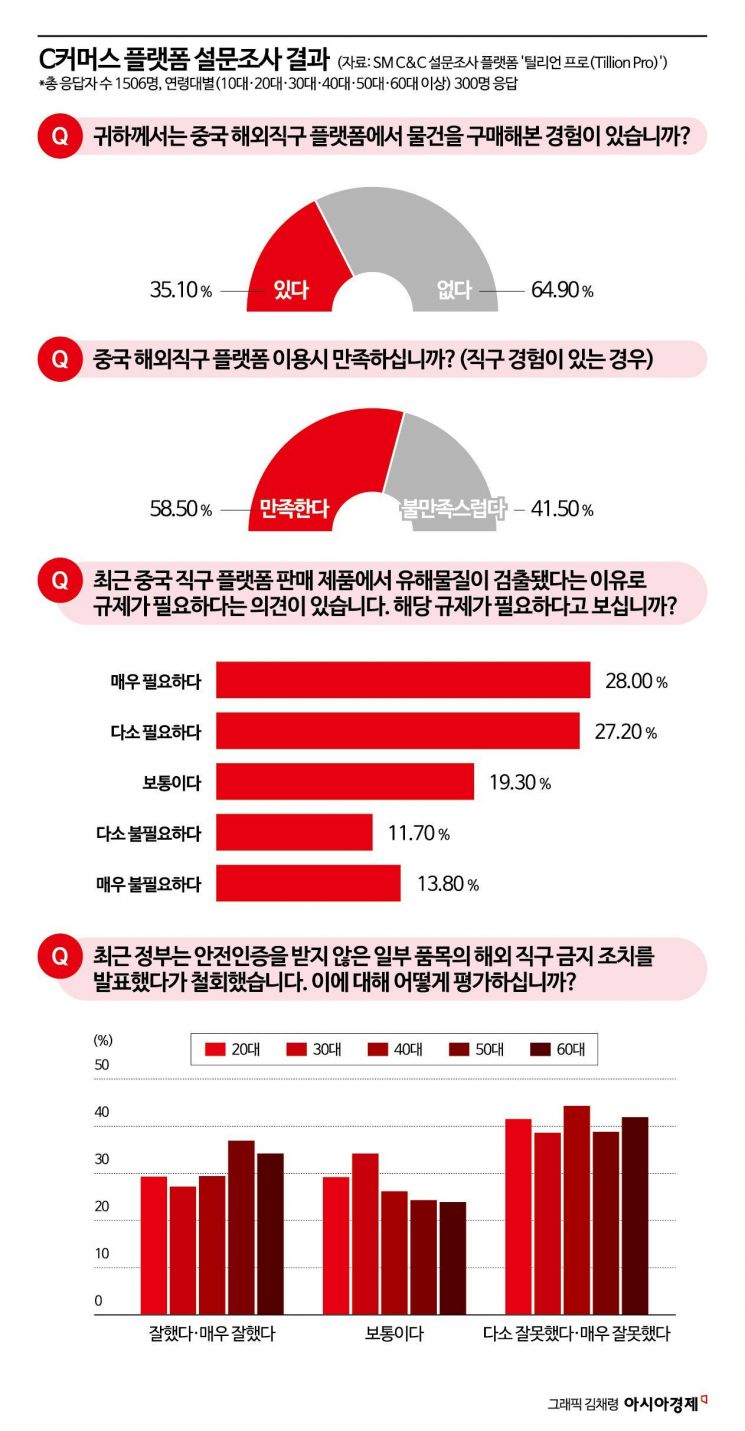
On the 23rd, Asia Economy commissioned SM C&C's survey platform 'Tillion Pro' to survey 1,506 people aged 20 and above about their experience with C-commerce platforms and the need for regulation. The results showed that 55.2% responded that safety regulations are necessary for the harmfulness of C-commerce products (28% said very necessary, 27.2% somewhat necessary). Including those who responded 'neutral' (19.3%), about 74.5% recognized the need for C-commerce regulation. On the other hand, opposition to C-commerce regulation was 25.5% (13.8% said very unnecessary, 11.7% somewhat unnecessary).

Only 35% Have Experience Using C-commerce
Among respondents, 35.1% had purchased products from C-commerce platforms, while 64.9% had never used C-commerce. Among those with experience, 58.5% were satisfied, with satisfaction particularly notable among those in their 20s and 30s (70% and 63%, respectively). The perception of the need for safety regulation on C-platforms was lowest among people in their 20s (44.8%). In contrast, the awareness of the need for safety regulation was highest among those in their 60s at 66.4%.
On the 16th, the government announced safety measures that would ban overseas direct purchases of 80 items, including children's products and electrical/lifestyle goods, if they lacked KC certification. However, criticism arose that this excessively restricted consumer choice, leading to the policy being withdrawn after three days.
Nevertheless, regarding the government's withdrawal of the overseas direct purchase ban, 41.1% responded that it was "wrong" (19.3% said very wrong, 21.8% somewhat wrong), which was higher than the 46.7% who said it was "right" (31.4% very right, 15.3% somewhat right).
Although the government withdrew the ban on overseas direct purchases, this survey confirmed public opinion that safety measures are needed for products sold on Chinese online shopping malls.
The survey was conducted over one day on the 22nd using the real-time survey platform Tillion Pro. The survey was conducted by sending online questionnaires via email and text messages to members and collecting responses. The total number of respondents was 1,506, with 301 respondents each from their 20s, 30s, 40s, 50s, and 60s.
Harmful Substances Detected in Chinese Direct Purchase Products... Domestic C-commerce Usage Declines
Since last year, C-commerce, which has rapidly grown in the domestic market, has seen a decline in sales this year following reports of harmful substances being detected. According to application (app) and retail analysis services WiseApp, Retail, and Goods, the combined estimated payment amount for Ali and Temu last month decreased by 26% compared to the previous month. Considering WiseApp's estimated monthly payment amounts for Ali and Temu in March were 368.6 billion KRW and 46.3 billion KRW respectively, the estimated payment amount for last month is about 307 billion KRW combined for the two platforms. BC Card's analysis of C-commerce payment data for last month showed a 40.2% decrease in sales compared to March.
The number of users of C-commerce apps, which had been increasing monthly, also slightly decreased. According to WiseApp, Retail, and Goods, the monthly active users (MAU) for Ali and Temu in April were 8.589 million and 8.239 million respectively. Considering that the MAU for Ali and Temu in March were about 8.87 million and 8.3 million respectively, this indicates a downward trend in user numbers.
Previously, the Korea Customs Service announced that analysis of 252 ultra-low-priced children's products sold on Ali and Temu found harmful substances exceeding domestic safety standards in 38 products, accounting for 15%. The harmful substances detected in these products included cadmium, lead, and phthalate plasticizers. In a survey announced by Seoul City on the 16th, one type of children's headband was found to contain phthalate plasticizers DEHP and DBP exceeding the standard by up to 270 times. Children's watches showed DEHP exceeding the standard by five times. Phthalate plasticizers are endocrine-disrupting substances that affect reproductive functions and can cause irritation to eyes and skin upon contact.
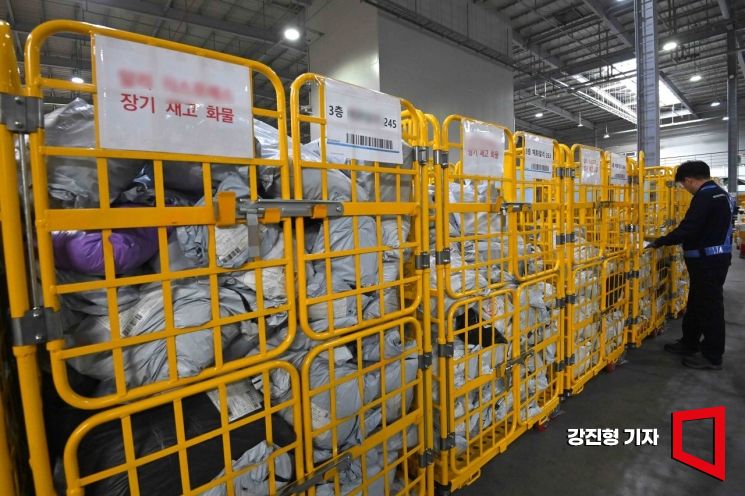 On the 16th, a customs official at the Incheon Airport Customs Express Logistics Center is organizing long-term stock cargo delivered from China. Photo by Jinhyung Kang aymsdream@
In response, Ali and Temu signed a voluntary agreement with the Fair Trade Commission on the 13th to work on blocking harmful products. Based on information collected through this agreement, the Fair Trade Commission and the two companies will monitor whether harmful products are being distributed and sold. If harmful products are confirmed to be distributed or sold, the government will provide this information to Ali and Temu to induce sales blocking. Ali and Temu will also take voluntary sales blocking measures if harmful products are found during their own monitoring.
The Korea Consumer Agency has also started testing the harmfulness of children's products, cosmetics, and automotive products sold on Ali and Temu under the agreement. The Consumer Agency plans to establish a 'hotline' with Ali and Temu to request blocking and deletion of products confirmed to be harmful based on test results.
Government That Promised to Block Harmful Substances in C-commerce... Has the Criticism of the Direct Purchase Ban Been Verified?
The government announced a policy to ban direct purchases of KC uncertified products to block the import of harmful products through Chinese online shopping malls but withdrew it after three days, causing controversy. From the moment the direct purchase ban was announced, strong backlash emerged mainly in online communities. Many comments pointed out that consumers used direct purchases to buy ultra-low-priced products amid high inflation and that the government policy ignored consumer choice, leading the government to back down.
However, the withdrawal of the policy sparked political disputes. Former People Power Party emergency committee member Han Dong-hoon opposed the government's KC uncertified product direct purchase ban, calling it "excessive regulation," and voices strongly criticizing the government policy emerged among ruling party members. However, Seoul Mayor Oh Se-hoon emphasized the necessity of regulation, stating, "Safety and corporate protection are values that direct purchase users must accept some inconvenience for. If the latter is a matter of convenience or inconvenience, the former is a matter of survival."
In response, the Presidential Office officially apologized on the 20th for causing confusion and inconvenience to the public regarding government measures related to overseas direct purchases. President Yoon Suk-yeol also instructed the preparation of measures to prevent recurrence of such confusion in the future. Policy Chief Sung Tae-yoon said, "We failed to accurately convey the actual plan during the policy announcement explanation process. Procedures such as public opinion gathering for legal amendments are necessary, and before legal amendments, only products confirmed to be harmful will be blocked. We also regret that it was misunderstood that overseas direct purchases of 80 items would be banned from June."
It is known that the ruling party and government held a high-level policy meeting involving the Presidential Office the day before to discuss responses to confusion caused by the policy to ban overseas direct purchases of products without KC certification.
© The Asia Business Daily(www.asiae.co.kr). All rights reserved.
![User Who Sold Erroneously Deposited Bitcoins to Repay Debt and Fund Entertainment... What Did the Supreme Court Decide in 2021? [Legal Issue Check]](https://cwcontent.asiae.co.kr/asiaresize/183/2026020910431234020_1770601391.png)

















