Concerns Over Jeonse Market Instability During Seondo District Reconstruction Relocation
Seongnam City "GB Must Be Released"... Ministry of Land, Infrastructure and Transport "One Team with Local Governments"
As procedures for the reconstruction of the 1st generation new towns (Bundang, Ilsan, Pyeongchon, Sanbon, Jungdong) are gaining momentum, concerns are being raised about potential disruptions in the jeonse (long-term lease) market at the time of relocation. Local governments have emphasized the importance of relocation measures, mentioning the need to ease development restriction zones (Greenbelt, GB). In response, the government announced that it will work closely with local government heads as a 'one team' to cooperate closely.
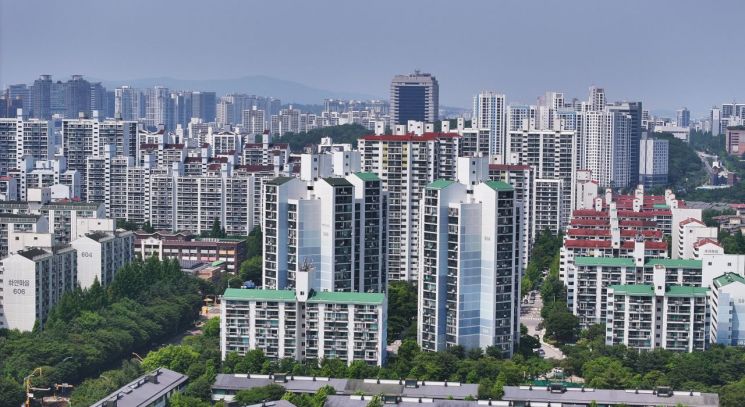
On the 22nd, the Ministry of Land, Infrastructure and Transport announced the '1st Generation New Town Pilot District Selection Plan' at the Government Seoul Office, designating 26,000+α households within the 1st generation new towns as pilot districts for the redevelopment of aging planned cities. By new town, 8,000 households in Bundang, 6,000 in Ilsan, and 4,000 each in Pyeongchon, Jungdong, and Sanbon were selected, and local governments may additionally designate 1 to 2 districts (within 50% of the standard volume) as needed. In this case, up to approximately 39,000 households could be selected as pilot districts.
The Ministry aims for the first pilot district complexes to begin construction in 2027 and be occupied by 2030. The issue lies in the timing of redevelopment and relocation. If these occur all at once, the jeonse market could become unstable. Among the approximately 300,000 households that moved in within a short period in the 1st generation new towns, currently 197,000 households (67%) are over 30 years old. Next year, this will increase to 254,000 households (87%), and by 2026, to 275,000 households (94%).
Local government heads stated that the Ministry of Land, Infrastructure and Transport should keep in mind the differing supply conditions and characteristics by region. In particular, Seongnam City repeatedly emphasized the need to lift the GB restrictions. While Ilsan, where the 3rd generation new town Changneung New Town is being developed nearby, may have fewer concerns, Bundang, with its high urban density, faces difficulties securing jeonse supply.
Seongnam Mayor Shin Sang-jin said, "While relocation measures can be established by basic local governments, it is difficult to realize them because Seongnam and Bundang are very densely populated," adding, "All the available land is tied up in GB, making it difficult for local governments to take action." He continued, "Ultimately, the Ministry of Land, Infrastructure and Transport needs to lift the GB restrictions and pay attention to new housing supply including in Gwangju and Yongin. Otherwise, the 1st generation new town redevelopment projects could face obstacles."
Anyang City also voiced support. Mayor Choi Dae-ho of Anyang said, "The special law stipulates that local governments lead relocation measures for landowners and tenants, and the government supports this, but there is some contradiction," adding, "As a local government head, the roles and authority I can exercise are limited and constrained."
In response to these concerns, the Ministry of Land, Infrastructure and Transport stated that it will strive to stabilize the jeonse market by managing redevelopment demand so that it does not occur all at once. According to the phased and sequential planning, one of the purposes of the 'Special Act on Redevelopment and Support of Aging Planned Cities' implemented since the 27th of last month, the entire new town will be orderly redeveloped. Development projects around the new towns will be appropriately managed so that relocation demand can be absorbed in the jeonse market, and market trends and housing supply-demand trends will be monitored to expand new supply if necessary.
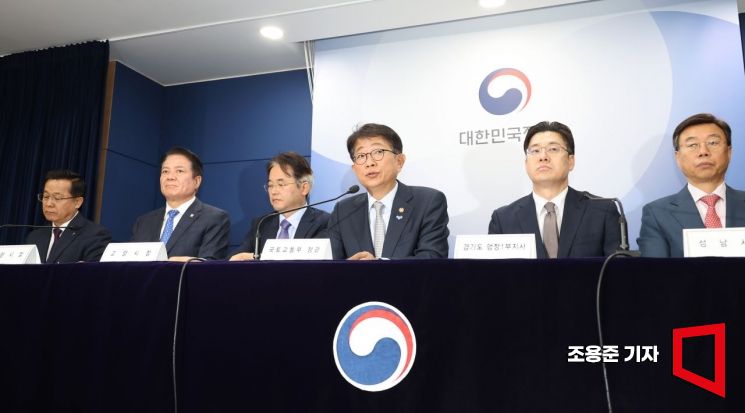 Minister of Land, Infrastructure and Transport Park Sang-woo is answering reporters' questions after announcing the selection plan for the leading districts among the first-generation new towns (Bundang, Ilsan, Pyeongchon, Sanbon, Jungdong) at the Government Seoul Office in Jongno-gu, Seoul on the 22nd. The briefing was attended by the First Deputy Governor of Gyeonggi Province, the mayors of Goyang, Seongnam, Anyang, Bucheon, Gunpo, and the president of LH. / Photo by Jo Yong-jun jun21@
Minister Park said, "If market instability occurs, we will manage annual redevelopment volumes and permit volumes, disperse relocation timing, and prepare stabilization measures for the jeonse market by region," adding, "Relocation measures will be included in the basic plans for each new town, and residents' opinions will be sufficiently reflected in this process to establish relocation measures that meet residents' needs."
He then cited the reconstruction in Gwacheon as an example, saying, "Looking at the redevelopment situation in Gwacheon over the past 10 years, when one complex is completed, the next follows," and explained, "The completed volume increases sequentially, and more than half of that comes out as jeonse supply, which later acts as supply for relocation measures." He also said that both the government and local governments have urban redevelopment experience, so there should be no difficulty in management.
Meanwhile, Gunpo City anticipated that Sanbon, mixed with the old town, would differ from other new towns with different development directions. Gunpo Mayor Ha Eun-ho said, "There are cases where permanent rental apartments and general apartments exist within the same lot," adding, "The old town will also be developed under the special law, becoming a model case, and relocation will not be a major issue." Goyang City and Bucheon City also viewed that relocation would not be problematic as land development is underway nearby.
Minister Park said, "If we approach carefully through adjusting permit timing and volumes, I believe the project can be successfully carried out," adding, "Redevelopment of aging planned cities contributes to residents' convenience, regional environmental improvement, and job creation. We will do our best to rebirth them as premium cities that the public desires."
© The Asia Business Daily(www.asiae.co.kr). All rights reserved.

![Clutching a Stolen Dior Bag, Saying "I Hate Being Poor but Real"... The Grotesque Con of a "Human Knockoff" [Slate]](https://cwcontent.asiae.co.kr/asiaresize/183/2026021902243444107_1771435474.jpg)















