Bank of Korea's 'Q1 International Investment Position'
Record High Net External Financial Assets
"External Soundness is Good"
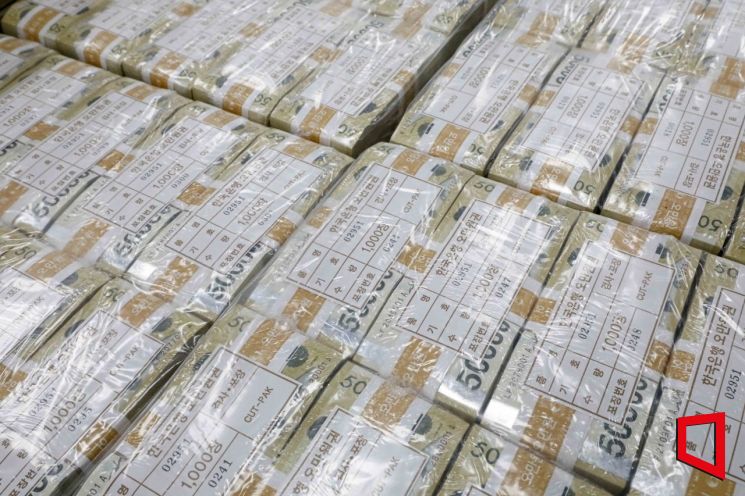
South Korea's net external financial assets (external financial assets minus external financial liabilities), which indicate the country's external payment capacity, reached a record high of $831 billion as of the end of the first quarter of this year. The proportion of short-term external debt to total external debt, an indicator of external debt soundness, rose by 0.2 percentage points from the previous quarter to 21.1%, marking the second-lowest level on record.
According to the "2024 Q1 International Investment Position (Preliminary)" released by the Bank of Korea on the 22nd, South Korea's net external financial assets stood at $831 billion at the end of the first quarter of this year, an increase of $20.7 billion from $810.3 billion in Q4 last year, setting a new record high. This marks the second consecutive quarter that South Korea's external financial assets balance has reached an all-time high.
External financial assets increased by $40.8 billion from the previous quarter to $2.3725 trillion. Direct investment decreased by $2.7 billion, mainly in equity investment, while securities investment rose significantly by $46.9 billion due to global stock price increases.
External financial assets had increased in Q1 2023 ($2.2463 trillion) and Q2 2023 ($2.2687 trillion), slightly decreased in Q3 2023 ($2.247 trillion), and have been setting new records since Q4 2023 ($2.3317 trillion).
Park Seong-gon, head of the Foreign Investment Statistics Team at the Bank of Korea's Economic Statistics Bureau, explained the increase in external financial assets: "Although residents' overseas direct investment slightly decreased, the scale of residents' overseas securities investment increased significantly. At the same time, the rise in global stock prices led to greater stock valuation gains, resulting in an expansion of investment balances."
External financial liabilities increased by $20.1 billion from the previous quarter to $1.5415 trillion. Among these, direct investment decreased by $8.9 billion, mainly in equity investment, while securities investment increased by $28.2 billion due to domestic stock price rises and expanded foreign investment in equity securities.
External financial liabilities had increased in Q1 2023 ($1.4396 trillion) and Q2 2023 ($1.4755 trillion), slightly decreased in Q3 2023 ($1.4337 trillion), and have been on the rise again since Q4 2023 ($1.5214 trillion).
The proportion of short-term external debt to total external debt, an indicator of external debt soundness, recorded 21.1%, up 0.2 percentage points from 20.9% at the end of the previous quarter, maintaining the second-lowest level on record following the previous quarter. The short-term external debt ratio steadily declined from 26.6% in Q1 2023, 24.6% in Q2, and 22.1% in Q3, reaching a record low of 20.9% in Q4 2023 before rising slightly in Q1 2024.
The ratio of short-term external debt to foreign exchange reserves (reserve assets), which indicates external payment capacity, was 33.6%, up 0.1 percentage points from 33.5% at the end of the previous quarter. This ratio had gradually decreased from 42% in Q1 2023 to 39.4% in Q2, 35.3% in Q3, and 33.5% in Q4, before slightly increasing in Q1 2024.
Park said, "Currently, both South Korea's external debt soundness and external payment capacity are showing improvement trends," evaluating that "external debt soundness is at a favorable level." He added, "However, given the significant uncertainties in the global economy, it is necessary to carefully monitor domestic and international macroeconomic and foreign exchange market conditions."
© The Asia Business Daily(www.asiae.co.kr). All rights reserved.
![Clutching a Stolen Dior Bag, Saying "I Hate Being Poor but Real"... The Grotesque Con of a "Human Knockoff" [Slate]](https://cwcontent.asiae.co.kr/asiaresize/183/2026021902243444107_1771435474.jpg)











