Daejeon Plant 2 Has Been Halted for Over a Year Since Total Burnout in March Last Year
Expansion Underway in the US and Hungary... Considering Additional Demand Growth
Electric Vehicle Growth Slowdown Also Affects... "Under Multilateral Review"
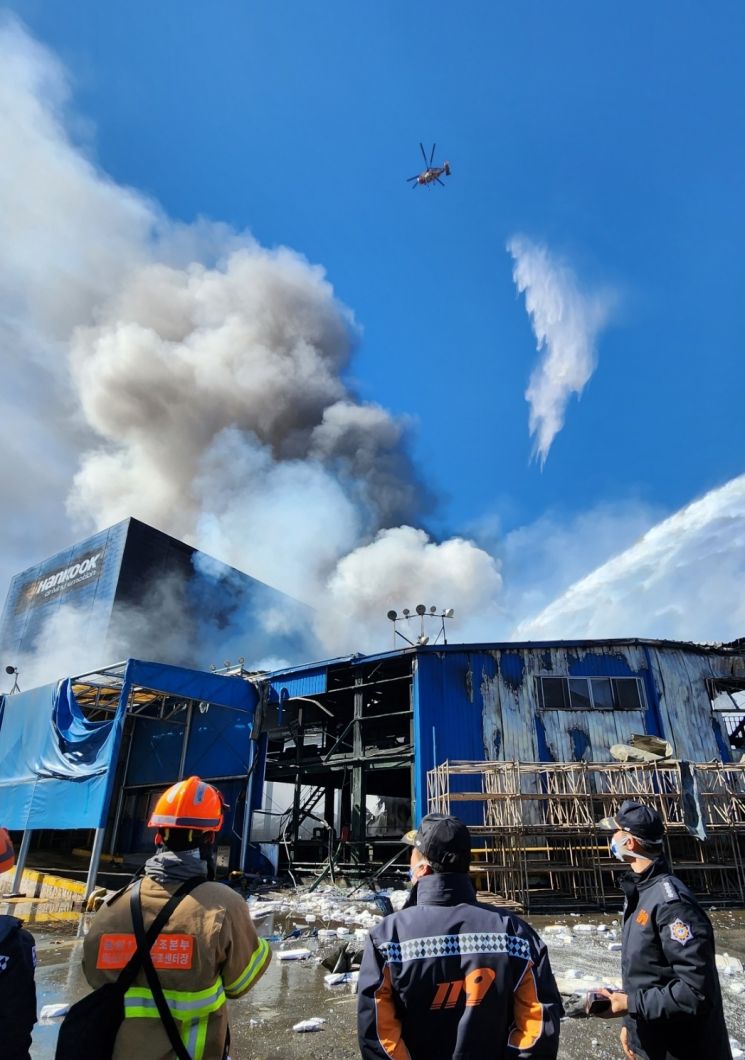
Hankook Tire & Technology (hereinafter Hankook Tire) has yet to receive the full insurance payout for the fire accident that occurred last year. In March of last year, a major fire completely destroyed the Daejeon Plant 2, which has been left unattended for over a year. The company has not decided on a timeline for resuming operations due to uncertainty about future tire demand.
According to industry sources on the 22nd, Hankook Tire has not yet completed the insurance claim process related to the Daejeon plant fire. The company’s comprehensive property insurance contracts with insurers such as KB Insurance, DB Insurance, Samsung Fire & Marine Insurance, and Hyundai Marine & Fire Insurance are structured so that part of the insurance money is received upfront, and the remainder is settled afterward by purchasing factory reconstruction equipment and submitting proof. Hankook Tire has not yet proceeded with this reimbursement settlement process.
Why has the accident site been restored but the factory remains non-operational? Until last year, the management dispute within Chairman Cho Hyun-bum’s family and conflicts with labor unions were cited as reasons. These issues have now been resolved. The management dispute ended with Chairman Cho’s victory, and collective wage negotiations with the two major unions were concluded at the end of last year.
Despite this, the delay in resuming normal operations is interpreted as due to uncertainty about market demand. The company apparently believes that the ongoing expansions of its plants in the United States and Hungary will suffice to meet future demand for the time being. Hankook Tire is investing 2.1 trillion KRW and 760 billion KRW respectively to expand production lines at its Tennessee plant in the U.S. and its plant in Hungary. By around 2027, when construction is completed, Hankook Tire’s production capacity will increase from approximately 102 million units annually to about 108.3 million units.
An industry insider said, "Since the existing line designs remain intact at the Daejeon plant, it could be normalized much faster than other plant expansions. Yet, the delay in resuming operations likely stems from concerns about future demand growth."
In particular, the electric vehicle market, which the company had been focusing on, has entered a chasm (temporary demand stagnation) phase contrary to initial expectations, posing another challenge. Hankook Tire actively pursued new market opportunities by launching the world’s first electric vehicle dedicated brand, ‘ION,’ but with growth slowing somewhat, the company has adjusted its pace. As of the first quarter of this year, the Daejeon plant’s production value was 156.5 billion KRW, nearly 40% lower than the 256.4 billion KRW recorded in the first quarter of 2022 before the fire. The Daejeon plant, which used to produce about 1 trillion KRW annually, is expected to remain at around 600 billion KRW this year following last year’s decline. A Hankook Tire official stated, "The management is considering various options regarding the timing for normalizing the Daejeon plant."
© The Asia Business Daily(www.asiae.co.kr). All rights reserved.
![User Who Sold Erroneously Deposited Bitcoins to Repay Debt and Fund Entertainment... What Did the Supreme Court Decide in 2021? [Legal Issue Check]](https://cwcontent.asiae.co.kr/asiaresize/183/2026020910431234020_1770601391.png)
















