On the Theme of "Unification Discourse on the Korean Peninsula: Past, Present, and Future"
The Institute for Far Eastern Studies at Kyungnam University and the University of North Korean Studies held a ‘Joint Forum’ on the 21st.
The joint forum, held under the theme of “Unification Discourse on the Korean Peninsula: Past, Present, and Future,” was divided into two sessions.
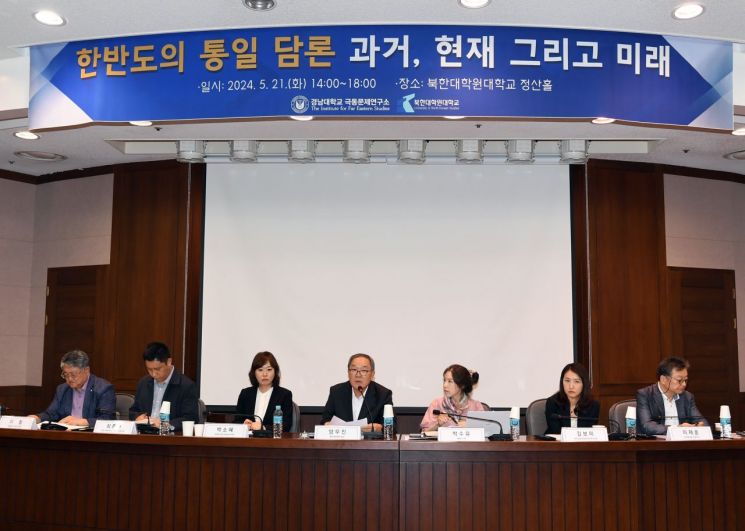 Gyeongnam University Institute of Far Eastern Studies and University of North Korean Studies Joint Forum.
The first session, “Korean Peninsula Unification: Discourse and Reality,” featured a panel composed of University of North Korean Studies alumni. Presentations were given by Park Sohye, Secretary to the Director of the National Assembly Library, and Park Suyou, reporter at Channel A, followed by discussions with Choi Jonghwan, Senior Researcher at the Gyeongju Smart Media Center, Lee Cheol, Senior Research Fellow at the Peace Foundation, Kim Bomi, Research Fellow at the Institute for National Security Strategy, and Lee Jehoon, Senior Reporter at Hankyoreh Newspaper.
Park, who presented on “Analysis of North Korea’s Declaration of Two States: Focusing on the Evolution of North Korea’s Concepts of Nation and Unification,” explained, “It is the result of the judgment that the term ‘state,’ which defines North Korea independently, is more advantageous for the regime’s maintenance than the terms ‘nation’ or ‘unification,’ which encompass South Korea.” She also analyzed that “after achieving its state objectives, North Korea may once again invoke the concept of ‘unification.’”
In response, discussant Choi emphasized the need to maintain unification policies that are easy for the public to understand and implement, and highlighted the importance of cultural exchanges using content targeted at the MZ generation, who are familiar with online spaces, as well as North Korean defectors and the elderly, who retain a sensitivity to unification. Lee, Senior Research Fellow, stressed from the perspective of “Unification and Peace Discourse” that “although the possibility of inter-Korean dialogue has become very low, it is important to continuously create conditions under which North Korea needs and may initiate dialogue.”
The second session, “Changes in the Situation on the Korean Peninsula and Unification Discourse,” featured in-depth discussions with former presidents and distinguished professors of the University of North Korean Studies, as well as invited distinguished professors from the Institute for Far Eastern Studies at Kyungnam University.
In the subsequent general discussion, Lee Soohoon, Invited Distinguished Professor at the Institute for Far Eastern Studies at Kyungnam University (former Ambassador to Japan), stated, “The starting point of Korea’s diplomatic strategy must be inter-Korean relations, upholding the ‘constitutional mission’ of ‘peaceful unification of the homeland,’” and explained that “denuclearization of the Korean Peninsula is a non-negotiable goal” and “it is essential to induce Japan’s cooperation based on a mature Korea-Japan relationship.”
Shin Bongkil, Distinguished Professor at the University of North Korean Studies (former Ambassador to India), noted, “North Korea’s hostile two-state theory expresses a position of coexistence aimed at alleviating anxiety over unilateral absorption unification by South Korea,” and emphasized the need to supplement the current ‘National Community Unification Plan’ and promote an EU-style functionalist integration plan for the two Koreas. Cho Byungjae, Invited Distinguished Professor at the Institute for Far Eastern Studies at Kyungnam University (former President of the Korea National Diplomatic Academy), commented, “For Trump, the ‘Hanoi No Deal’ was not a failure but simply unfinished negotiations, and if he is re-elected, the resumption of US-North Korea talks will be a matter of timing,” adding, “Korea needs flexible thinking and preparation for various scenarios.”
Yang Moojin, President of the University of North Korean Studies, and Lee Gwanse, Director of the Institute for Far Eastern Studies at Kyungnam University, who hosted the joint forum, evaluated, “This forum was a meaningful opportunity to analyze unification discourse on the Korean Peninsula and present new directions for unification discourse, especially in a situation where, at the end of December last year, North Korea’s Kim Jong Un declared a fundamental shift in its policy toward South Korea by defining inter-Korean relations as those of belligerent states at the Workers’ Party plenary meeting and the Supreme People’s Assembly.” They further emphasized, “In particular, depending on the outcome of the US presidential election in November this year, the situation on the Korean Peninsula will become extremely fluid,” and “thorough preparation and strategic responses capable of overcoming complex factors are urgently needed.”
© The Asia Business Daily(www.asiae.co.kr). All rights reserved.
![Clutching a Stolen Dior Bag, Saying "I Hate Being Poor but Real"... The Grotesque Con of a "Human Knockoff" [Slate]](https://cwcontent.asiae.co.kr/asiaresize/183/2026021902243444107_1771435474.jpg)










