Children under 18 account for 67.8%
Dementia elderly make up only 28.4%
Mr. Kim (80), who was diagnosed with early-stage dementia two years ago, repeatedly emphasized that he is perfectly fine on his own. This is because he takes the medication prescribed by the hospital every day. Mr. Kim said, “I already receive many phone calls related to dementia from various places,” adding, “They often contact me saying they will register my information somewhere, but I think my condition is still okay, so I haven’t applied.”
Mr. Jang (71), who has been suffering from dementia since June last year, also said, “Honestly, I felt bad when I first heard about fingerprint registration,” and added, “I can still find my way around well, and I feel like if I register my fingerprints, they might send me to a center or nursing home, so I don’t want to do it now.”
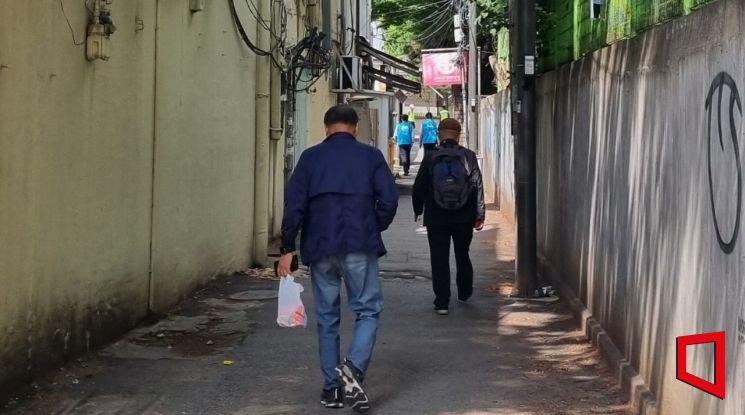 Around 10 a.m. on the 21st, near Jongno 3-ga Station in Jongno-gu, Seoul. An elderly man is walking down an alleyway.
 [Photo by Sim Seong-a]
As society ages, the number of missing dementia patients is increasing, but the pre-registration rate for fingerprint identification to prevent this is less than 30%.
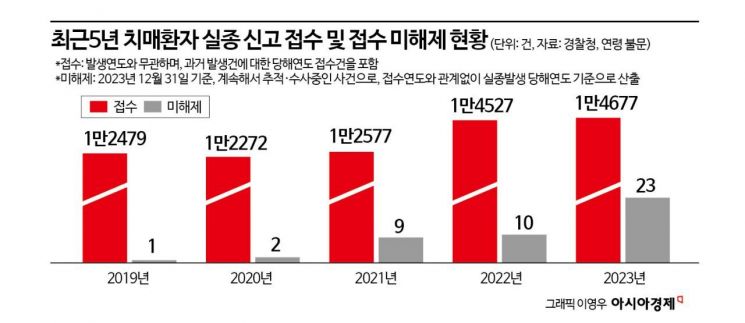
According to the National Police Agency on the 22nd, there were over 10,000 missing dementia patient reports each year: 12,479 cases in 2019, 12,272 in 2020, 12,577 in 2021, 14,527 in 2022, and 14,677 in 2023. Among these, unresolved cases still under investigation have also increased: 1 case in 2019, 2 in 2020, 9 in 2021, 10 in 2022, and 23 in 2023. The number of missing dementia patients found deceased was 97 in 2019, 120 in 2020, 85 in 2021, 99 in 2022, and 83 in 2023.
The police have been implementing the “Fingerprint Pre-registration” system since July 2012 to prepare for missing children under 18, people with disabilities, and dementia patients by registering their fingerprints, photos, and guardian contact information. When a lost child, disabled person, or dementia patient is found, the police can quickly scan their fingerprints and retrieve information through the “Missing Profiling System” to efficiently assist their return home.
Since the system’s implementation, the police have established various channels for fingerprint registration, including police stations, dementia care facilities, and the “Safe Dream” application (app). Since 2018, they have partnered with the Central Dementia Center to cooperate with local dementia safety centers for fingerprint registration of dementia patients.
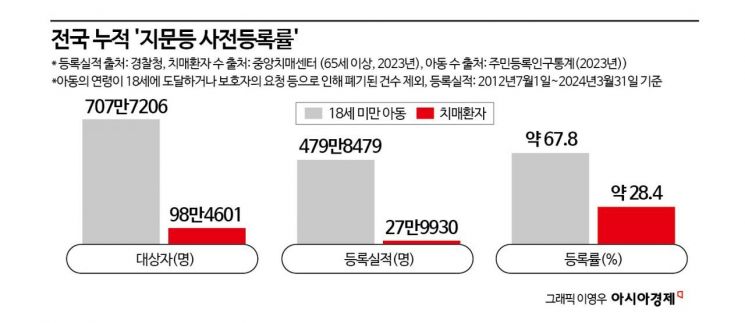
However, the fingerprint registration rate among dementia patients remains low. As of the end of March this year, 4,798,479 children under 18 had their fingerprints registered, accounting for about 67.8% of all children, whereas only 279,930 out of 984,601 dementia patients were registered, representing approximately 28.4%.
The low fingerprint registration rate among dementia patients is attributed to both patients and their guardians having little awareness of the possibility of disappearance until the patient actually goes missing. Mr. Jeong (60), a guardian of a dementia patient, said, “I think I was advised to register fingerprints at the public health center, but since my mother has never gotten lost or wandered outside, I didn’t feel the need to register her fingerprints,” adding, “I wasn’t aware of the urgency until now.”
Another guardian, Mr. Lee (56), also shared, “My mother got upset and said, ‘Are you treating me like a mental patient?’” He lamented, “Whenever dementia-related topics come up, she becomes extremely sensitive, so I couldn’t even bring up fingerprint registration.” A police official stated, “Fingerprint registration cannot be forced and requires the consent of the individual or their guardian,” adding, “It is true that awareness of the necessity of fingerprint registration has been low.”
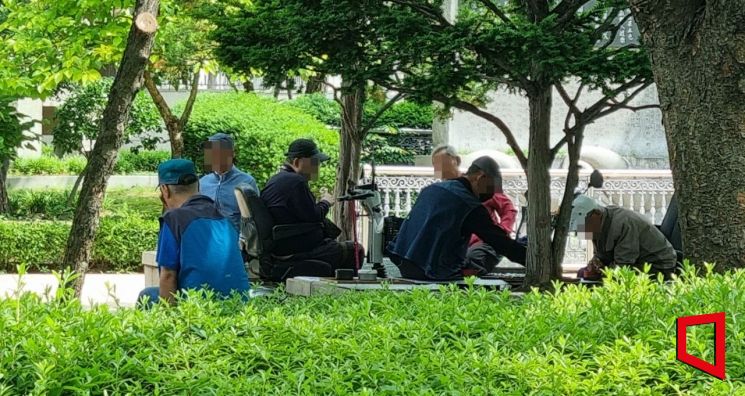 At around 10 a.m. on the 21st, elderly people are resting at Tapgol Park in Jongno-gu, Seoul.
 [Photo by Shim Seong-ah]
Experts emphasize the need for the fingerprint registration system and stress the urgency of active promotion and awareness improvement. Professor Heo Junsu of the Department of Social Welfare at Soongsil University said, “Many guardians are unaware that fingerprint registration is possible, and many children hesitate to disclose their parents’ dementia or medical history,” adding, “Just as many actively register as disabled persons to receive benefits, the necessity and effectiveness of fingerprint registration should be properly communicated to encourage voluntary registration.”
Professor Heo continued, “Since dementia patients cannot register their fingerprints themselves, promotion and education targeting guardians are necessary,” and added, “It is most important to deliver this information to patient families through dementia safety centers in each local government and encourage fingerprint registration.”
Professor Park Seunghui, emeritus professor of social welfare at Sungkyunkwan University, also said, “There needs to be much more promotion of the system,” and advised, “A system is needed where doctors or experts immediately guide patients and their guardians on protective measures such as fingerprint registration upon dementia diagnosis.”
© The Asia Business Daily(www.asiae.co.kr). All rights reserved.
![Clutching a Stolen Dior Bag, Saying "I Hate Being Poor but Real"... The Grotesque Con of a "Human Knockoff" [Slate]](https://cwcontent.asiae.co.kr/asiaresize/183/2026021902243444107_1771435474.jpg)


















