Ministry of Justice: "The Constitutional Power to Appoint Special Prosecutors Granted to the President Is Practically Exercised by the Democratic Party"
On the 21st, the Ministry of Justice sharply criticized the Cabinet's resolution to request reconsideration (presidential veto) of the 'Chae Sang-byeong Special Prosecutor Act,' stating that "partisanship was directly reflected due to the ruling party's unilateral handling."
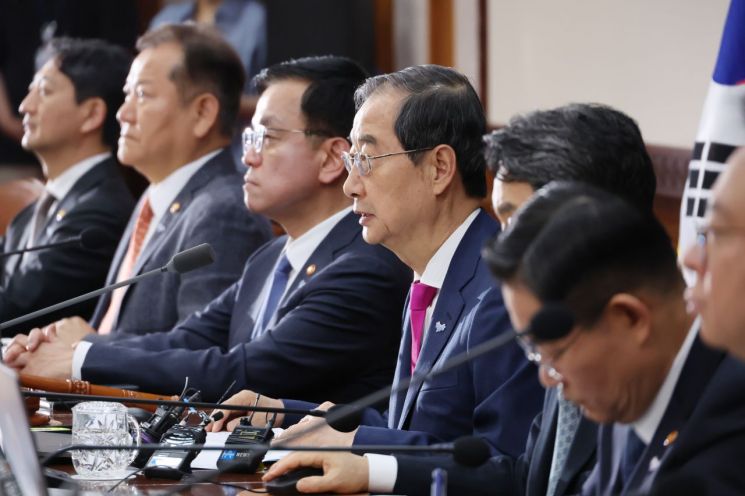 Prime Minister Han Duck-soo is speaking at the Cabinet meeting held at the Government Seoul Office in Jongno-gu, Seoul on the 21st.
 [Image source=Yonhap News]
The Ministry of Justice stated, "This bill was passed without bipartisan agreement through the National Assembly's abuse of power, undermining the constitutional authority of the executive branch, violating the principle of subsidiarity which is essential to special prosecutors, damaging the political neutrality and fairness of the special prosecutor, and reflecting partisanship due to the ruling party's unilateral handling without deliberation."
The Ministry pointed out that the structure in which both special prosecutor candidates are recommended by the Democratic Party of Korea has lost credibility.
The Ministry explained, "The fundamental principle of the current judicial system is to ensure fairness and reliability by preventing the parties involved, such as complainants and accusers, from arbitrarily choosing the investigative or judicial institutions and officials. (This special prosecutor bill) allows the complainant to select the investigative institution and directly determine the investigation targets and scope."
It further argued, "If politically biased individuals are recommended and appointed as special prosecutors, it will be clear that securing fairness and political neutrality will be impossible, as investigations will be conducted to reach conclusions aligned with the intentions of a specific political party rather than discovering substantive truth."
It added, "The appointment authority over executive branch officials is a core presidential power, and the president's appointment authority over special prosecutors is also a key element of the separation of powers principle that must not be infringed. This bill effectively allows the Democratic Party to exercise appointment authority, thereby infringing on the substance of the president's appointment power."
Additionally, the Ministry cited the fact that investigations into the Chae Sang-byeong line-of-duty death case and the related allegations of investigation interference are currently being conducted separately by the police and the Corruption Investigation Office for High-ranking Officials (CIO), as one of the reasons for recommending reconsideration.
The Ministry stated, "There is no precedent for introducing a special prosecutor in cases where the police and CIO are investigating and the prosecution's follow-up investigation is planned. In particular, the CIO was unilaterally established under the previous administration as the Democratic Party's first pledge under the banner of prosecutorial reform, even utilizing expedited procedures. Considering the purpose of the CIO's establishment, introducing a special prosecutor and halting the investigation would deny the very reason for the CIO's existence."
© The Asia Business Daily(www.asiae.co.kr). All rights reserved.

![A Woman with 50 Million Won Debt Clutches a Stolen Dior Bag and Jumps... A Monster Is Born [Slate]](https://cwcontent.asiae.co.kr/asiaresize/183/2026021902243444107_1771435474.jpg)















