Thorough Moisture and Ventilation Management... Important to Suppress Nitrogen Absorption
The Jeonbuk Special Self-Governing Province Agricultural Research and Extension Services (Director Choi Jun-yeol) has urged special caution regarding wilting symptoms and other issues in the management of high-quality watermelon production and harvest during May and June, ahead of the full-scale shipment of semi-early cultivated watermelons in the province.
According to the provincial agricultural research institute on the 21st, semi-early cultivated watermelons are planted in February to March in major production areas such as Gochang and Jeongeup, and are produced under abundant sunlight and temperatures suitable for growth after fruit setting, making this the period for producing high-quality watermelons with high sugar content.
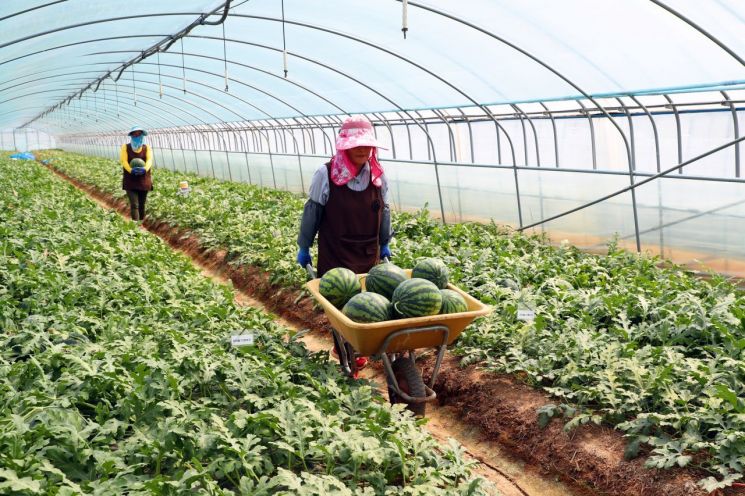 On the 21st, the Jeonbuk Agricultural Research and Extension Services urged special attention to the production of high-quality watermelons and management during the harvest season ahead of the full-scale shipment of semi-early cultivated watermelons in the province from May to June.
 [Photo by Jeonbuk Province]
However, watermelons entering the harvest period weaken due to aging, raising concerns about a decrease in sugar content caused by physiological disorders, so careful management during the harvest period is necessary. The most common physiological disorder during this time, wilting symptoms, mostly occur due to high temperatures inside facilities and lack of soil moisture.
Currently, watermelons planted during the low-temperature period have low adaptability to high temperatures, and when temperatures rise, transpiration and respiration increase, consuming photosynthates that would otherwise be stored as sugars. Therefore, sufficient ventilation should be provided to maintain temperatures around 25 to 30℃.
Rare irrigation, as done during the low-temperature period, causes wilting symptoms due to lack of moisture. Even during the harvest period, small amounts of water should be supplied. If wilting symptoms still appear, shading should be applied to prevent excessive direct sunlight.
When vegetative growth is strong during the harvest period, photosynthates do not concentrate in the fruit, resulting in lower sugar content, and in severe cases, hollow fruit with cracked flesh occurs, reducing marketability. Depending on growth vigor, potassium dihydrogen phosphate should be applied as fertilizer, or water should be supplied just enough to prevent wilting, suppressing nitrogen absorption.
Researcher Jeong Ju-hyeong urged, "Please pay attention to ventilation and water management during the harvest period, suppress nitrogen absorption, and produce high-quality watermelons."
© The Asia Business Daily(www.asiae.co.kr). All rights reserved.
![Clutching a Stolen Dior Bag, Saying "I Hate Being Poor but Real"... The Grotesque Con of a "Human Knockoff" [Slate]](https://cwcontent.asiae.co.kr/asiaresize/183/2026021902243444107_1771435474.jpg)











