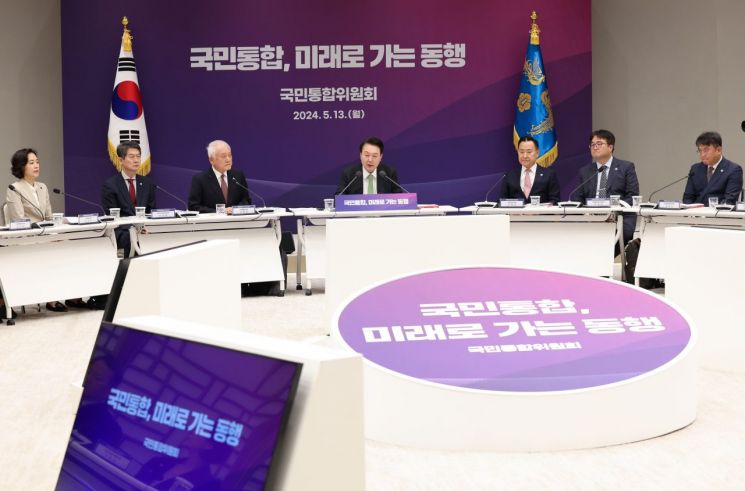
 President Yoon Suk-yeol is delivering a speech at the 2nd Performance Report Meeting of the National Unity Committee held at the Yongsan Presidential Office Building in Seoul on the 13th. [Image source=Yonhap News]
The Presidential Committee on National Integration proposed the introduction of a tailored medical care model for the elderly.
The Special Committee under the National Integration Committee, titled "A Society Where the Role of the Elderly is Alive," finalized and announced this policy proposal on the 21st.
The tailored medical care model for the elderly is a system that provides integrated care for elderly patients, similar to how pediatric and adolescent patients are treated, to reduce the medical and caregiving burdens in a super-aged society.
The current medical system is divided by individual diseases and specialties, making it difficult for elderly patients with multiple illnesses to receive integrated services as they have to visit multiple departments. This has led to issues such as polypharmacy.
The special committee proposed operating elderly patient management offices within tertiary general and public hospitals and introducing appropriate fees for comprehensive elderly care at clinic level to comprehensively manage medication overlap and abuse, as well as frailty prevention.
In particular, they suggested promoting discussions with the medical community to introduce a medical care system specializing in "Geriatric Medicine" in the long term.
Additionally, the committee proposed promoting continued employment of "main jobs" to prevent elderly poverty.
In the short term, support will be provided so that labor and management can autonomously introduce and expand continued employment such as retirement age extension and reemployment through expanding incentives for continued employment of the elderly, while in the mid-to-long term, a plan to institutionalize continued employment based on reforming the job-centered wage system will be prepared.
Furthermore, considering the higher education level of the baby boomer generation, the committee recommended presenting various models such as career-preferential admissions and expansion of elderly-friendly majors to local governments and universities to encourage expanded university education opportunities for the elderly.
To change the perception of the elderly as objects of support or the vulnerable, they proposed promoting positive aging awareness campaigns and self-regulating elements of ageism and elder hatred in the media and press.
Jeong Sun-dul, chairperson of the special committee, explained, "We focused on creating institutional and social environments where the elderly can actively perform their social roles and finding ways to coexist with future generations."
© The Asia Business Daily(www.asiae.co.kr). All rights reserved.

















