AI Summit Discusses Low-Power Semiconductor Plans
Semiconductor Conference Also Addresses AI Expansion Challenges
Memory Industry Accelerates LPDDR Technology Development
Package Module 'LPCAMM' Released One After Another
Not only Samsung Electronics and SK Hynix but also memory semiconductor companies such as the US-based Micron are intensifying competition by focusing on the development of low-power double data rate (LPDDR) DRAM. In particular, at the AI Summit held over two days on the 21st and 22nd, low-power semiconductors are expected to be a key topic as power consumption issues related to the everyday use of AI come to the forefront.
According to the semiconductor industry and the Ministry of Science and ICT on the 21st, the ministerial session addressing the theme of "Promoting Sustainable AI Development" during the AI Seoul Summit has adopted the issue of low-power semiconductors as an agenda item. This is a result of the growing need to respond to massive power consumption due to the expansion of AI development and operation.
The International Energy Agency (IEA) recently reported, "Comparing the average power demand of a typical Google search (0.3Wh) with OpenAI's ChatGPT (2.9Wh per request), and considering that 9 billion searches are conducted daily, approximately 10 terawatt-hours (TWh) of additional power will be required annually." It added, "Looking ahead to AI server-based demand, the AI industry is expected to grow exponentially by 2026, consuming at least 10 times last year's power demand."
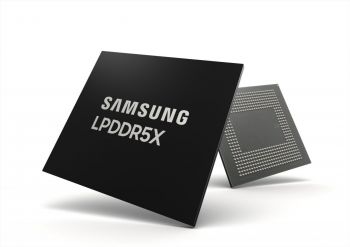 Samsung Electronics introduced last month the low-power double data rate (LPDDR) 5X with an operating speed of 10.7 gigabits per second (Gbps).
 [Photo by Samsung Electronics]
The issue of low-power semiconductors is also emerging as a major topic at international conferences. At the VLSI Symposium, held on the 16th of next month (local time) in Honolulu, Hawaii, discussions on edge computing environments and related semiconductor technologies will take place. The VLSI Symposium is one of the world's top three semiconductor conferences, where major semiconductor companies, related organizations, and universities gather to present outstanding papers and discuss next-generation semiconductor technologies.
At this event, Ahmad Bahai, Chief Technology Officer (CTO) of Texas Instruments, will deliver a keynote speech titled "Making Sense at the Edge." As AI services are increasingly implemented not only in the cloud but also on individual devices such as mobile phones and PCs (edge environments), power consumption is surging, and semiconductor technology challenges are growing, making this a core topic of discussion.
The industry is already fervently developing semiconductors that consume less power. In particular, development is accelerating for LPDDR, a type of DRAM specialized for low power consumption tailored to battery-limited mobile devices, and related products such as LPCAMM (Low Power Compression Attached Memory Module). The expansion of AI applications is increasing the use of LPDDR in various fields such as servers and automotive electronics to reduce power consumption.
Micron released the "Crucial LPCAM2" this month. This product is a type of LPCAMM, a low-power specialized package module that bundles multiple latest LPDDR products (LPDDR5X). LPCAMM was introduced by Samsung Electronics last year, and the market is expected to fully blossom this year. Micron emphasized that the new product reduces the area by 64% compared to previously used modules while increasing power efficiency by up to 58%.
Samsung Electronics and SK Hynix are accelerating the development of next-generation LPDDR. They are also conducting development at the practical level to secure the LPDDR6 market, which will be released in the future. Kim Ju-seon, President in charge of AI infrastructure at SK Hynix, raised expectations this month by stating, "We are preparing innovative memories such as LPDDR6."
The semiconductor industry expects LPDDR6 to be fully commercialized starting next year. Currently, the JEDEC Solid State Technology Association is working to finalize the LPDDR6 standard within this year. Industry forecasts suggest that the bandwidth of LPDDR6 could more than double compared to the previous generation.
An industry insider explained, "LPDDR5X is struggling to meet the increasing AI demands, so the need for LPDDR6, which can reduce power consumption further, is growing," adding, "The importance of power efficiency technology has increased to the extent that even low-power versions of high-bandwidth memory (HBM) are being considered."
© The Asia Business Daily(www.asiae.co.kr). All rights reserved.

















